
There’s a certain type of discomfort that shows up when you spend enough time around crypto. Everything moves fast, talks loud, promises disruption—and somehow still feels fragile. When something doesn’t try to excite you, it almost feels suspicious.
That was my reaction to Dusk.
Not curiosity. Not hype. Just a quiet sense that it wasn’t playing the same game as most chains. And the longer I watched it, the more that difference stood out.
Most projects want to be impressive. Dusk seems more interested in being survivable.
That distinction matters more than it sounds.
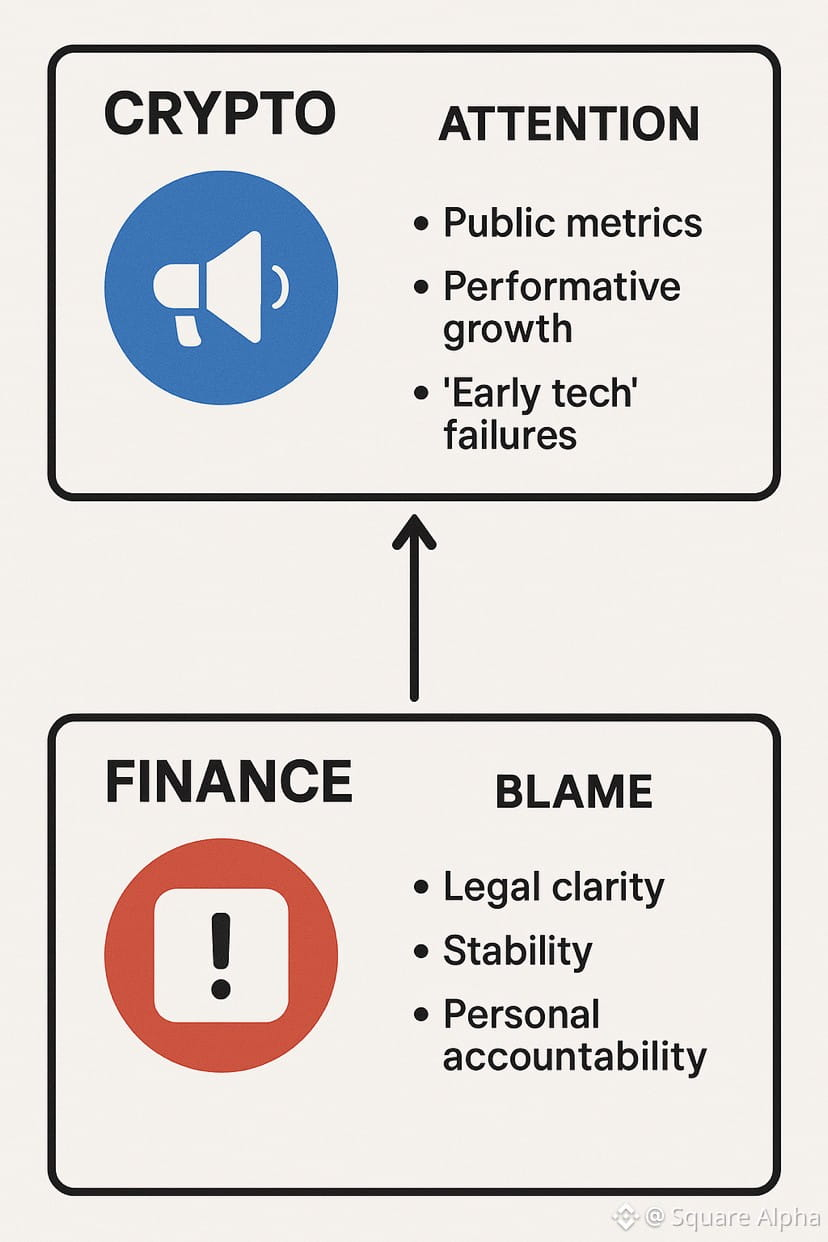
Crypto Optimizes for Attention. Finance Optimizes for Blame.
In crypto, attention is oxygen. Metrics are public. Growth is performative. If something breaks, it’s shrugged off as “early tech.”
In finance, the incentive structure is inverted. Nobody is rewarded for innovation that creates legal ambiguity. People are rewarded for systems that don’t fail visibly. When something goes wrong, someone is accountable—sometimes personally.
Dusk feels like it was designed by people who understand that second environment.
You can see it in what they emphasize—and what they don’t. There’s very little grandstanding about revolution. Very little “permissionless utopia” language. Instead, there’s an implicit assumption that the world already has rules, and if you want to be relevant, you don’t get to ignore them.
That’s not idealism. That’s pragmatism.
Privacy as a Default Behavior, Not a Political Statement
A lot of chains treat privacy like an identity. You’re either for total opacity or you’re against it. That framing works online. It doesn’t work in markets.
Dusk’s approach feels less ideological and more operational. Privacy isn’t something you toggle to feel protected—it’s something that exists because broadcasting sensitive financial behavior is irrational.
At the same time, Dusk doesn’t pretend that invisibility equals legitimacy. There’s an acceptance that certain actors will need to see certain things under certain conditions. Instead of resisting that reality, the protocol builds around it.
That’s a subtle but important shift: privacy not as defiance, but as discipline.
Stability Is a Feature You Only Notice When It’s Missing
One of the quiet themes running through Dusk’s development is restraint.
No constant reinvention of the base layer. No endless re-architecting for marginal gains. The settlement layer feels intentionally boring—and that’s a compliment. It suggests an understanding that foundations should be harder to change than applications.
Crypto culture often treats stability as stagnation. Traditional finance treats instability as a liability.
Dusk seems to side with the latter.
That choice won’t trend on social feeds, but it’s exactly the mindset you want if real institutions are expected to rely on the system without babysitting it.
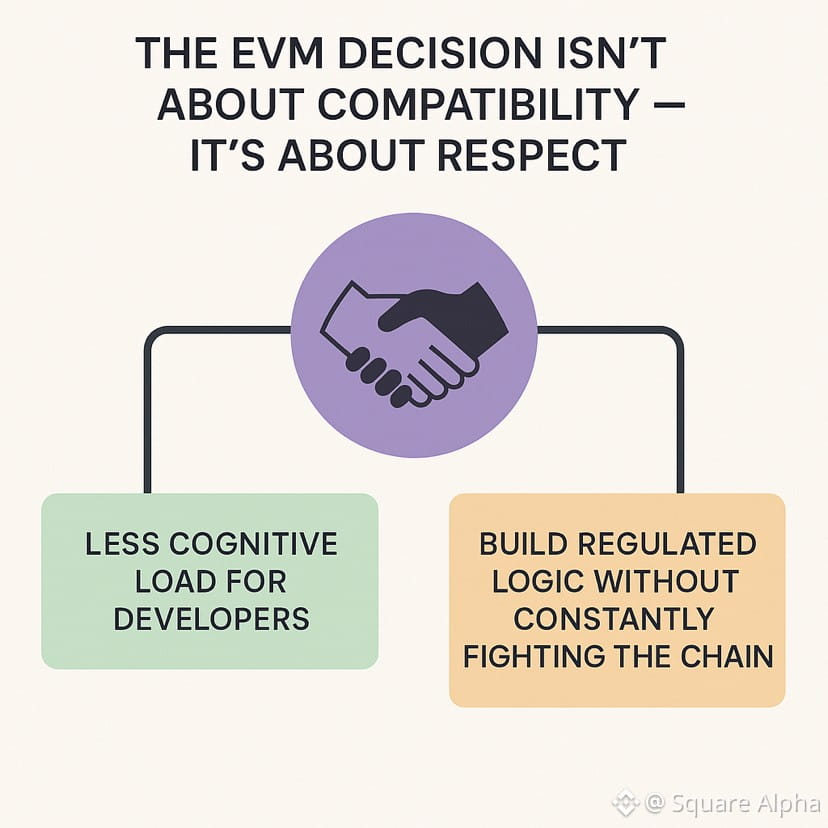
The EVM Decision Isn’t About Compatibility — It’s About Respect
Supporting an EVM environment could be dismissed as following the herd. But in Dusk’s case, it reads differently.
It feels like an acknowledgment that developers already carry enough cognitive load. If you want people to build serious things—things that have legal and financial consequences—you don’t ask them to relearn the universe first.
The real bet isn’t “developers will come because it’s EVM.”
The bet is “developers will stay because Dusk lets them build regulated logic without constantly fighting the chain.”
That’s a much quieter value proposition, but a stickier one.
The Token Reflects the Same Personality as the Network
The DUSK token doesn’t pretend to be a cultural asset. It doesn’t market itself as a movement. It exists to secure the network, facilitate execution, and align participants.
That might sound underwhelming if you’re used to narratives about infinite upside. But it’s internally consistent with everything else about the project.
Systems that aim to be infrastructure rarely need charismatic tokens. They need predictable incentives and tolerable economics.
Again: boring. And intentional.
Why This Is Hard for the Market to Love
Dusk doesn’t offer instant validation. There’s no obvious moment where retail suddenly “wins.” Adoption, if it happens, will look incremental and unglamorous: more compliant flows, more regulated use cases, fewer surprises.
That makes it a frustrating asset to trade and an awkward one to hype.
But it also makes it one of the few projects that feels designed for a future where crypto stops trying to shock the world—and starts trying to fit into it without breaking anything important.
Final Thought
Dusk doesn’t feel like it’s building the future of crypto.
It feels like it’s building a place where crypto could quietly coexist with everything else that already exists.
In an industry obsessed with being louder, faster, and more radical, choosing predictability is almost rebellious.
And that might be exactly why it stands out.