


Last week’s move in silver was abrupt enough to reset expectations. The sharp reversal didn’t just shake out weak positioning—it forced the market to pause and reassess where value actually sits. As I look at the chart now, what stands out isn’t continuation in either direction, but stabilization. Sellers had control, but they’ve met a zone where momentum starts to slow.
This feels less like the start of a new trend and more like a cooling-off phase after an overheated rally.
The Reversal That Set the Tone
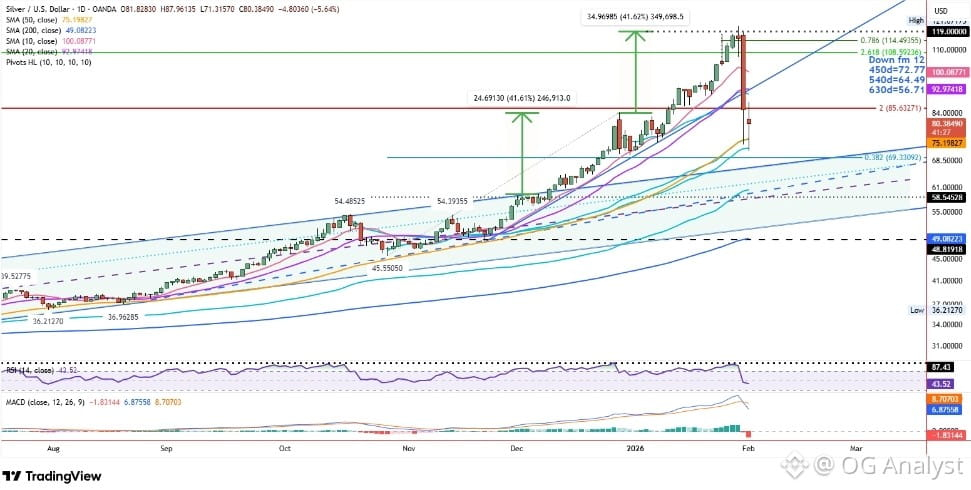
The bearish weekly engulfing candle was hard to ignore. It marked a clear shift in control, pushing silver down to a three-week low and confirming that the prior advance had likely run its course for now. The follow-through selling into Monday reinforced that view, with price briefly slipping to $71.32.
That level matters. It wasn’t random selling—it coincided with a broader technical area where buyers had reason to step in.
Why the $71 Area Matters
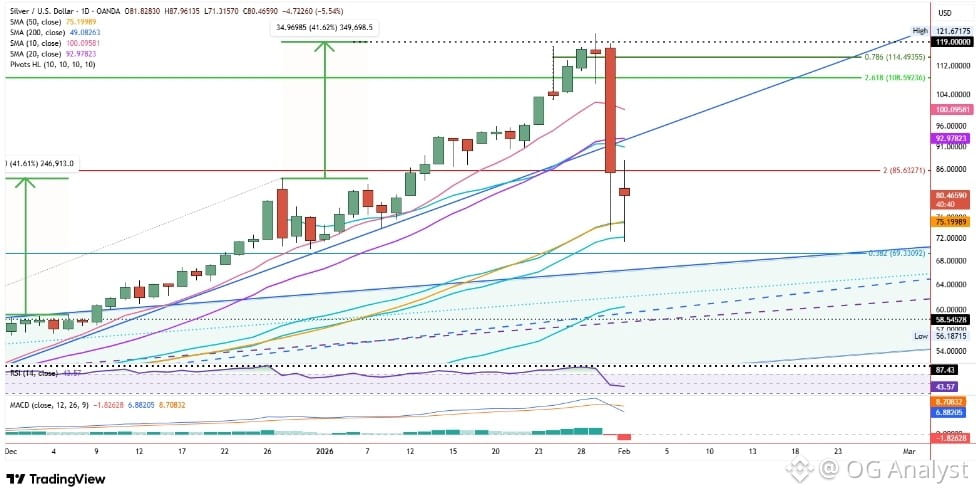
What caught my attention was where silver found its footing. The $71.32 low aligned closely with the 50-day moving average and an anchored VWAP drawn from the October swing high. When multiple reference points converge, I tend to treat the reaction seriously.
Silver managing to close above the 50-day average for a second consecutive session adds weight to the idea that this zone is being defended. It doesn’t mean the downtrend is over—but it does suggest sellers are no longer pressing aggressively.
Signs of a Short-Term Floor
Monday’s price action quietly improved the picture. By dipping to a fresh intraday low and then recovering, silver avoided forming a bearish inside day and instead showed early signs of demand returning.
A close above the midpoint of the day’s range signals that buyers were willing to engage, even if cautiously. For me, that’s often how short-term bottoms begin—not with confidence, but with hesitation slowly giving way to accumulation.
If silver continues to hold above the 50-day average, I’d expect further probing higher, at least to test former support zones now acting as resistance.
Resistance Is Still the Near-Term Challenge
That said, upside isn’t open-ended.
The area around the 20-day moving average remains the first real test. This level previously defined the lower boundary of the short-term uptrend before it failed, so it now acts as a natural ceiling. The internal trendline converging near that zone strengthens its importance.
Until silver can reclaim and close above the 20-day average, I see rallies as corrective rather than impulsive.
Wide Ranges Mean Patience Is Required
Friday’s range was unusually large, and markets rarely resolve that kind of volatility quickly. Silver has already tested the lower end of that range and bounced, which is constructive—but price still has room to oscillate.
A move toward the 10-day average is possible as part of ongoing price discovery. However, without a decisive close above the 20-day average, I’d expect strength to fade and support near the 50-day average to be tested again.
My Takeaway: Support Is Holding, But Control Is Unclear
Right now, silver looks balanced rather than bullish or bearish. Support has proven resilient, but resistance remains firm. That combination usually leads to consolidation, not breakout.
For me, the message is simple: the market is digesting the reversal. Until silver proves it can regain short-term trend control, I’m treating this phase as stabilization—not the start of the next leg higher.