
Crypto markets periodically rotate attention from speculation back to utility. When that shift happens, projects with real usage, infrastructure relevance, and ecosystem integration begin to stand out. Walrus (WAL) is currently moving through such a phase, where renewed market interest aligns with tangible development rather than narrative hype.
A recent price increase reflects more than short-term trading activity. It highlights growing confidence driven by ecosystem traction, technical recovery, and a clear infrastructure focus tied to decentralized storage, AI, and the Sui ecosystem. Understanding this phase requires looking beyond the price chart and into what is actually being built and used.
1. Ecosystem Growth: WAL Gains Traction Through Exchange Roadmap Progress and Expanding Data Usage
Ecosystem Expansion as a Leading Signal
Ecosystem growth often acts as a leading indicator of future value rather than an immediate price driver. In @Walrus 🦭/acc 's case, recent traction is tied to meaningful developments rather than abstract promises. Roadmap progress involving major exchange integration signals increasing visibility and accessibility, which are critical for broader participation.
Exchange roadmap additions are not merely cosmetic. They suggest growing confidence from infrastructure partners and increased liquidity pathways for the asset. This type of expansion typically follows sustained development rather than speculation.
Real Data Usage Validates Core Utility
One of the strongest signals in WAL’s ecosystem growth is real-world data usage. Processing significant volumes of data demonstrates that the protocol is not theoretical. It is actively being used, tested, and relied upon.
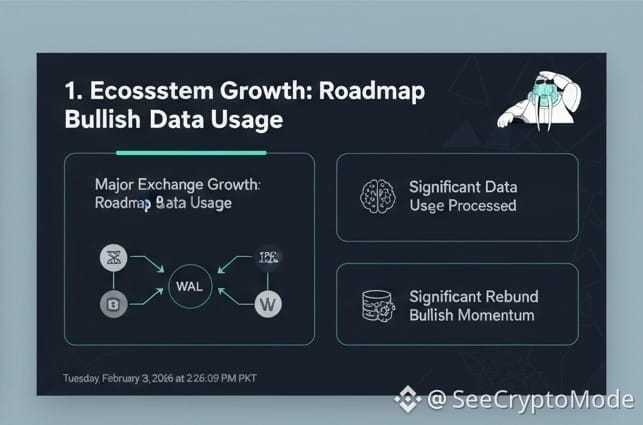
In decentralized storage, usage matters more than announcements. Storage protocols gain value through reliability, throughput, and scalability. WAL’s increasing data processing reflects trust from applications and developers, reinforcing its position as a functional component of the broader ecosystem.
Why Ecosystem Growth Often Precedes Market Repricing
Markets frequently lag behind infrastructure progress. Ecosystem growth happens quietly, while price often reacts later when usage reaches a visible threshold. This creates periods where development outpaces valuation.
#walrus ’s ecosystem traction suggests it is moving through this phase. The groundwork is being laid while broader recognition is still forming, a pattern commonly observed before more sustained market attention arrives.
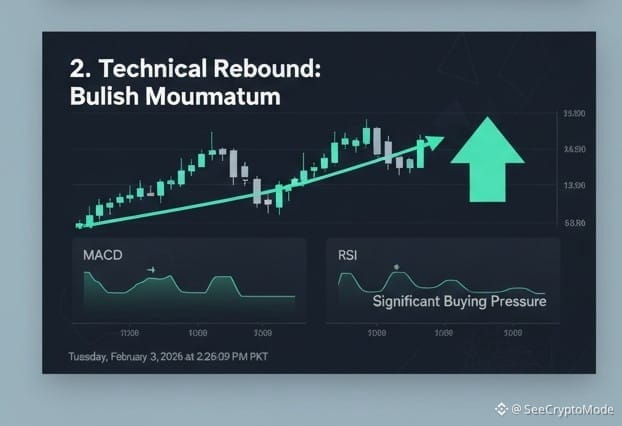
2. Technical Rebound: Bullish Momentum Emerges After a Period of Price Recovery
Understanding the Context of the Rebound
Technical rebounds are most meaningful when they occur after a prolonged period of consolidation or recovery. WAL’s recent price movement follows such a phase, where selling pressure gradually subsided and buyers began to regain control.
Rather than a sharp speculative spike, the rebound appears structured, supported by improving indicators. This suggests a shift in short-term sentiment rather than random volatility.
Bullish Indicators Signal Momentum Shift
Short-term technical indicators now point toward bullish momentum. Moving average crossovers and positive momentum signals indicate that the market is reassessing WAL’s near-term outlook.
While technical signals do not guarantee continuation, they influence trader behavior. Bullish setups attract attention, increase volume, and can act as a bridge between utility-driven narratives and market participation.
Why Technical Recovery Matters for Infrastructure Projects
For infrastructure-focused tokens, technical recovery often marks the moment when the market begins to reconnect price with fundamentals. Long periods of undervaluation are common in utility projects, as development timelines do not always align with trading cycles.
When technicals turn positive alongside ecosystem growth, it suggests that the market is beginning to recognize underlying progress. WAL’s current technical posture reflects this early-stage recalibration.
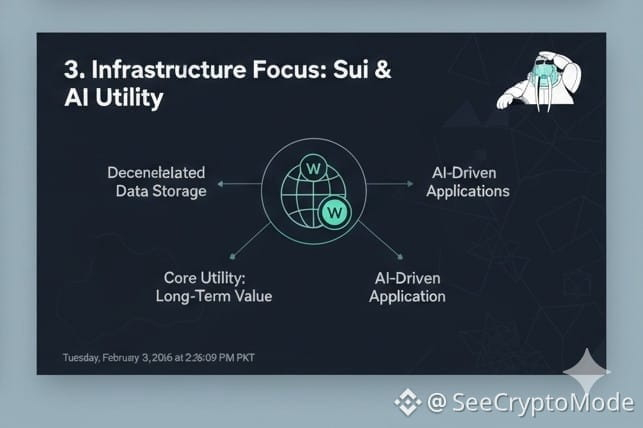
3. Infrastructure Focus: Decentralized Storage for Sui and AI as a Long-Term Value Driver
Decentralized Storage as Critical Infrastructure
Decentralized storage is a foundational layer, not a trend. As blockchain applications, AI systems, and data-driven platforms expand, the demand for secure, scalable, and decentralized data storage grows alongside them.
WAL’s core utility lies in this infrastructure role. Rather than competing in crowded narrative spaces, it focuses on providing essential services that other systems depend on. This positioning favors long-term relevance over short-term attention.
Strategic Alignment With Sui Ecosystem Growth
Sui’s ecosystem growth creates natural demand for storage solutions that are optimized, reliable, and integrated. WAL’s alignment with Sui places it within a growing environment where infrastructure needs increase as adoption scales.
This type of alignment is strategic. Infrastructure that grows alongside its host ecosystem benefits from organic demand rather than speculative interest. As Sui applications expand, storage usage becomes a necessity rather than an option.
AI and Data-Driven Demand Amplify Storage Importance
AI systems are fundamentally data-hungry. Training, inference, and model iteration require massive volumes of accessible data. Decentralized storage protocols that can support this demand stand to benefit as AI use cases expand across blockchain ecosystems.


WAL’s infrastructure focus positions it at the intersection of blockchain scalability and AI data needs. This convergence is not a short-term narrative but a structural shift that unfolds over years.
Why Infrastructure Value Is Often Underestimated
Infrastructure tokens are frequently underestimated because their value is indirect. They do not always generate excitement, but they enable everything else to function. Markets tend to appreciate this role only after dependency becomes obvious.
WAL’s growing usage suggests that this dependency is forming. As reliance increases, so does the long-term value proposition.
Closing Perspective: Utility, Momentum, and Structure Begin to Align
WAL’s recent price increase is notable not because of its size, but because of its context. Ecosystem growth, technical recovery, and infrastructure relevance are converging in a way that suggests more than a temporary move.
This does not imply guaranteed continuation or immediate upside. Markets remain volatile and subject to broader conditions. However, alignment between usage, momentum, and long-term utility is rare enough to deserve attention.
WAL appears to be transitioning from a recovery phase into a recognition phase, where real usage begins to matter more than speculation. For infrastructure-driven projects, this is often where long-term narratives quietly take shape.
The market may still be early in fully pricing this shift, but the signals are becoming harder to ignore.