

Plasma feels like it was built by people who stared at the same problem for too long and finally decided to stop pretending that every blockchain needs to be everything. The whole project is shaped around one clear reality: stablecoins already move more real value in crypto than most other use cases, and the infrastructure underneath them still looks like it was never designed for payments at scale. Plasma steps into that gap with a simple promise, stablecoin settlement that stays fast, cheap, and dependable when activity gets heavy, while still giving developers an EVM environment that feels familiar and practical to build on.
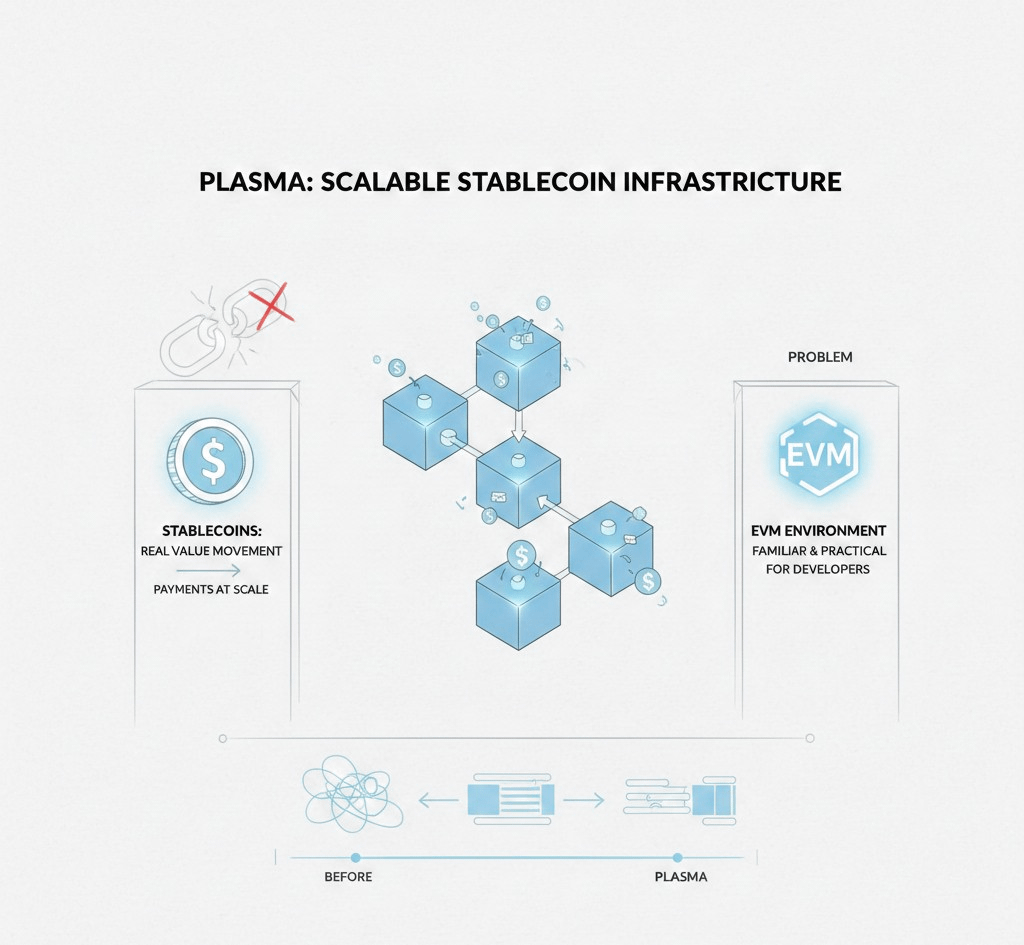
What makes this approach stand out is the way Plasma frames its identity as a purpose built Layer 1 for high volume stablecoin transfers rather than a generic platform trying to chase every narrative at once. That focus matters because stablecoin movement is not like speculative trading where delays are tolerated and friction is expected, because the user expectation is closer to everyday money rails where transfers should settle quickly, fees should stay predictable, and the system should not demand extra steps that complicate the experience. Plasma leans into that expectation by positioning the chain as stablecoin first from architecture to feature priorities, and that alignment is the difference between a chain that hosts stablecoins and a chain that is shaped around them.
Under the hood, Plasma highlights full EVM compatibility through a Reth based execution approach, which sends a clear signal that developers are not being asked to relearn the world just to ship useful products. When teams can port contracts, reuse tooling, and keep their security practices and developer workflows intact, adoption becomes a matter of incentives and product fit rather than a costly migration decision. That matters even more in payments because the winners are rarely the chains with the most novelty, they are the rails that feel boringly reliable while still being efficient enough to scale.
Plasma also emphasizes fast settlement through PlasmaBFT, aiming for sub second finality so stablecoin transfers can feel immediate in the way users expect payments to feel. Finality is not a marketing line in a payments oriented chain, because it determines how confidently a merchant can release goods, how quickly an exchange of value can complete, and how smoothly any treasury workflow can operate without holding risk for longer than necessary. If finality stays consistent under load, the chain becomes a base that payment style applications can actually trust, and if finality degrades when the network becomes busy, the entire value proposition collapses into the same pain that users already want to escape.
The deeper story is that Plasma is not pretending it can ship every differentiator at once, because it communicates a phased rollout where the core chain launches and then additional capabilities mature over time. That approach often looks less flashy, but it is usually the path that produces real infrastructure, because a chain that is meant to carry high volume stablecoin settlement cannot afford fragile complexity at launch. What really matters in the earliest stage is whether the chain keeps producing blocks smoothly, whether transactions confirm predictably, and whether the system can handle stress without becoming inconsistent, because those qualities become the foundation on top of which everything else can safely be built.
One of the more meaningful directions Plasma describes is privacy for stablecoin transfers, positioned as privacy preserving and opt in, which is important because stablecoins are used for commerce, payroll, supplier payments, and treasury movement where transparency can become a business liability. The concept is not just about hiding information for fun, it is about giving legitimate users the ability to move value without broadcasting sensitive amounts and counterparties to the entire world, while still maintaining a system that applications can integrate with and users can operate safely. If Plasma delivers privacy that remains composable and practical, it becomes a very real differentiator for stablecoin activity that wants discretion without breaking the usability of onchain infrastructure.
Plasma also talks about Bitcoin anchoring as part of its security and neutrality posture, which matters because payment rails are judged differently than experimental networks. When the goal is to serve both high adoption retail markets and institutional style flows, the chain needs to communicate long term settlement credibility, resistance to censorship pressure, and the kind of neutrality that operators can rely on. Whether that becomes a decisive advantage will depend on execution, but the intent is clear, Plasma is trying to look like infrastructure designed for long horizon money movement rather than a temporary venue for attention cycles.
The token story, XPL, sits at the center of this design because it is presented as the asset that secures consensus and powers execution, which is a standard pattern for Layer 1 networks but becomes more delicate when the chain is trying to make stablecoin usage feel effortless. Plasma tries to reconcile that by keeping XPL as the backbone for security and network coordination while pushing the user experience toward stablecoin first behavior over time, and the more the network succeeds at making stablecoin flows smooth, the more XPL becomes tied to the real economic utility of the chain rather than pure speculation.
What makes the token narrative easier to evaluate is that Plasma has published detailed tokenomics, including initial supply, allocation buckets, and vesting schedules across ecosystem growth, team, and investors. This is useful because it allows anyone to model supply expansion windows and understand when emissions may increase, which matters for risk management and for judging whether ecosystem incentives are likely to support real adoption rather than short lived liquidity. When token distribution is clear, it becomes easier to separate the chain performance story from the market cycle story, even if the two still influence each other.
When you look at the benefits Plasma is chasing, the theme stays consistent. Users should be able to move stablecoins quickly with low cost settlement that does not surprise them when the network is busy. Builders should be able to deploy EVM applications without rebuilding their stack from scratch, and they should be able to design payment style experiences that feel immediate because finality is fast and predictable. The ecosystem should be able to grow around actual stablecoin flow rather than purely speculative activity, because a payments chain becomes powerful when liquidity is deep, rails are reliable, and the network becomes the default place where stablecoins live and move.
The risks are also clear, and Plasma will not be judged gently because the stablecoin niche is both massive and competitive. Distribution is the hard part, because winning payments is rarely about better slogans and more about integrations, liquidity depth, and trust built over time. Roadmap risk exists because the most compelling differentiators, like privacy modules and anchoring narratives, must arrive as real deliverables, and delays can create a gap between expectation and reality even if the core chain continues improving. Token dynamics matter too, because unlock schedules can create pressure if network usage and demand do not grow fast enough to absorb supply expansion, which is why the best way to evaluate progress is to keep returning to real network usage, stablecoin activity, and developer adoption signals rather than short term price excitement.
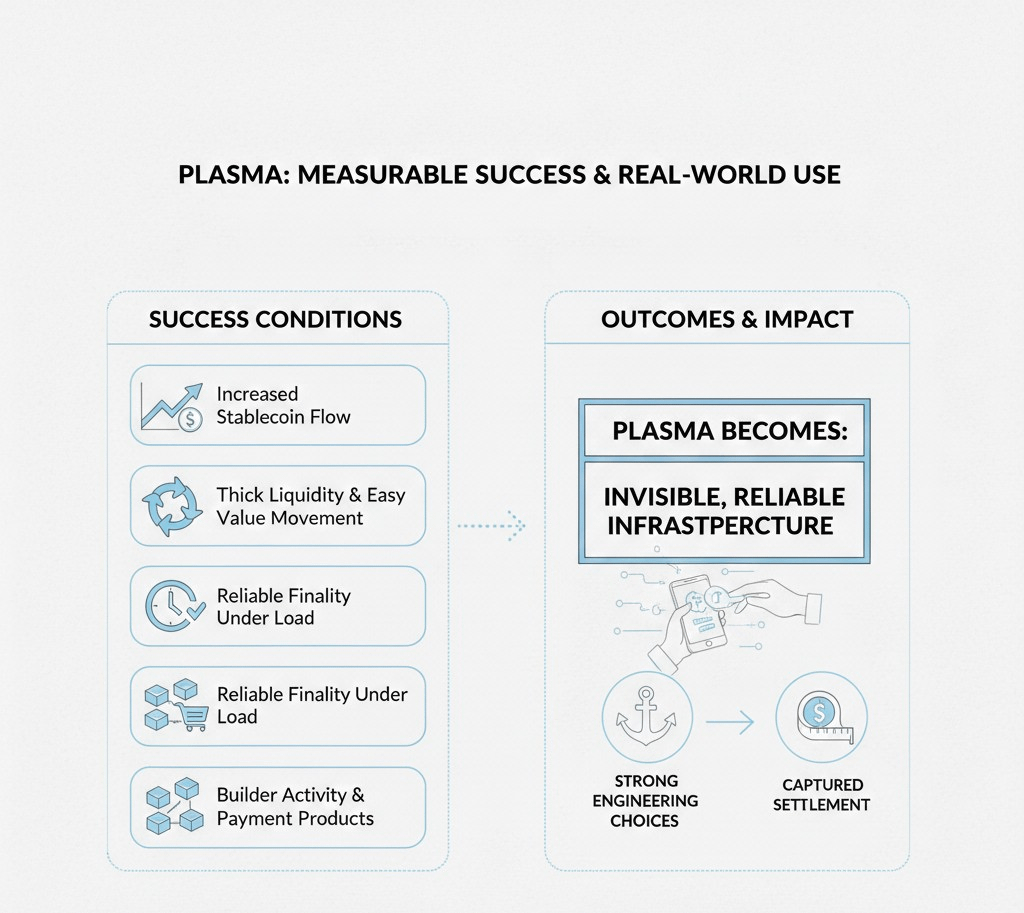
What feels most important about Plasma right now is that its success condition is measurable and not philosophical. If stablecoin flows increase on the network, liquidity becomes thick enough that moving value is easy, finality stays reliable under load, and builder activity produces real payment oriented products, then Plasma becomes something bigger than a typical Layer 1 story, because it becomes infrastructure that people use without thinking about it. If those signals stay weak, then even strong engineering choices will struggle to translate into long term relevance, because a stablecoin chain is only as strong as the actual settlement it captures.
My takeaway is that Plasma is choosing the right kind of narrow, the kind that can grow into dominance if executed properly. Stablecoins are the closest thing crypto has to a global money product, and building a chain that treats stablecoins as the first class citizen rather than an afterthought is a serious bet on the most useful part of the market. If Plasma delivers on fast finality, keeps fees predictable, grows stablecoin liquidity, and turns its privacy and anchoring roadmap into working production features, then it has a clean path to becoming a settlement layer people rely on, not because it is loud, but because it works.

