

I’ve spent enough time watching blockchain cycles to be cautious whenever a project leads with applications. Demos are compelling. Interfaces photograph well. Early traction looks like inevitability. Yet if the underlying system cannot absorb growth, the excitement fades quickly. What remains are workarounds, patches, and the gradual realization that usability was built on fragile assumptions.
Because of that history, I tend to pay closer attention to what sits beneath the surface. Not what is showcased, but what is standardized. Not what is marketed, but what is repeatable.
After examining how Vanar Chain positions itself, the priority appears clear. The emphasis is not on pushing headline applications into the spotlight. It is on shaping the environment those applications will eventually depend on.
That ordering is easy to miss. It is also difficult to fake.
When infrastructure comes first, progress often feels slower. The visible pieces emerge gradually. There are fewer moments of spectacle. From the outside, it can resemble hesitation. From the inside, it usually reflects preparation.
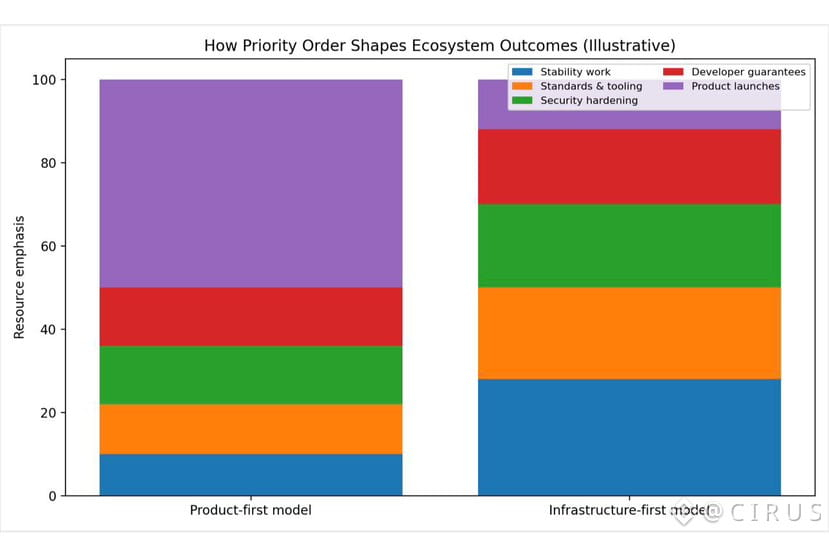
Systems built this way assume that success, if it happens, will stress the network. Demand will spike unpredictably. Users will behave in ways designers did not anticipate. Edge cases will become normal cases.
Infrastructure-first thinking plans for that discomfort.
The alternative approach is familiar. Launch products early, gather attention, then retrofit stability as problems appear. This can work for a time. But retrofitting is expensive. Every adjustment risks breaking continuity. Developers hesitate to build deeply because foundations keep moving.
Eventually, innovation slows not because ideas run out, but because trust in the base layer weakens.
Vanar seems determined to avoid that pattern.
One signal is how much of the conversation revolves around conditions rather than outcomes. Instead of promising what will exist, the network appears focused on ensuring that whatever emerges can operate predictably.
Predictability is underrated in crypto.
Yet it is the prerequisite for professional participation.
Developers, in particular, respond to this orientation. They want environments where assumptions hold tomorrow. They want economic logic that does not rewrite itself every quarter. When infrastructure behaves consistently, planning horizons extend. Teams invest more deeply.
Products become better as a result.
Users experience this differently. They may not notice architectural discipline directly, but they feel its absence immediately. Failed transactions, unexpected costs, changing mechanics. Each surprise erodes confidence. When systems behave steadily, attention shifts from survival to exploration.
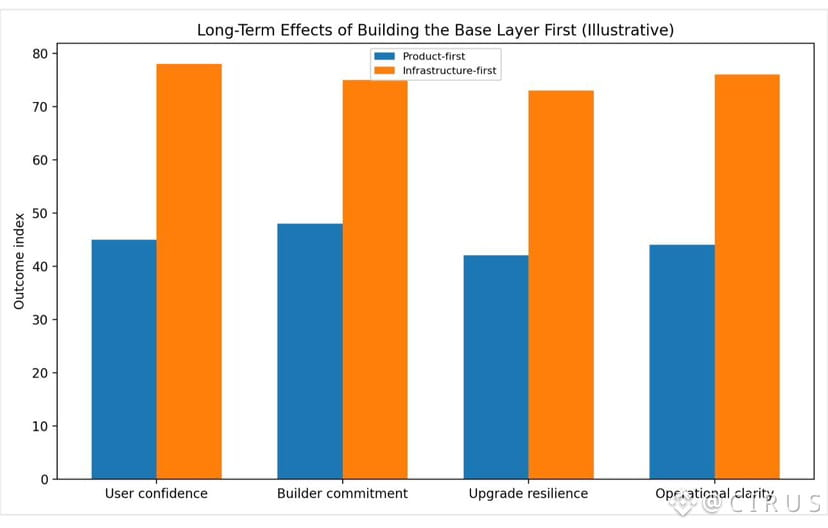
That is when ecosystems mature.
Another consequence of infrastructure priority is restraint in narrative. Projects following this path rarely claim they are about to transform everything overnight. They talk about readiness, compatibility, and durability. To some ears, this sounds conservative.
It is.
But conservatism in foundational layers is often a feature, not a flaw.
Security posture reinforces the same impression. Well-understood mechanisms tend to dominate over experimental shortcuts. The aim is not novelty; it is reliability under stress. Participants can reason about outcomes because the rules remain legible.
In volatile environments, legibility builds trust.
Governance also benefits. When infrastructure is stable, decision-making becomes less reactive. Communities can debate direction instead of constantly repairing damage. The conversation shifts from crisis management to strategy.
That shift marks a different stage of development.
Of course, products still matter. Without them, infrastructure remains potential energy. But when products arrive on stable ground, they inherit credibility. Integration becomes easier. External partners engage with more confidence.
Momentum becomes organic rather than forced.
After spending time observing Vanar’s trajectory, the overall feeling is not urgency but patience. The project seems willing to delay spectacle in favor of preparation. It is building the conditions under which others can move faster later.
That approach demands discipline.
It also requires accepting that recognition may come slowly.
One way to evaluate seriousness is to ask what a system optimizes for when nobody is watching. Is it polishing demos, or is it strengthening coordination? Is it chasing headlines, or is it tightening guarantees?
Infrastructure-first projects tend to choose the latter.
If adoption does accelerate in future cycles, networks that invested early in foundations will likely experience fewer shocks. They will adapt instead of scramble. Participants will remain because their expectations continue to hold.
Durability compounds.
None of this guarantees success. Execution remains difficult, and history is full of careful systems that never found their audience. Skepticism remains healthy. But recognizing the right priorities is still meaningful.
Vanar appears to understand that products built on unstable ground inherit instability.
So it is trying to stabilize the ground first.
The emotional result is subtle. You do not leave with adrenaline. You leave with a sense of preparedness. A feeling that, should growth arrive, the system might actually be able to handle it.
In crypto, that is rarer than it should be.
And for that reason alone, it deserves attention.
