

Most blockchains talk about speed the way car ads talk about horsepower. It’s impressive on paper. It sounds powerful. But once you’re actually driving—especially in traffic—you realize horsepower isn’t the same thing as responsiveness.
Fogo feels less like a new car launch and more like someone quietly rebuilding the road itself.
At its core, Fogo runs on the Solana Virtual Machine, which means it doesn’t ask developers to relearn everything from scratch. Smart contracts, tooling, and developer habits from Solana can migrate over with relatively low friction. That’s not flashy, but it’s practical. It says: “Let’s not reinvent execution. Let’s change the environment around it.”
And that environment is where Fogo becomes interesting.
Most chains treat latency as a performance stat. Fogo treats it like oxygen. The difference sounds subtle, but it isn’t. When latency becomes a foundational constraint, you start caring about things most projects barely mention: validator placement, networking paths, client uniformity, propagation timing. You stop thinking in averages and start thinking about worst-case delays. Because in trading—where Fogo is clearly aiming—what kills you isn’t the average block time. It’s the moment something hiccups.
There’s a kind of honesty in that design choice. Instead of pretending that blockchains float in a neutral, borderless cloud, Fogo acknowledges something slightly uncomfortable: infrastructure lives somewhere. Signals travel at finite speeds. Coordination has physical limits. If you want a chain that behaves like a real-time venue, you have to respect that reality.
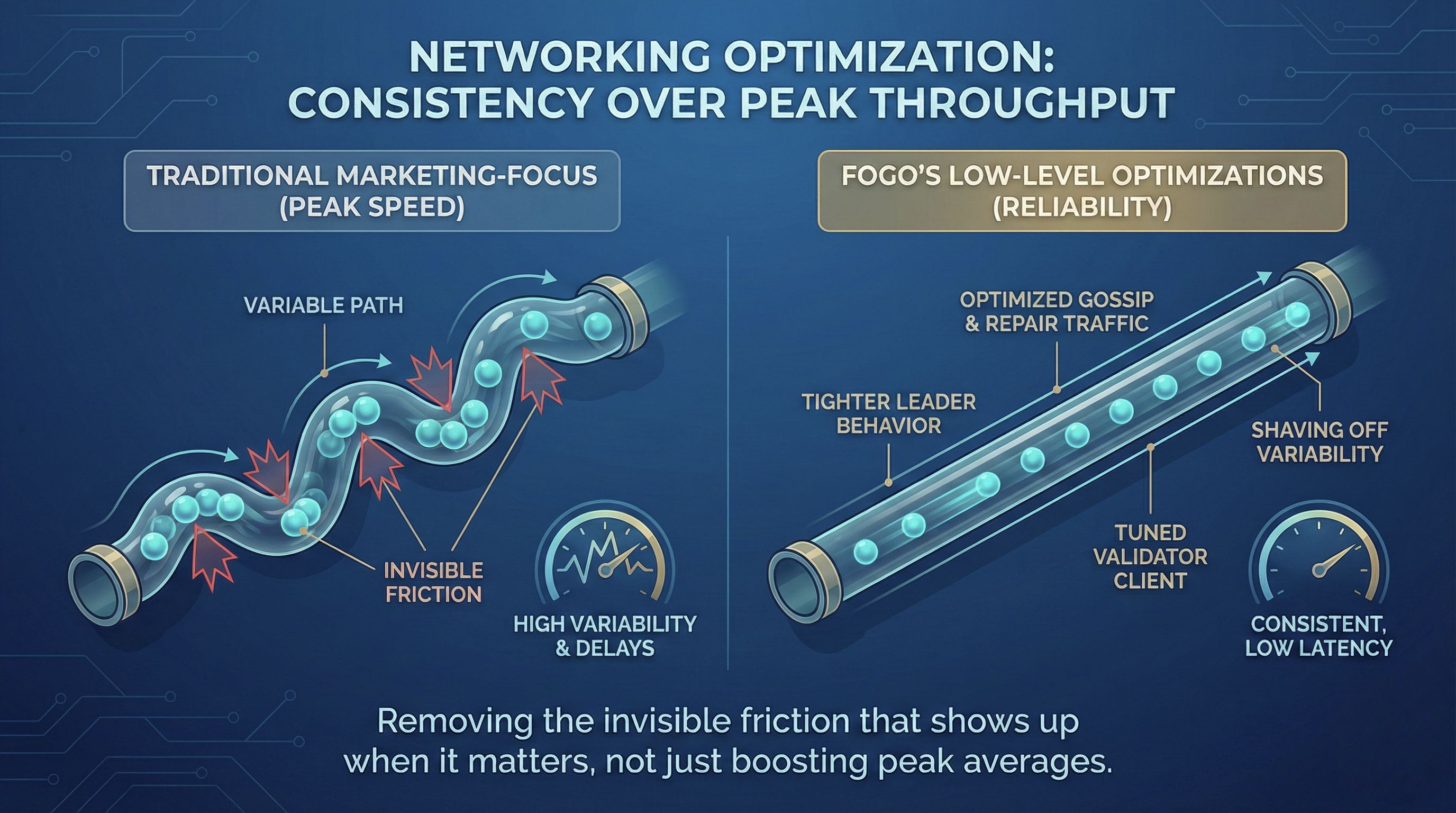
That’s why the networking updates matter more than marketing ever will. Moving gossip and repair traffic to faster networking layers, tightening leader behavior, tuning the validator client—these aren’t cosmetic tweaks. They’re the kind of low-level optimizations you only prioritize if you genuinely care about shaving off variability, not just boosting peak throughput. It’s less “look how fast we are” and more “let’s remove the invisible friction that shows up when it matters.”
And then there’s Sessions.
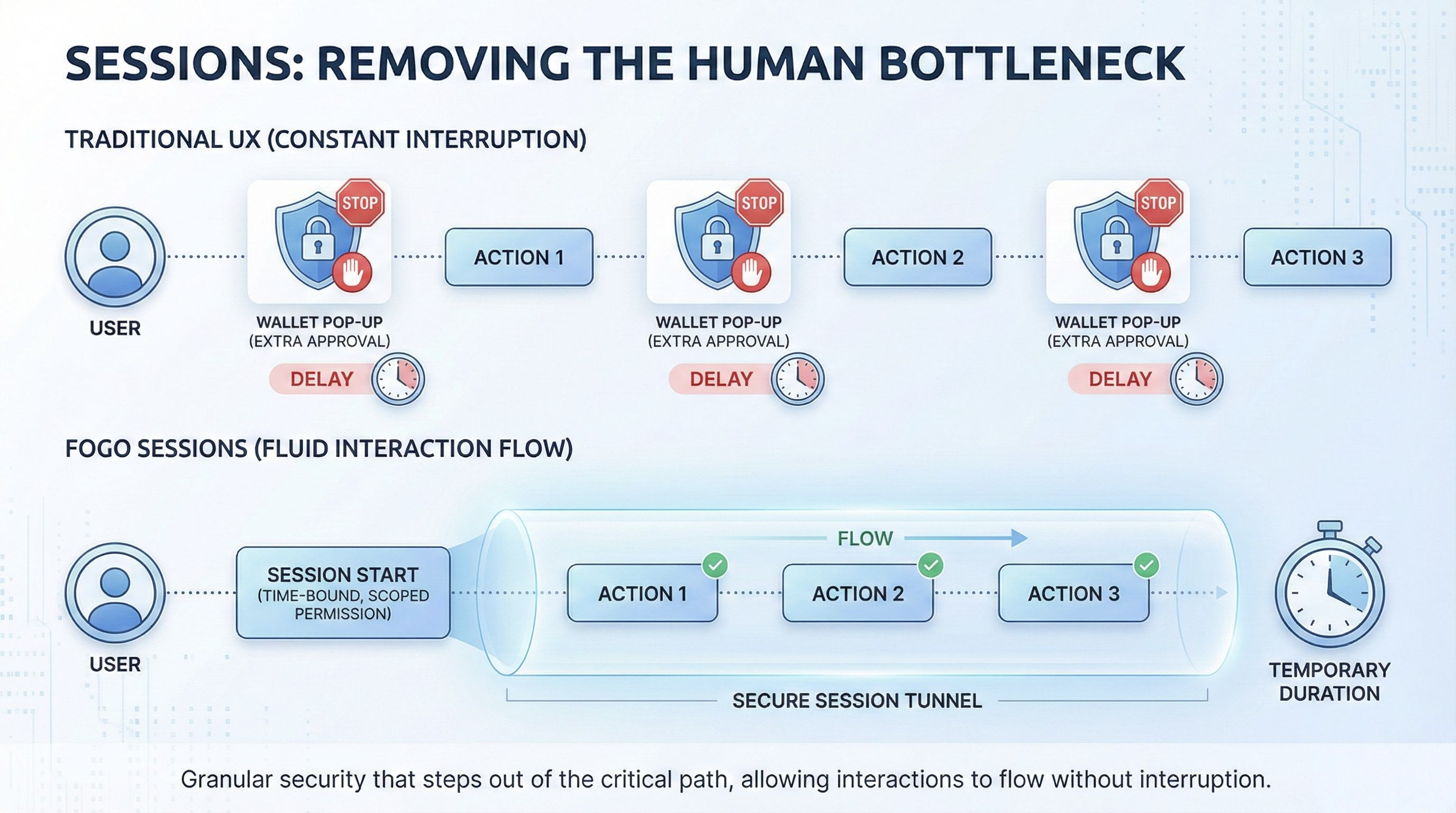
On the surface, Sessions sound like a UX improvement: fewer signature prompts, gasless interactions, temporary session keys with scoped permissions and optional fee sponsorship. But if you’ve ever tried to trade quickly on-chain, you know the real enemy isn’t block time—it’s you. It’s the wallet pop-up. The extra approval. The need to hold just enough native token to pay fees before you can even act.
Sessions are an attempt to pull the human bottleneck out of the critical path. By allowing constrained, time-bound permissions—only certain programs, certain limits, certain durations—the system lets interactions flow without constant interruption. It’s not about removing security; it’s about making security more granular and less intrusive.
That’s a subtle but important shift. Most blockchains optimize machines. Fogo is also trying to optimize the human loop.
Looking at independent on-chain data, the network already shows extremely short block intervals and fast finality, along with billions of transactions processed since launch. That tells you the chain isn’t just theoretical—it’s running. At the same time, validator counts and decentralization metrics are still modest compared to larger, more mature networks.
And that’s where things get real.
You don’t get tight coordination and ultra-low latency without trade-offs. A smaller validator set can move faster. A more centralized governance structure can upgrade more cleanly. But decentralization is not a decorative feature—it’s a long-term credibility engine. If Fogo wants to be seen not just as fast, but as foundational, its decentralization story will need to expand without losing the performance edge that defines it.
That tension isn’t a flaw. It’s the core experiment.
The ecosystem choices reinforce that this isn’t just about benchmarks. Oracle integrations, indexing support, high-performance RPC infrastructure—these pieces determine whether “fast blocks” translate into “fast experience.” A chain can technically finalize quickly and still feel sluggish if RPC endpoints lag or data layers choke. Fogo seems aware that performance is holistic. It’s a stack problem, not a single-layer metric.
Token utility also becomes more nuanced in this design. Yes, the native token pays fees and secures the network through staking. But if fee sponsorship becomes common—if apps regularly cover transaction costs for users—then holding the token isn’t strictly required just to participate. That shifts the demand narrative. The token becomes more about securing the system and aligning incentives than simply serving as gas. Meanwhile, incentive programs and distribution schedules suggest the team understands liquidity and early participation don’t happen automatically. They have to be cultivated.
What stands out to me isn’t that Fogo is fast. It’s that Fogo feels opinionated.
It’s not trying to be everything. It’s trying to be precise. A chain where timing feels consistent. Where interactions don’t stutter. Where the difference between “almost real-time” and “actually real-time” isn’t shrugged off as inevitable.
The real question isn’t whether Fogo can post impressive latency numbers today. It’s whether that real-time feel survives stress—high volume, adversarial conditions, broader validator participation. And whether it can widen decentralization without losing the tight coordination that makes it distinct.
If it succeeds, Fogo won’t just be another high-performance L1. It will represent a shift in how we think about blockchain infrastructure—not as a diffuse global fog, but as engineered space where geography, physics, and human behavior are deliberately accounted for.
That’s an uncomfortable idea in a space that likes to talk about pure decentralization and abstract networks. But it’s also refreshingly grounded.
And sometimes progress doesn’t look like adding more features. Sometimes it looks like taking the uncomfortable parts of reality—and building around them instead of pretending they don’t exist.