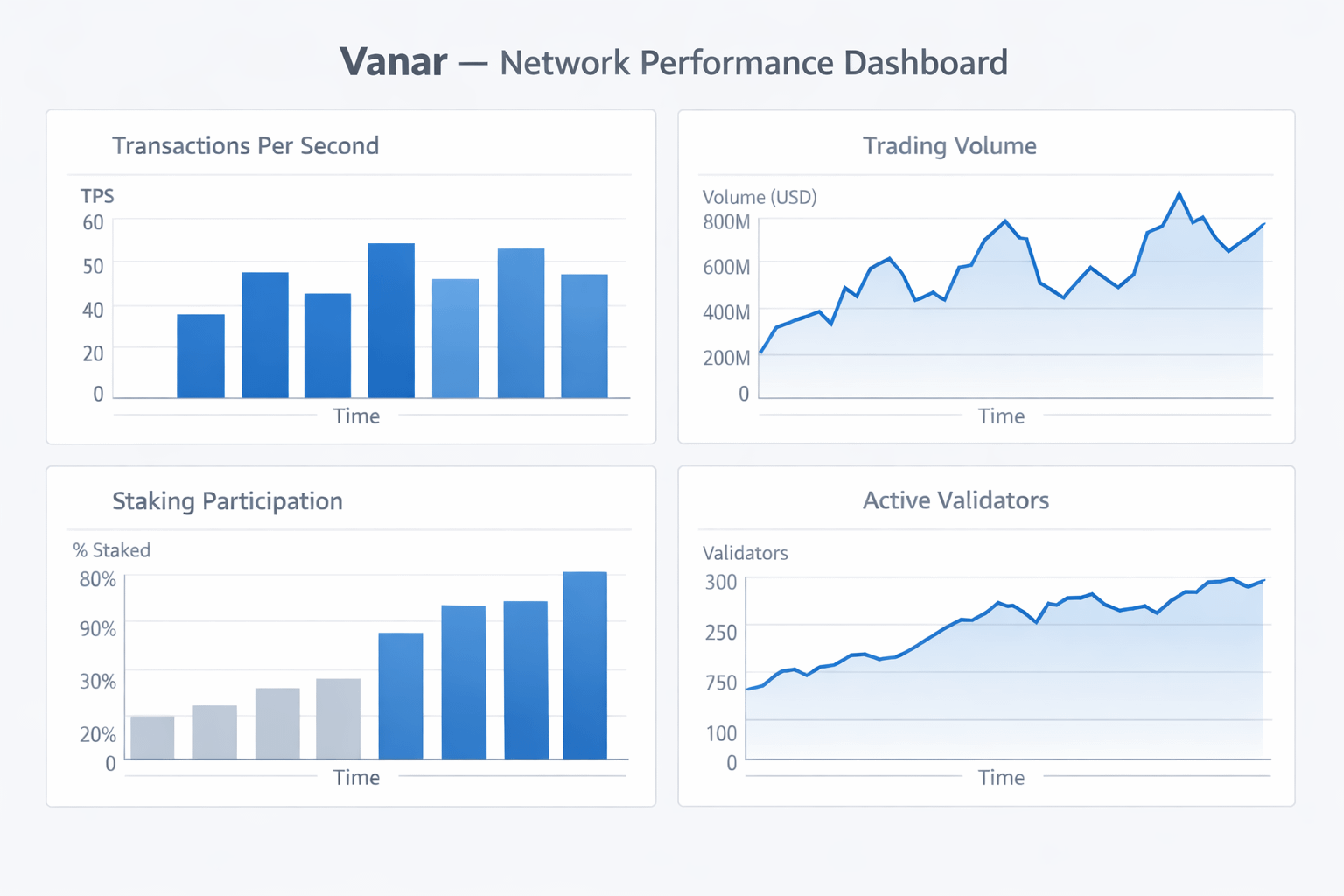
Vanar is an L1 blockchain engineered with an unusual starting assumption: that mass adoption will not come from financial primitives alone, but from consumer software patterns such as games, media platforms, branded experiences, and AI driven services that must behave predictably under non-expert usage. This assumption materially shapes its infrastructure decisions. Instead of optimizing purely for peak throughput or speculative DeFi composability, the system emphasizes deterministic performance, low perceived latency, and operational stability under heterogeneous workloads. In practical terms, this means the chain is designed less like a high-frequency trading substrate and more like a distributed application platform that must support millions of intermittent users whose tolerance for delays, failures, or complex wallet interactions is extremely low.
Real-world performance on such a network is defined not only by raw transaction throughput but by consistency of execution under burst conditions. Consumer applications generate traffic patterns very different from financial bots: synchronized events, content drops, in-game actions, or promotional campaigns can produce sudden spikes from geographically dispersed users. Vanar’s architecture therefore prioritizes predictable block production and bounded confirmation times over opportunistic throughput scaling that might degrade under congestion. Latency is managed not just at the consensus layer but across the full transaction lifecycle, including mempool handling, state propagation, and finality signaling. For end users, what matters is the time between pressing a button and receiving a reliable outcome, not the theoretical TPS ceiling.
Settlement behavior reflects this consumer orientation. Many entertainment and brand use cases require “soft immediacy” — actions must feel instant, but the economic consequences may be small or reversible. Vanar’s design implicitly accommodates layered certainty, where applications can treat early confirmations as sufficient for user feedback while relying on deeper finality for irreversible state changes. This reduces friction without compromising the integrity of high-value operations. It also aligns with gaming mechanics, digital ownership transfers, and AI service payments, where responsiveness is as critical as correctness.
Validator design appears calibrated for operational reliability rather than maximal decentralization at any cost. Supporting consumer applications demands nodes that can maintain uptime, bandwidth, and storage performance comparable to commercial infrastructure. A curated or performance-screened validator set, if present, trades some permissionless openness for predictable service quality. This is a common but controversial engineering compromise: broader validator participation increases censorship resistance, while stricter requirements improve user experience and reduce chain instability. Vanar’s approach suggests that, for mainstream adoption scenarios, intermittent outages or inconsistent block production are more damaging than a moderately concentrated validator topology.
Governance mechanisms in such systems must balance upgrade agility with stakeholder trust. Entertainment and brand partnerships evolve rapidly, and the platform must be able to deploy protocol changes without prolonged coordination deadlocks. At the same time, enterprises integrating with the chain require assurances that rules will not shift arbitrarily. This tension often leads to governance structures that combine on-chain signaling with off-chain coordination among core developers, validators, and ecosystem partners. The result is typically pragmatic rather than ideologically pure: upgrades are feasible on human timescales, but legitimacy depends heavily on transparency and stakeholder alignment.
Usability considerations permeate the stack. Consumer users cannot be expected to manage private keys securely, monitor gas fees, or understand transaction semantics. Infrastructure supporting account abstraction, delegated transactions, or session-based permissions becomes essential. Such mechanisms allow applications to sponsor fees, batch operations, or limit permissions without exposing users to custodial risk. In gaming or branded environments, this can make blockchain components effectively invisible, which is arguably necessary for adoption beyond technically literate audiences. However, abstraction layers introduce additional trust assumptions and attack surfaces that must be carefully constrained.
The VANRY token functions as the coordination mechanism for the network’s economic security and operational incentives. Beyond paying for computation and storage, the token likely underpins validator staking, governance participation, and possibly ecosystem funding programs. For consumer-focused chains, token velocity can be high because many transactions are low value but frequent. This creates pressure on token design to avoid excessive dilution while still enabling affordable usage. If transaction fees are subsidized or abstracted away from users, value capture must occur elsewhere in the ecosystem, such as through staking rewards, service fees, or enterprise integrations. Maintaining alignment between token holders, validators, developers, and end users is a nontrivial economic design challenge.
Risks emerge primarily from the same trade-offs that enable usability. Performance-oriented validator requirements may reduce decentralization margins. Governance agility can drift into centralization if not counterbalanced by credible community oversight. Consumer applications often demand content moderation, intellectual property enforcement, or compliance features that sit uneasily with the permissionless ethos of public blockchains. Additionally, reliance on specific verticals such as gaming or branded experiences exposes the network to cyclical adoption patterns; if flagship applications lose popularity, transaction activity may decline sharply.
Architecturally, Vanar represents a deliberate departure from the assumption that one blockchain must excel at every category simultaneously. By optimizing for predictable user experience, low perceived latency, and integration with mainstream digital industries, it positions itself as infrastructure for interactive services rather than purely financial settlement. This specialization can be a strength if the targeted sectors achieve sustained growth, but it also limits flexibility compared to general-purpose chains that rely on emergent use cases.
Ultimately, the success of such a system depends less on benchmark metrics and more on whether real applications can operate on it without forcing users to think about the underlying blockchain at all. If the infrastructure can deliver reliability comparable to conventional cloud platforms while preserving the advantages of verifiable ownership and programmable coordination, it addresses a gap that high-throughput financial chains do not. Vanar’s design suggests that the next phase of Web3 adoption may hinge not on faster transactions in isolation, but on systems engineered to behave like dependable consumer platforms first and decentralized networks second.