I looked into how Fogo handles trading and it uses Ambient Finance as its native decentralized exchange. This integration allows for built-in perpetuals and spot trading directly on the layer 1. Because the chain runs the full Firedancer client, it hits 46,000 transactions per second to keep order books liquid. It provides the speed institutional desks need on Binance.
@Fogo Official $FOGO #fogoI have spent a lot of time thinking about why on-chain trading still feels like a second-class experience compared to professional desks. The issue is not just the speed of a single block, but the unpredictability of the entire pipeline. Most chains treat every transaction the same, which sounds fair until a bot with a faster connection to a random validator jumps ahead of your trade. @Fogo Official is the first network I have seen that builds "execution fairness" into the protocol itself by using a curated validator set and native price feeds.
The Problem of Toxic MEV
The non-obvious problem in decentralized finance is the "bot tax" that drains value from every retail swap. On most networks, sophisticated actors use Maximum Extractable Value (MEV) to front-run trades, causing slippage that costs users millions. @Fogo Official tackles this by moving away from a completely open, unvetted validator set. By hand-picking 19 to 30 high-performance validators, the network can enforce rules that penalize abusive behavior. This creates a "clean" trading environment where the protocol protects the user rather than leaving them to the bots.
Enshrined Trading Primitives
Fogo uses a mechanism called "enshrined primitives" to make the network feel like a single, cohesive exchange. Instead of forcing developers to build every tool from scratch, Fogo integrates a native decentralized exchange (DEX) and real-time price feeds directly into the Layer 1. This means the core liquidity and data are part of the blockchain's foundation. When a trade happens, it does not have to jump through multiple third-party smart contracts that add latency and risk. Everything happens in one optimized flow, which is how the network maintains its 40-millisecond block times even under heavy loThe Performance Maximalism Tradeoff
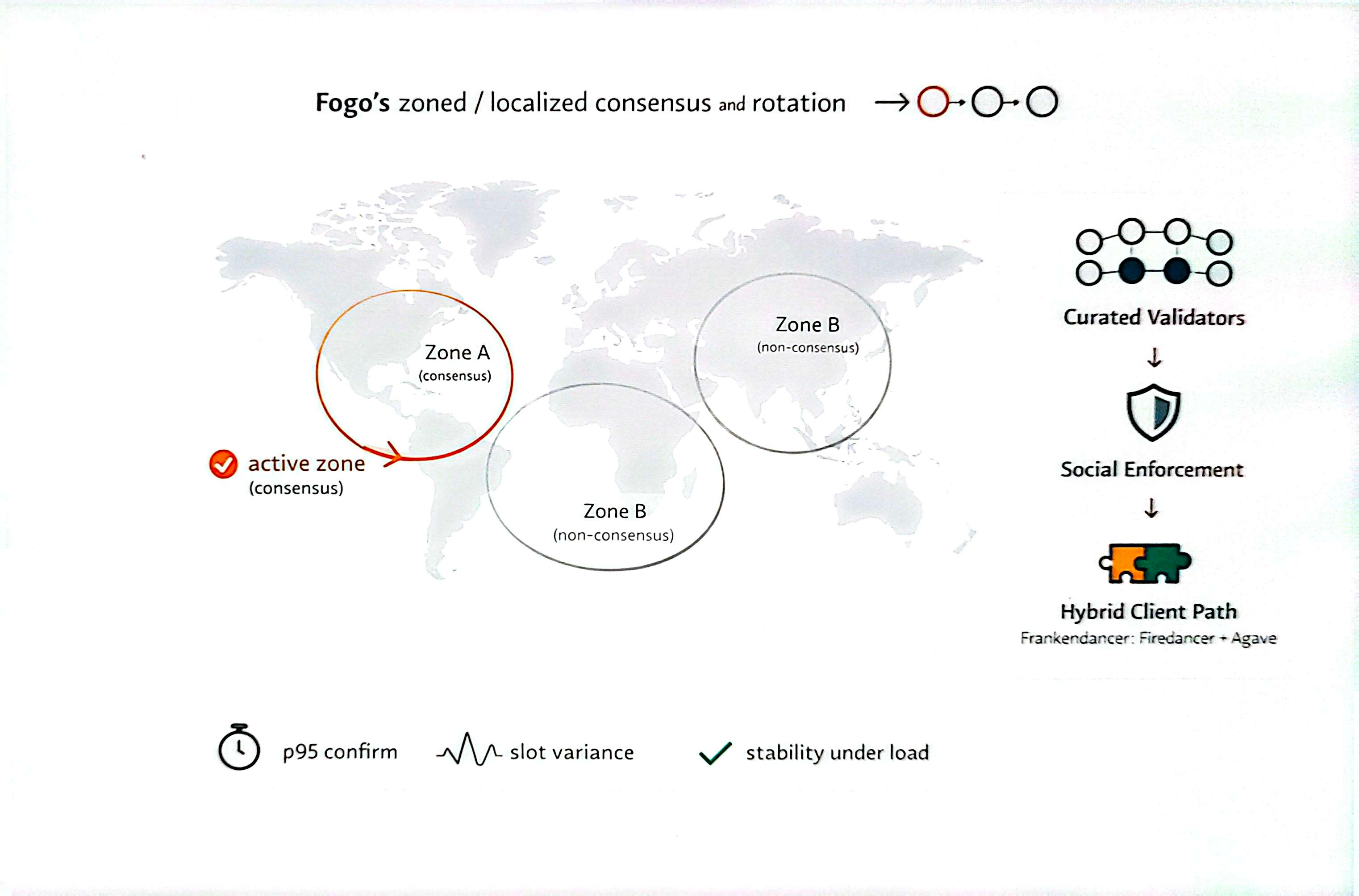
The clear tradeoff here is the rejection of client diversity. Most blockchain developers believe that having multiple software versions running the network is the only way to stay secure. Fogo disagrees. It bets entirely on a highly optimized client Firedancer-based, mainnet uses a hybrid Firedancer client (Firedancer components + Agave). The team argues that the only way to reach 100,000+ transactions per second is to ensure every node is running the fastest possible code without being slowed down by weaker versions. It is a move toward performance maximalism that prioritizes the needs of high-frequency traders over traditional blockchain dogmasFogo SVM: The Architecture of Execution Fairness
I have spent a lot of time thinking about why on-chain trading still feels like a second-class experience compared to professional desks. The issue is not just the speed of a single block, but the unpredictability of the entire pipeline. Most chains treat every transaction the same, which sounds fair until a bot with a faster connection to a random validator jumps ahead of your trade. @Fogo Official is the first network I have seen that builds "execution fairness" into the protocol itself by using a curated validator set and native price feeds.
The Problem of Toxic MEV
The non-obvious problem in decentralized finance is the "bot tax" that drains value from every retail swap. On most networks, sophisticated actors use Maximum Extractable Value (MEV) to front-run trades, causing slippage that costs users millions. @Fogo Official tackles this by moving away from a completely open, unvetted validator set. By hand-picking 19 to 30 high-performance validators, the network can enforce rules that penalize abusive behavior. This creates a "clean" trading environment where the protocol protects the user rather than leaving them to the bots.
Enshrined Trading Primitives
Fogo uses a mechanism called "enshrined primitives" to make the network feel like a single, cohesive exchange. Instead of forcing developers to build every tool from scratch, Fogo integrates a native decentralized exchange (DEX) and real-time price feeds directly into the Layer 1. This means the core liquidity and data are part of the blockchain's foundation. When a trade happens, it does not have to jump through multiple third-party smart contracts that add latency and risk. Everything happens in one optimized flow, which is how the network maintains its 40-millisecond block times even under heavy load.
The Performance Maximalism Tradeoff
The clear tradeoff here is the rejection of client diversity. Most blockchain developers believe that having multiple software versions running the network is the only way to stay secure. Fogo disagrees. It bets entirely on a highly optimized client Firedancer-based, mainnet uses a hybrid Firedancer client (Firedancer components + Agave). The team argues that the only way to reach 100,000+ transactions per second is to ensure every node is running the fastest possible code without being slowed down by weaker versions. It is a move toward performance maximalism that prioritizes the needs of high-frequency traders over traditional blockchain dogmas.
How to Measure Network Health
To judge if Fogo is succeeding, you have to look past the total value locked. The real metric is "deterministic execution", whether trades are actually landing at the price you see without unexpected delays. You can track this on the Fogo Testnet Explorer, which shows real-time slot times and validator responsiveness. Another sign of health is the growth of the "Fogo Flames" program, which rewards users for actually testing the network's limits through high-frequency apps like Fogo Fishing. If the network stays stable at 40ms while thousands of people are spamming transactions, the tech is working.
Bottom Line
Fogo is a specialized execution layer that treats trading as a first-class citizen rather than just another type of data. By combining the speed of Firedancer with a curated validator model, it removes the hidden taxes that have kept professional capital away from the chain. It is a focused, high-performance tool for a future where on-chain finance finally matches the reliability of a global stock exchange.