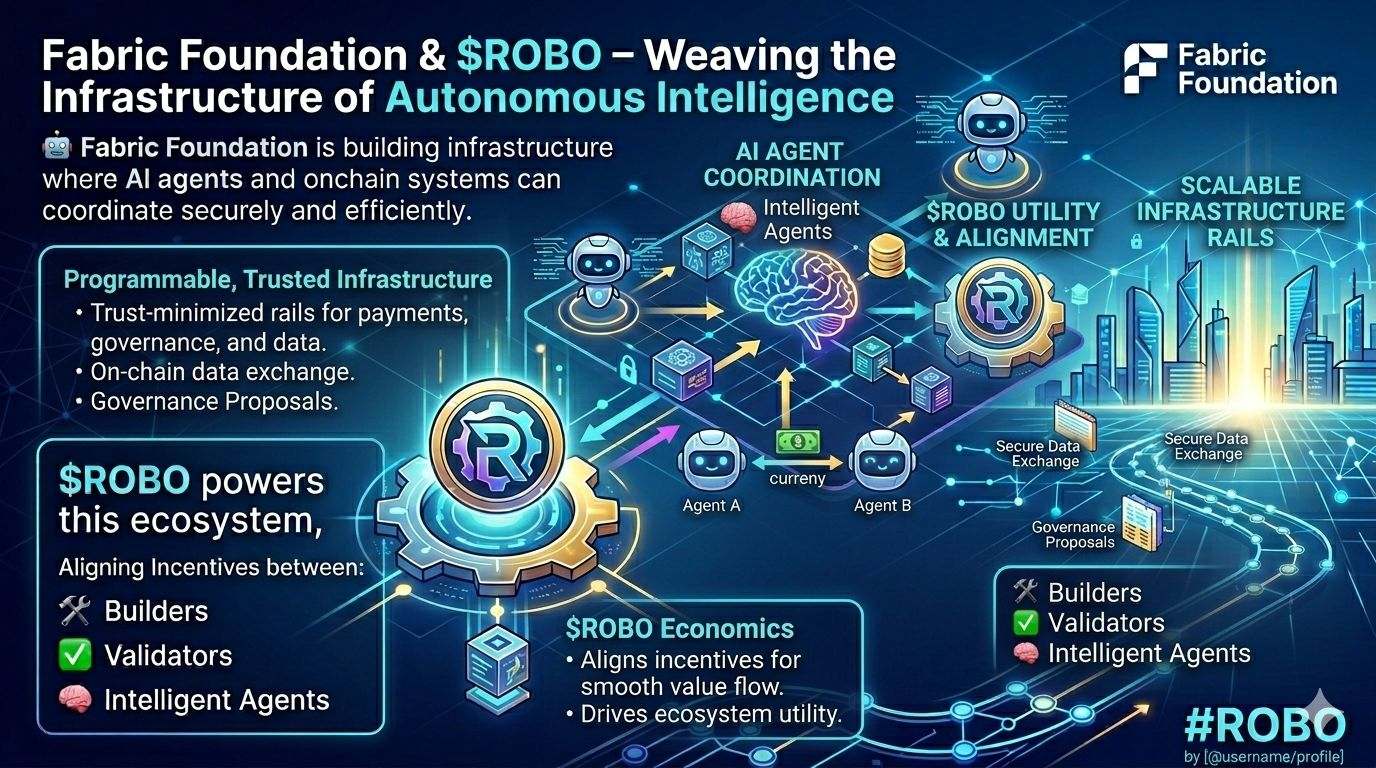
The future of automation is not just about smarter bots, it is about coordinated, on-chain intelligence that can act, transact, and evolve without friction. That is exactly where Fabric Foundation enters the arena. By building programmable infrastructure for autonomous systems, Fabric Foundation is transforming blockchain from a static ledger into a living execution layer for intelligent agents.
The token $ROBO plays a central role in this ecosystem. It is not just a utility asset, it is the fuel that powers coordination, validation, and economic alignment across the network. As decentralized AI agents emerge, they require trust-minimized rails for payments, governance, and secure data exchange. Fabric Foundation provides that fabric of trust, while $ROBO ensures value flows smoothly between participants.
What excites me most is the long-term vision. We are moving toward a world where machine-to-machine economies become normal. Imagine autonomous services negotiating, executing contracts, and optimizing resources in real time. That vision requires scalable infrastructure and a token model designed for real usage, not speculation alone. Fabric Foundation is laying those bricks carefully.
The growth potential here lies in utility and adoption. As more developers and innovators plug into the Fabric ecosystem, demand for $ROBO strengthens organically. This is about building rails for the next generation of digital coordination.
I am closely watching updates from @ and following the evolution of $ROBO. The infrastructure narrative is powerful, and Fabric Foundation is positioning itself as a backbone layer for autonomous Web3 systems.