
The coming decade will not be shaped by the size of our screens, but by the autonomy of our physical world. The era of general-purpose robots is no longer science fiction, but a rapid deployment reality. Yet, as robots transition from the enclosed factory floor to our cities, homes, and vital infrastructure, we are faced with a critical bottleneck: Trust. How do we ensure that a multi-vendor network of autonomous agents can safely coordinate with each other? How is their decision-making process verifiable? This is where the Fabric Foundation and its key asset, $ROBO , are establishing the vital intersection of blockchain trust and physical automation.
The challenge with today’s robotic deployment is fragmentation. Companies build closed systems that do not easily integrate with each other, and their decision-making processes are a “black box,” rendering accountability impossible. This paradigm will not scale to the trillions of robotic agents that are forecasted for the coming economy. What is needed is a global, open network that offers the necessary scaffolding—a single fabric—for general-purpose robots to work together and adapt. The Fabric Protocol, led by the non-profit @Fabric Foundation , is developing this critical infrastructure.
Fabric’s vision is to transcend the existing “hardware first” paradigm and shift towards a “verifiable data first” ecosystem. By harnessing agent-native infrastructure and a public ledger, the protocol enables the optimization of three aspects of robotic system deployment: Data, Computation, and Regulation. This is more than just tracking the location of a robot; it’s about the verifiable computation of its instructions and the enforcement of safety and regulatory guidelines.
In order for this entire ecosystem to run independently, there needs to be a universal medium of exchange and value coordination. This is where #Robo comes in. ROBO is intended to be the token that powers the decentralized hardware-software collaboration, such that all inputs into the system, whether it be a developer’s optimized pathfinding algorithm or a data provider’s LiDAR data, are all transparently tracked, verified, and rewarded.
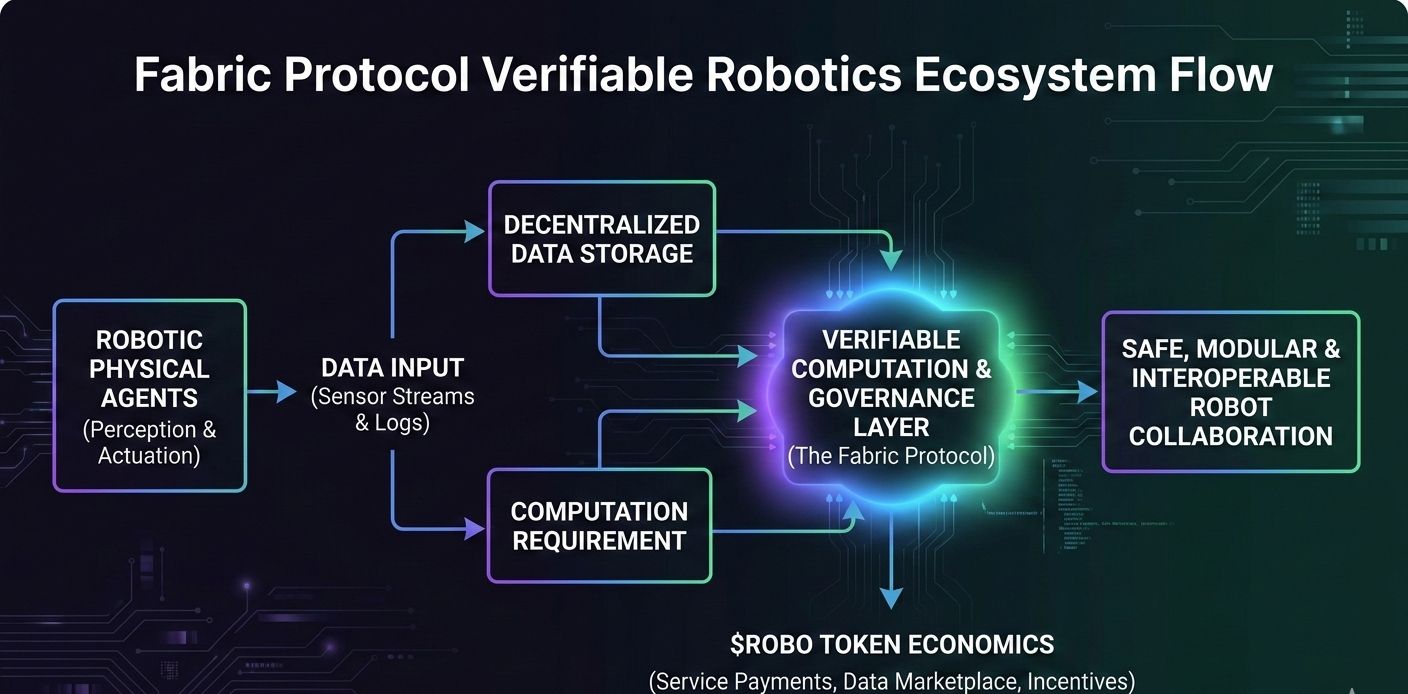
The flowchart shows how Fabric’s modular infrastructure bridges the physical layers (robots and sensors) to the trust layers (computation verification and decentralized data storage), all managed and enabled by the $ROBO token mechanisms. The net effect is a system where safe and interoperable human-machine collaboration is no longer a dream but a hard-coded reality.
By leveraging verifiable computing and decentralized storage, the Fabric Protocol enables a platform where robots can share verified experiences and data, enabling faster collective learning without the privacy risks of centralized data repositories. This "modular infrastructure" enables a robot to obtain its perception model from one vendor, its task planner from another, and its safety governor from a third, with the whole process managed and logged on-chain.
Historically, investment in the robotics industry has been a piecemeal investment in individual hardware companies. The Fabric Foundation presents a different viewpoint: a foundation-level investment in the infrastructure that makes all robots better, safer, and more collaborative. $ROBO is more than just a token; it is the unit of account for the first verifiable robot-native economy. With the integration of the physical world and decentralized ledger technology on the horizon, this protocol and its associated token are positioning themselves at the obvious crossroads of the future industry. The robotics revolution will not only be automated but also verifiable.