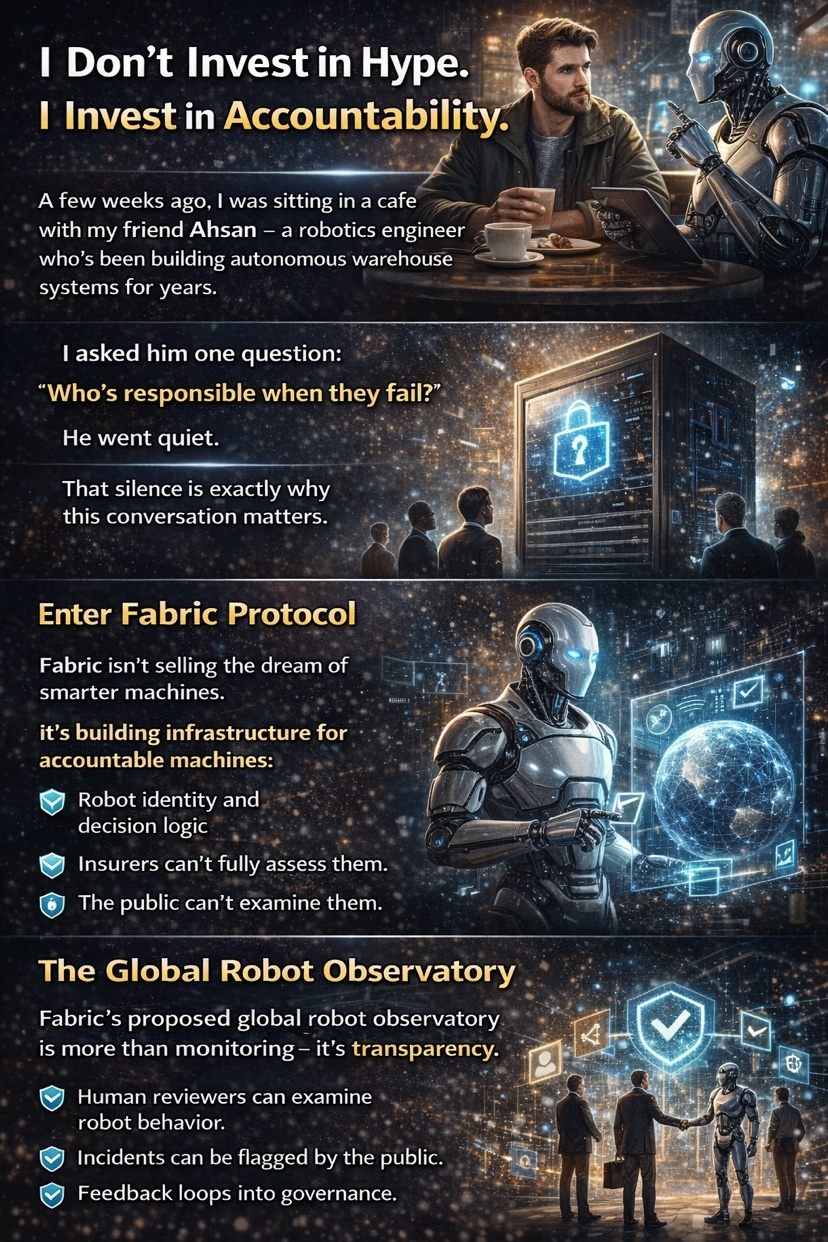
A few weeks ago, I was sitting in a café with my friend Ahsan a robotics engineer who’s been building autonomous warehouse systems for years.
He was excited.
“Robots are finally leaving controlled environments,” he said. “Hospitals. Streets. Infrastructure. This is the breakthrough moment.”
I asked him one question:
“Who’s responsible when they fail?”
He went quiet
That silence is exactly why this conversation matters.
The Black Box Problem No One Wants to Talk About
Right now, most autonomous systems operate like sealed containers.
They make decisions.
They execute tasks.
Sometimes they fail.
But the reasoning behind those decisions? Locked inside proprietary servers. Hidden behind corporate walls.
Regulators can’t fully audit them.
Insurers can’t fully assess them.
The public certainly can’t examine them.
That’s not a technical limitation.That’s a design choice.
And as robots move beyond warehouses into hospitals and city streets, that choice becomes dangerous.
Enter Fabric Protocol
When I started reading about Fabric, I expected another “future of robots” pitch.Instead, I found something different.The Fabric Foundation isn’t selling the dream of smarter machines.It’s building infrastructure for accountable machines.Systems where robot identity, task history, and decision logic aren’t buried inside a vendor’s private database but recorded on a ledger that no single company controls.That changes the power dynamic
ROBO Isn’t the Point
Yes, the $ROBO token has recently been listed on exchanges. Yes, price action has drawn attention.But focusing only on the token misses the bigger argument.This isn’t about speculation.It’s about coordination and traceability.
@Fabric Foundation proposes that robot coordination should run on tamper-resistant infrastructure auditable by regulators, reviewable by insurers, and transparent to authorized oversight bodies.
That’s a structural shift.
The Global Robot Observatory
One concept that stood out to me in the white paper was the idea of a “global robot observatory.”
Imagine a system where:
• Human reviewers can examine robot behavior
• Incidents can be flagged and reviewed
• Feedback loops directly into governance
That’s not marketing language.
That’s architecture.
Architecture for accountability.
Why This Matters Now
Robots are no longer experimental.
The questions from regulators and enterprise clients have changed.
It’s no longer:
“Can it work?”
It’s
“Who is responsible when it doesn’t?”
And current black box systems don’t have a convincing answer.Transparency won’t make machines perfect. Nothing will.But transparency makes mistakes understandable.And understanding mistakes is where safety standards, liability structures, and public trust begin.A robot that fails with a full, auditable record is fundamentally different from one that fails silently inside a closed ecosystem.
The Real Bet
Fabric isn’t betting that the most capable robot will win.It’s betting that the most accountable infrastructure will.The next wave of adoption won’t be decided by speed alone.It will be decided by which systems give:
• Regulators something real to audit
• Insurers something solid to underwrite
• The public a window into machine behavior
That’s the pool I’m watching.
Because in the long run, accountability isn’t a feature.
It’s the foundation.