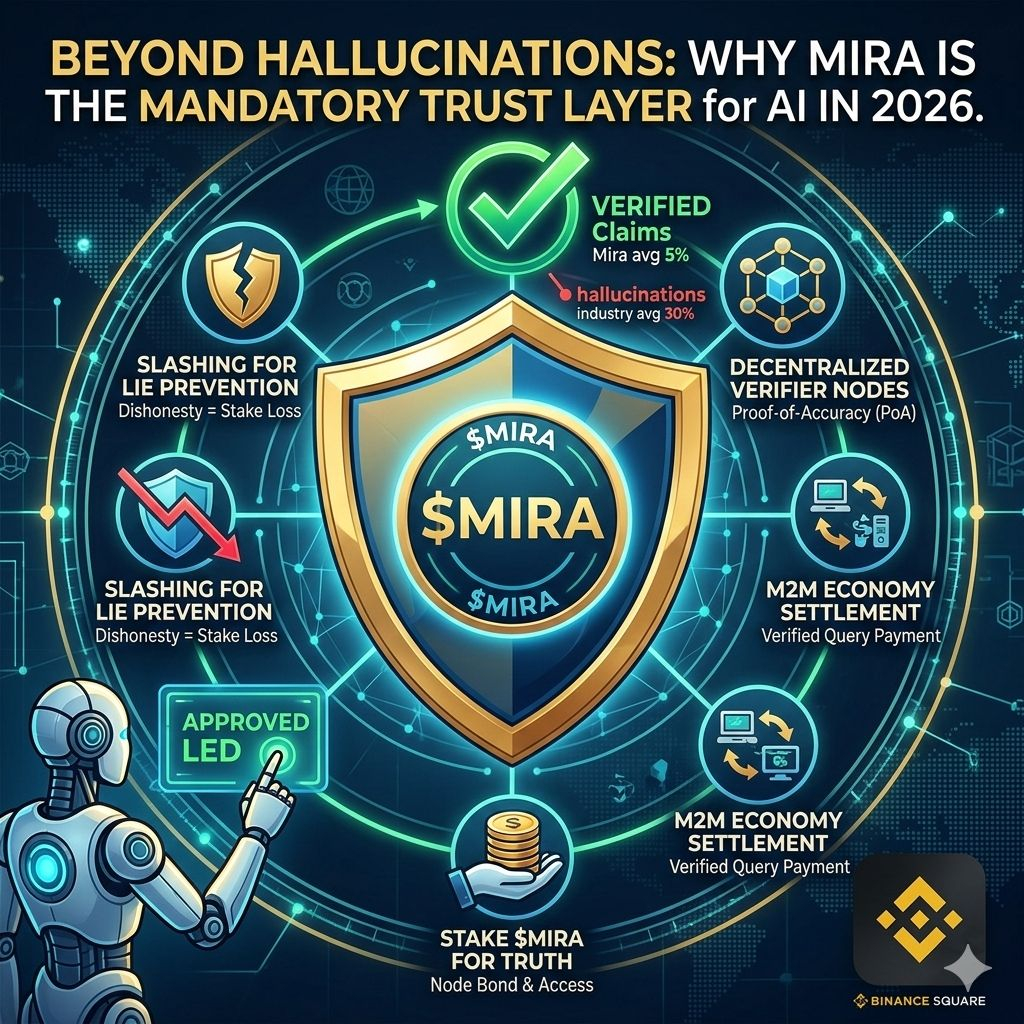
The greatest bottleneck for AI adoption in 2026 isn't a lack of intelligence—it’s a lack of trust. As autonomous agents begin to move billions in capital, the cost of an AI "hallucination" shifts from a minor annoyance to a catastrophic financial risk. This is the exact problem @mira_network was built to solve.
The Technology: From Black Boxes to Verifiable Claims
Most AI models today operate as "black boxes," offering no audit trail for their conclusions. Mira changes the game by breaking down complex AI outputs into atomic, verifiable claims. These claims are then routed through a decentralized network of independent verifier nodes. By reaching consensus across diverse LLMs, Mira has successfully reduced hallucination rates from the industry average of 30% down to a staggering 5%.
The $MIRA Economic Engine
The MIRA token isn't just a speculative asset; it is the fundamental "bond" of the network.
Staking for Truth: Verifier nodes must stake $MIRA to participate.
Slashing for Lies: Any node providing dishonest or low-quality verification faces immediate slashing, ensuring the economic cost of lying always outweighs the gain.
M2M Economy: As we move toward a machine-to-machine economy, MIRA serves as the universal settlement layer for verified AI queries.
The Bottom Line
In a world where deepfakes and AI errors are becoming structural risks, the projects that provide "Truth-as-a-Service" will capture the most value. With over 19 million verified queries processed weekly, Mira is no longer a "whitepaper project"—it is the working infrastructure of the decentralized AI era.
Follow Me @Juliana_Queen