
1) Opening (Hook with Insight, Not Hype)
We are entering a phase of technology where the question is no longer whether machines can act, but who is responsible when they do. For years, crypto focused on digital coordination: tokens moving across ledgers, smart contracts executing in clean, deterministic environments. Robotics is different. When a robot performs a task incorrectly, the consequence is not a bug report. It is physical, financial, and sometimes irreversible.
Fabric Protocol sits inside that tension. It does not begin with price charts or promises of exponential growth. It begins with a quieter observation: autonomy without accountability is fragile. If robots are going to operate in warehouses, hospitals, farms, and public infrastructure, the systems coordinating them cannot rely on blind trust or centralized gatekeepers alone. They need rules, incentives, and oversight that scale beyond a single company’s control. That is the environment Fabric is stepping into—one shaped by the collision of AI capability and institutional responsibility.
2) The Core Thesis
At its heart, Fabric is trying to solve a coordination problem. As robotics advances, ownership of the stack often consolidates. A company builds the hardware, controls the software, defines the rules of participation, and captures most of the value. That model can accelerate innovation in the short term, but it narrows participation and makes oversight opaque.
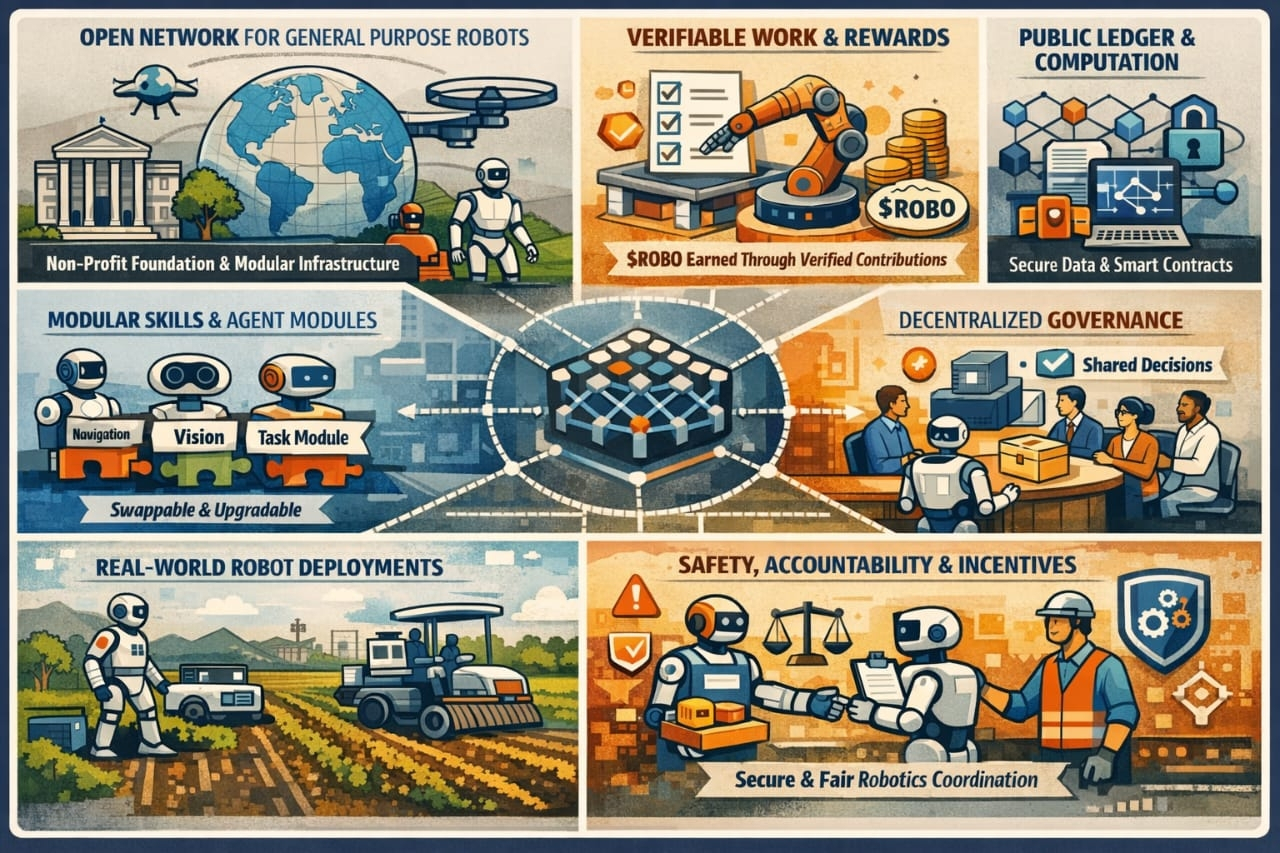
Fabric proposes an alternative structure: a global open network, supported by a non-profit foundation, where general-purpose robots can be constructed, governed, and improved collaboratively. The goal is not simply to put robots “on-chain.” It is to create shared infrastructure where data, computation, and regulation are coordinated through a public ledger. In this model, multiple contributors—developers, operators, validators—can participate in shaping how machines behave and how they are rewarded.
Why now? Because the enabling layers have matured. AI systems are increasingly modular. Blockchain networks can reliably handle identity, settlement, and economic incentives. And there is growing discomfort with opaque, centralized control over autonomous systems. The timing reflects a broader shift in crypto itself. After cycles dominated by speculative narratives, there is renewed interest in infrastructure that ties token incentives to measurable work rather than passive capital. Fabric leans directly into that shift.
What makes its approach structurally different is its insistence that rewards should be tied to verifiable contribution, not mere token ownership. In theory, holding $ROBO does not entitle someone to yield. Performing useful, measurable tasks does. That framing pushes the network toward participation rather than pure financial engineering. Whether that principle holds under pressure remains to be seen, but the design intent is clear: economic incentives should discipline behavior, not inflate it.
3) Architecture & Design
Fabric’s architecture is modular by design. The whitepaper describes robot capabilities as composed of function-specific components, sometimes framed as “skill chips,” which can be added or upgraded independently. The significance of this is less technical and more economic. Modular skills mean contributors can specialize. A developer might focus on navigation optimization, another on perception accuracy, another on task verification. The network becomes a marketplace of capabilities rather than a monolithic robotics stack.
In its early stages, Fabric uses existing EVM-compatible chains, including Ethereum and Base, to deploy smart contract components. This choice signals pragmatism. Instead of demanding a brand-new chain before product-market fit, the team leverages mature infrastructure. At the same time, the long-term vision includes a dedicated Layer 1 aligned with machine participation as a first-class concern. That progression—from borrowed infrastructure to purpose-built infrastructure—mirrors the evolution path of several successful crypto projects.
The economic model introduces bonding and reservoir mechanisms intended to secure behavior while allowing high-frequency operations. Operators post a base bond tied to declared capacity. From that reservoir, per-task collateral can be allocated. This design attempts to balance accountability with usability. A robot performing frequent micro-tasks cannot realistically stake anew for each action; the reservoir concept acknowledges that operational reality.
Importantly, Fabric distinguishes itself from conventional proof-of-stake reward systems. The whitepaper repeatedly emphasizes that token ownership alone should not generate returns. Rewards are linked to task completion, validation, data submission, and skill development—activities that can be measured and evaluated. It is an attempt to align token emissions with service provision rather than capital parking.
The ecosystem positioning reflects ambition without theatricality. Fabric is neither just a robotics API nor merely a payment rail. It aims to be a coordination layer—where identity, execution, oversight, and economic incentives intersect. That breadth creates opportunity, but it also creates complexity.
4) Market Positioning
Fabric sits at the intersection of two narratives currently gaining traction: the agent economy and verifiable infrastructure. As AI agents transact autonomously, markets need ways to identify them, measure their work, and settle payments. Fabric extends that logic to physical robots.
This positioning has strengths. Robotics makes the accountability question concrete. In purely digital environments, mistakes are abstract. In physical environments, they are tangible. That gives Fabric’s thesis weight.
However, robotics adoption tends to move slower than crypto cycles. Hardware integration, regulatory compliance, and operational safety introduce friction that cannot be bypassed with clever tokenomics. That is both a risk and a credibility test. If Fabric overpromises speed, it will struggle. If it sequences carefully—starting with identity, settlement, and measurable primitives—it may build durable foundations.
Compared to competitors, Fabric’s differentiation lies more in institutional structure and incentive design than in flashy features. The non-profit foundation model is intended to protect openness. Whether that protection holds depends on governance in practice, not just on legal diagrams. Balanced analysis requires acknowledging that decentralization is a spectrum, not a switch.
5) Real-World Signal
Early signal in infrastructure projects is subtle. It shows up not in headlines but in rollout sequencing. Fabric’s phased deployment—identity systems, settlement layers, structured data collection—suggests attention to operational order. You do not start with complex governance mechanics; you start with primitives that can be tested.
Exchange listings and broader token accessibility indicate that $ROBO has entered public circulation. That provides liquidity for participants who want to engage. But liquidity is not adoption. The more meaningful signal will be whether developers build useful modules and whether operators deploy robots that actually use the protocol’s coordination tools.
Community quality is another signal. A detailed whitepaper that spends significant time on incentive alignment, bonding mechanics, and legal structure reflects seriousness. It signals that the team understands the difference between narrative and infrastructure. Infrastructure requires precision.
6) Forward Outlook
For Fabric to succeed, its verification mechanisms must work in imperfect environments. Measuring whether a physical task was completed correctly is harder than verifying a digital signature. The network will need reliable dispute resolution and robust penalty systems. Without them, “verifiable work” risks becoming symbolic.
It must also attract builders motivated by long-term contribution rather than short-term emissions. If the network fills with participants optimizing loopholes, its accountability promise will weaken. Incentive systems are only as strong as their enforcement.
Governance will be another stress point. As stakes grow, maintaining open decision-making becomes harder. If control consolidates, the protocol could drift toward the centralized models it aims to counterbalance.
Fabric deserves attention not because it guarantees transformation, but because it addresses a real structural gap. As machines become economic actors, society will need coordination layers that are transparent, incentive-aligned, and not owned by a single entity. Whether Fabric becomes that layer depends on execution, restraint, and the patience to build infrastructure in a market that often rewards spectacle.
In the end, the project’s significance is not about robots alone. It is about whether open systems can responsibly coordinate autonomy at scale. That is a question larger than any token cycle—and one worth watching carefully.