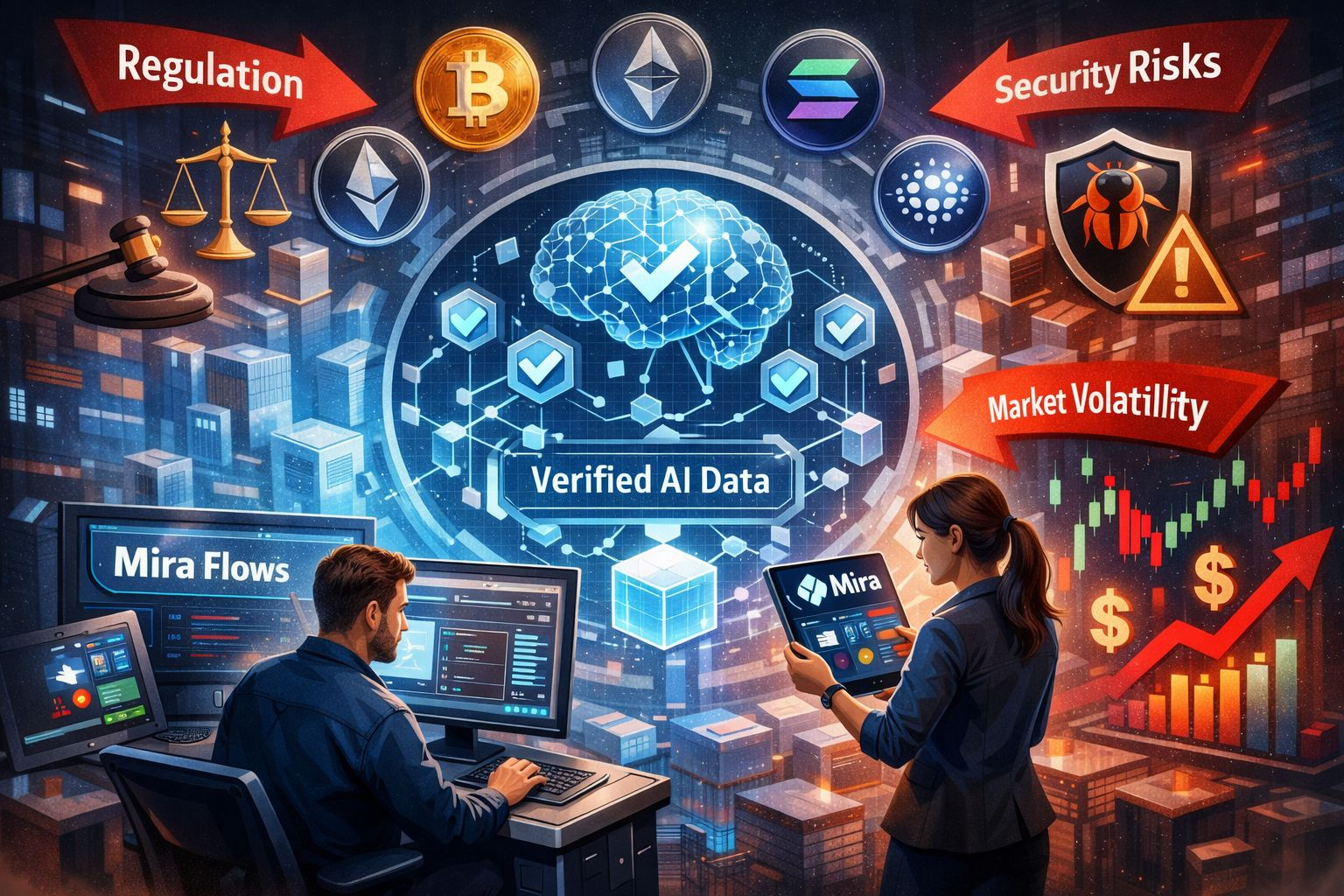
The rapid evolution of blockchain and artificial intelligence has opened new opportunities for innovative crypto projects. One project gaining attention is $MIRA Network (MIRA), which aims to combine blockchain infrastructure with AI verification technology. While the project shows promising potential, it also faces several challenges in an increasingly competitive crypto market. Understanding these challenges is essential when evaluating Mira’s long-term sustainability and growth.
Key Developments of Mira
Before discussing the challenges, it is important to highlight some of Mira’s notable developments. The project focuses on creating a decentralized system that verifies AI outputs using blockchain consensus. Its Verified Generate API allows developers to generate AI results with cryptographic verification, reducing the need for manual checking and increasing reliability. The ecosystem also includes the Mira Flows marketplace, where developers can deploy or monetize AI workflows. In addition, the network operates through nodes that stake tokens and verify AI outputs, creating incentives for honest validation. (MEXC)
These developments position Mira as a project working at the intersection of AI and blockchain, a rapidly expanding sector within Web3.
1. Intense Competition in the Crypto Industry
The cryptocurrency market is extremely crowded, with thousands of projects competing for attention, investment, and developer support. Major blockchain networks and AI-focused projects already have strong ecosystems, funding, and community adoption. For Mira to stand out, it must continuously innovate and prove that its AI verification model offers real advantages over existing solutions.
2. Regulatory Uncertainty
Regulation remains one of the biggest obstacles for emerging crypto projects. Because $MIRA a operates in both AI and blockchain sectors, it could face scrutiny from regulators concerned about data security, AI governance, and cryptocurrency compliance. Different countries have varying regulatory approaches, which could impact adoption and global expansion. (Gate.com)
3. Technical and Security Risks
Blockchain networks rely heavily on secure smart contracts and stable infrastructure. Any vulnerability in the system can damage user trust and impact the token’s reputation. Like many crypto platforms, Mira has faced technical risks in the past, including potential smart-contract vulnerabilities that required security patches and audits. Maintaining robust security will remain critical for the project’s credibility. (CoinPaprika)
4. Market Volatility and Token Economics
Another challenge for $MIRA is the volatility of the crypto market. Projects with relatively small market capitalization can experience significant price swings due to changes in investor sentiment or liquidity. Additionally, the gradual release of token supply may create dilution pressure, which can affect price stability and investor confidence. (Gate.com)
5. Adoption and Real-World Utility
While Mira offers innovative AI verification tools, widespread adoption is not guaranteed. The success of the ecosystem depends on developers, enterprises, and AI platforms integrating the technology into real-world applications. Without strong adoption, even technically advanced projects may struggle to maintain long-term value.
Conclusion
@Mira - Trust Layer of AI Mira Network represents an ambitious attempt to build trust infrastructure for AI using blockchain technology. Its ecosystem—including AI verification tools, decentralized node networks, and developer marketplaces—demonstrates strong innovation potential. However, the project must overcome challenges such as intense market competition, regulatory uncertainty, security concerns, and the need for large-scale adoption. If the team can continue improving its technology and expanding its ecosystem, Mira may strengthen its position in the evolving Web3 and AI landscape.
#MarketPullback #USJobsData #AIBinance #KevinWarshNominationBullOrBear