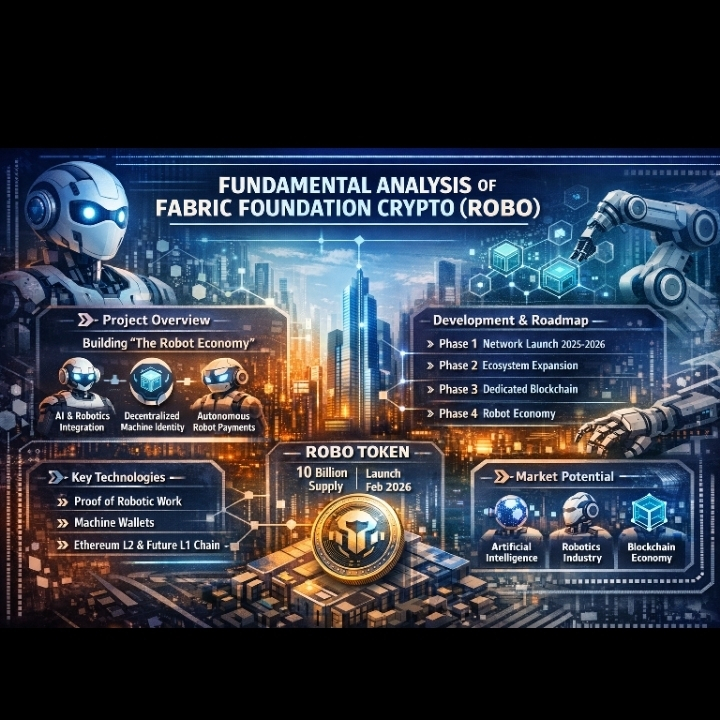
1. Project Overview
The Fabric Protocol (ROBO) is an emerging blockchain project developed by the Fabric Foundation. Its goal is to create a decentralized infrastructure that allows robots and intelligent machines to participate in the global economy.
Unlike traditional cryptocurrencies that focus mainly on finance, Fabric aims to connect AI, robotics, and blockchain into one ecosystem where machines can:
Have verifiable digital identities
Perform autonomous work
Receive and send payments on-chain
Participate in decentralized markets for labor and services
The project’s long-term vision is what it calls “The Robot Economy”—a global system where humans and intelligent machines collaborate through decentralized infrastructure. �
fabric.foundation +1
2. Core Technology and Utility
Fabric Protocol uses blockchain to create a coordination layer for robotics and AI systems.
Key technical components include:
Decentralized Robot Identity
Robots will receive on-chain identities so they can be tracked, authenticated, and assigned tasks transparently across the network.
Autonomous Machine Wallets
Machines can hold crypto wallets to:
receive payments
pay for maintenance or data
participate in machine-to-machine economic activity
Proof of Robotic Work
Instead of traditional mining or staking, the protocol introduces Proof of Robotic Work, rewarding verified robotic tasks, data contributions, and operational work on the network. �
CoinMarketCap
Blockchain Infrastructure
The network initially runs on Ethereum Layer-2 Base, with future plans to launch a dedicated Layer-1 blockchain optimized for machine transactions and robotics coordination. �
CoinMarketCap
3. Tokenomics
The native token ROBO is used for payments, governance, and staking.
Token Details
Metric
Value
Token Name
ROBO
Total Supply
10 Billion
Inflation
Fixed supply
Launch
February 2026
Allocation
Ecosystem & Community: 29.7%
Investors: 24.3%
Team & Advisors: 20%
Foundation Reserve: 18%
Community Airdrops: 5%
Liquidity & Launch: 2.5%
Public Sale: 0.5%
Most allocations follow multi-year vesting schedules to support long-term ecosystem growth. �
Fabric Foundation +1
4. Development Progress
Fabric Foundation focuses on building infrastructure for AI-driven machines.
Major development areas include:
Research & Governance
The foundation supports research on:
machine alignment
AI safety
governance for autonomous systems
Infrastructure Development
Fabric is developing systems for:
decentralized machine identity
task coordination
machine-to-machine payments
robotics data networks
Ecosystem Collaboration
The project collaborates with:
developers
robotics companies
policymakers
AI researchers
Its goal is to create open infrastructure so the robotics economy is not controlled by a few corporations. �
Fabric Foundation +1
5. Roadmap Highlights
Based on project announcements and documentation, the roadmap includes several major phases.
Phase 1 – Network Launch (2025-2026)
Release Fabric whitepaper
Launch ROBO token
Deploy protocol on Base L2
Begin ecosystem incentives and airdrops
Phase 2 – Ecosystem Expansion
Developer tools for robotics integration
AI skill modules and training infrastructure
Robot identity registry
Phase 3 – Dedicated Blockchain
Launch Fabric Layer-1 blockchain
Optimize network for machine-to-machine transactions
High-throughput robotic coordination
Phase 4 – Robot Economy
Autonomous robot marketplaces
Global robotics workforce networks
Machine-operated financial systems
6. Market Potential
The project sits at the intersection of three high-growth industries:
Artificial Intelligence
Robotics
Blockchain
As robotics adoption increases in sectors like logistics, healthcare, and manufacturing, Fabric could become a financial infrastructure layer for autonomous machines.
If successful, it could unlock a decentralized marketplace for automated labor, which would represent a completely new economic model.
7. Risks and Challenges
Despite its ambitious vision, several risks exist:
1. Early-stage technology
Large-scale robotic coordination via blockchain is still experimental.
2. Adoption dependency
The network’s success depends on robotics companies integrating with Fabric.
3. Market volatility
The ROBO token recently launched on exchanges, which could lead to strong price volatility in early trading stages. �
hokanews.com
8. Conclusion
Fabric Foundation represents one of the most ambitious crypto projects combining AI, robotics, and blockchain.
Its core innovation lies in enabling robots to become autonomous economic participants through decentralized identity, payments, and governance systems.
If the project successfully builds its infrastructure and gains adoption from robotics companies, Fabric Protocol could become a foundational layer for the future robot economy.
However, because the project is still early in development, investors should closely monitor technology progress, partnerships, and real-world deployment before making long-term decisions.