Fundamental Analysis: Fabric Foundation (ROBO)
Overview
@Fabric Foundation is an emerging Web3 initiative focused on building the economic and governance infrastructure for autonomous robots and intelligent machines. The project sits at the intersection of blockchain, artificial intelligence, and robotics, aiming to create an open network where machines can participate in the global economy.
The ecosystem introduces $ROBO , a utility and governance token designed to coordinate robot deployment, facilitate payments for robotic services, and incentivize contributors who support the network’s development.
In simple terms, Fabric’s long-term vision is to enable a “Robot Economy”—a decentralized system where robots can work, transact, and interact economically using blockchain infrastructure.
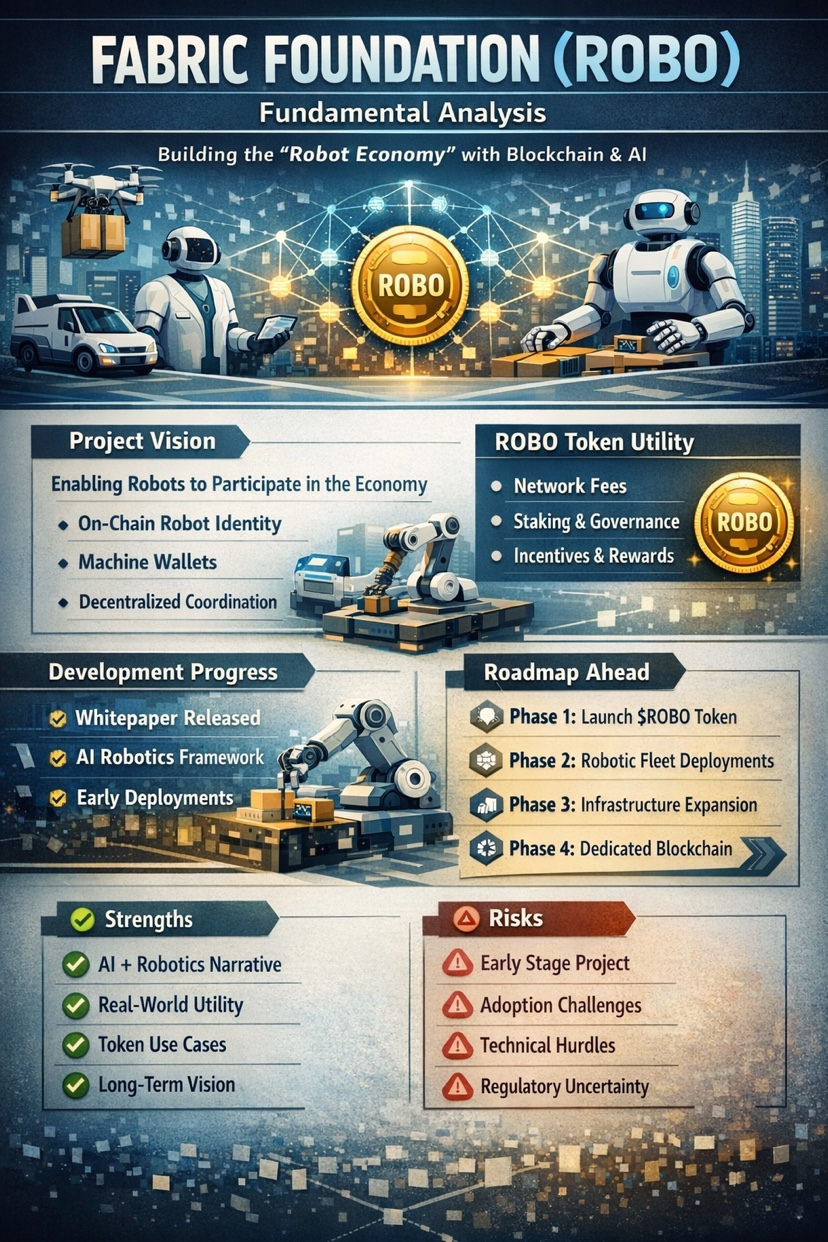
Visual Concept of the Fabric Robot Economy
(AI-style concept illustration)
(Concept: robots connected through blockchain networks performing tasks in logistics, healthcare, and manufacturing.)
1. Project Vision and Narrative
The core thesis of @Fabric Foundation is that robots and autonomous systems will soon become economically active entities, but existing financial and governance systems were built only for humans.
Robots currently cannot:
Open bank accounts
Hold identities
Receive payments autonomously
Fabric proposes blockchain infrastructure to solve these issues through:
On-chain robot identity
Autonomous crypto wallets
Decentralized coordination of robotic work
The protocol functions as a coordination layer for robotic labor markets, where companies pay for robot work and settlements occur through blockchain transactions.
This positions Fabric in the AI + robotics + crypto narrative, which is currently one of the strongest emerging sectors in Web3.
2. Technology and Ecosystem
Fabric’s system combines several key components:
On-Chain Identity for Robots
Each robot receives a verifiable blockchain identity containing:
ownership
permissions
operational history
This creates transparent and auditable machine behavior, improving trust and safety.
Machine Wallets
Robots can hold crypto wallets that allow them to:
receive payments
pay for services (maintenance, compute)
execute automated contracts.
Decentralized Robot Coordination
Fabric introduces a marketplace where participants help coordinate robot fleets and deployments worldwide.
Participants contribute resources and receive incentives based on verified robotic work.
3. Token Utility – $ROBO
The native token ROBO plays several roles in the ecosystem.
Network Fees
All protocol transactions such as:
payments
identity verification
task settlement
are paid in $ROBO.
Staking and Participation
Developers and ecosystem participants must stake @Fabric Foundation ROBO to access network services and build applications.
Governance
Token holders influence:
protocol parameters
network policies
ecosystem decisions.
Incentives
Rewards are distributed to contributors who:
train AI models
contribute data
validate robotic work.
4. Tokenomics Overview
Initial allocation of ROBO includes:
Category
Allocation
Investor
24.3%
Team & Advisors
20%
Foundation Reserve
18%
Ecosystem & Community
29.7%
Airdrops
5%
Liquidity
2.5%
Public Sale
0.5%
Many allocations have multi-year vesting schedules, helping align incentives with long-term development.
5. Development Progress
The project is still in early stages but has already begun several initiatives:
Whitepaper and Protocol Design
Fabric released its protocol framework explaining how decentralized systems can coordinate the creation and governance of general-purpose robots.
AI-First Robotics Architecture
The protocol envisions a modular robot intelligence system where capabilities can be added through “skill chips”, similar to mobile apps.
Infrastructure Development
Early deployments involve building:
machine identity systems
decentralized robot task coordination
blockchain settlement layers.
6. Roadmap and Future Plans
While the ecosystem is early, the roadmap revolves around several major phases.
Phase 1 – Network Bootstrap
Launch ROBO tokens
Build community participation mechanisms
Deploy initial coordination infrastructure
Phase 2 – Robotic Deployment
Partner with robotics operators
Deploy early robot fleets
Launch robot work marketplaces
Phase 3 – Infrastructure Expansion
Develop decentralized robot identity systems
expand developer ecosystem
integrate machine-to-machine payments
Phase 4 – Dedicated Blockchain
The network initially launches on an existing chain (Base), with plans to eventually migrate to its own Layer-1 blockchain as adoption grows.
7. Market Narrative and Competitive Position
Fabric sits in a niche but powerful category:
AI + Robotics + Crypto Infrastructure
Comparable narratives include projects focusing on:
AI compute markets
decentralized machine networks
autonomous agent economies.
If robotics adoption accelerates globally, Fabric could become infrastructure for robotic labor marketplaces.
However, execution risk remains high because success depends on:
real-world robotics adoption
partnerships with hardware companies
regulatory frameworks.
8. Strengths
✔ Unique AI + robotics narrative
✔ Real-world utility potential
✔ Token utility tied to machine economic activity
✔ Long-term infrastructure thesis.
9. Risks
⚠ Very early-stage project
⚠ Robotics industry adoption uncertain
⚠ Complex real-world integration
⚠ Competition from centralized robotics platforms.
Conclusion
@Fabric Foundation represents an ambitious attempt to build the economic infrastructure for autonomous machines. By combining blockchain coordination with robotics and AI systems, the project aims to unlock a decentralized “Robot Economy” where machines can work, transact, and collaborate alongside humans.
While still in its infancy, the project’s long-term vision could become increasingly relevant as AI-powered robotics expand across industries such as logistics, healthcare, and manufacturing.