I’ll be honest about my first impression of Fabric Protocol. When I initially heard about it, I was skeptical. In the tech and crypto world, new projects appear constantly, and many claim they will revolutionize everything. At first glance, Fabric seemed like just another project attaching itself to buzzwords like AI and robotics.
But after reading more about it, my perspective changed. The idea behind Fabric isn’t really about hype. It’s about something much more practical: what kind of systems we’ll need when machines start operating independently in the real world.
Today, automation is already everywhere. Robots move goods inside warehouses, automated systems help run factories, and AI supports decision-making in many industries. Some cities are even testing delivery robots on sidewalks.
Yet there’s a gap most people rarely think about.
We’ve built incredibly capable machines, but the systems that coordinate how those machines interact with society are still incomplete.
Right now, most robots operate inside controlled environments. A company builds the robot, installs its own software, and manages everything internally. That setup works well inside factories or private facilities.
But the real world is more complicated.
Imagine robots from different companies working in the same public environment. A delivery robot crosses a busy street. An automated cleaning machine operates nearby. Another robot transports packages through the same area.
If something goes wrong—maybe a malfunction or an accident—questions immediately arise.
Who is responsible?
The developer who wrote the code?
The company that deployed the robot?
Or the manufacturer that built the hardware?
These kinds of questions will become more common as automation expands. And that’s the gap Fabric Foundation is trying to explore.
Fabric isn’t trying to build better robots. Instead, it focuses on the infrastructure around them.
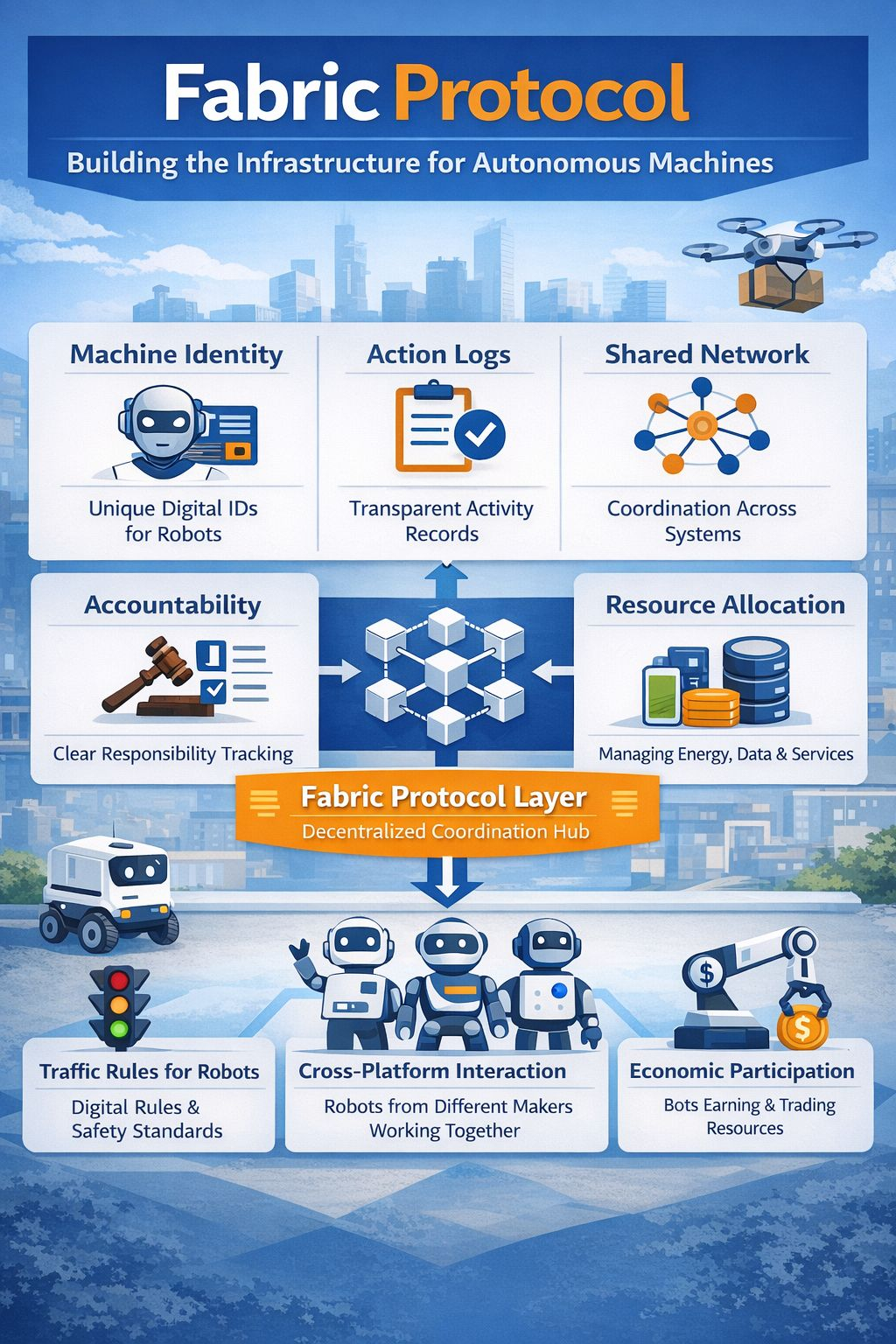
The project proposes a shared coordination layer where machines can have verifiable digital identities. Their actions—like delivering packages, processing information, or completing tasks—can be recorded and verified on a network.
Think of it like the rules that organize traffic in a city. Thousands of vehicles move through streets every day without constant chaos because shared rules exist—traffic lights, lanes, and regulations that everyone follows.
Fabric is trying to create something similar for machines.
Not road signs and signals, but digital coordination rules that help autonomous systems operate together safely and transparently.
One important idea within Fabric is machine identity. Each connected robot or autonomous system could have a digital identity that confirms who it is and what actions it performs. If a machine completes a task, that activity could be verified through the network.
This matters because trust becomes harder when machines act independently. Humans trust systems partly because responsibility can be traced. With autonomous systems, that chain of accountability becomes less obvious.
Fabric’s approach aims to create systems where machine actions are transparent and difficult to manipulate, helping maintain accountability without relying entirely on centralized control.
Another interesting aspect is that Fabric isn’t designed around one company owning the ecosystem. The network is meant to function as shared infrastructure, where developers, researchers, and organizations can contribute and build systems together.
That idea makes sense when you consider how widespread robotics is becoming. Machines will operate in factories, hospitals, farms, logistics networks, and cities. Managing all of that through a single organization would be unrealistic.
Fabric also explores something unusual but increasingly relevant: how machines participate in economic systems.
Machines don’t need salaries or bank accounts, but they still require resources—electricity, computing power, maintenance, and software updates. When machines perform useful tasks, systems are needed to coordinate how those resources are distributed and verified.
Traditional financial infrastructure was built for humans and companies, not autonomous systems. Fabric experiments with ways to structure these interactions in a shared network.
What I personally find refreshing about the project is its focus on foundational infrastructure rather than flashy applications. Identity systems, verification layers, and governance frameworks might not sound exciting, but they’re often the parts that determine whether large networks work reliably over time.
Early experiments within the Fabric ecosystem are exploring how machines interact with this coordination layer—how identities are tracked, how tasks are verified, and how different systems exchange information.
It’s still early. Infrastructure rarely appears overnight. It usually develops slowly through testing, adjustments, and gradual adoption.
While learning about Fabric, one idea kept coming back to me.
What happens when machines stop being simple tools and start becoming participants in complex systems?
Not just assistants that follow commands, but participants that perform tasks, make decisions, and interact with other technologies.
If that future arrives, entirely new layers of infrastructure will be necessary. Machines would need identities. Their actions would need verification. Governance systems would need to define how they interact with human institutions and with each other.
Fabric Protocol doesn’t claim to have every answer yet. But it’s one of the few projects asking these questions early.
And in technology, sometimes asking the right questions early is just as important as building the final solution.
@Fabric Foundation #ROBO $ROBO