Blockchain technology was originally designed around a powerful idea: transparency. Every transaction could be verified by anyone. Records would remain open, distributed, and independent of any single authority. This openness removed the need to trust a central organization and instead placed trust in mathematics and consensus. For many years, that model defined what blockchain meant.
But as the technology evolved, its limitations became more visible. Total transparency, while valuable, also introduced unintended consequences. Public blockchains allow anyone to inspect transaction histories, wallet activity, and network behavior. Even without real names attached, patterns can reveal insights over time. What begins as pseudonymous can gradually become traceable. The system that was designed for openness can unintentionally create long-term exposure.
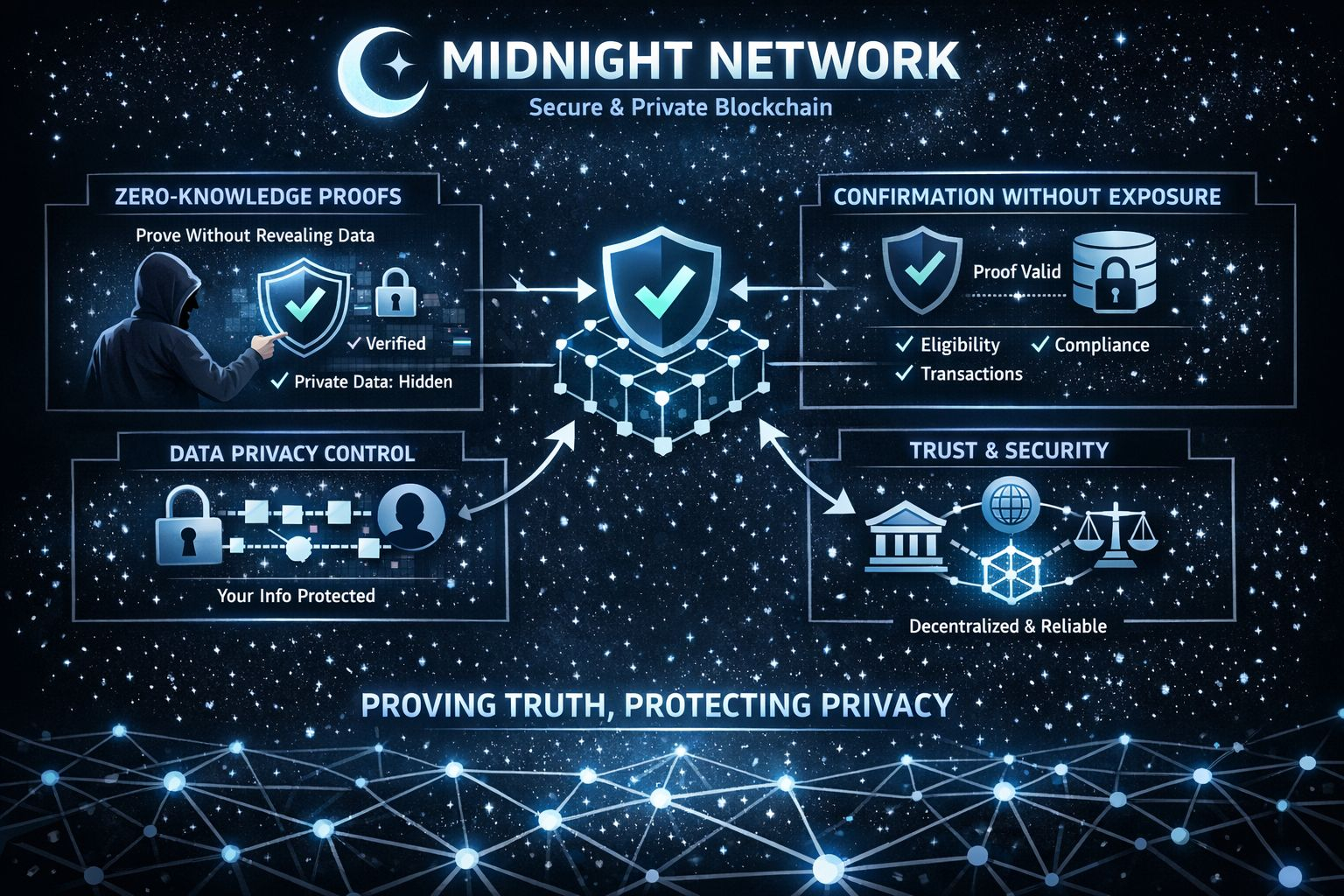
Midnight Network approaches this challenge differently. Rather than rejecting transparency altogether, it introduces a more balanced design. Built around zero-knowledge proof technology, Midnight aims to preserve verification while reducing unnecessary data disclosure. In simple terms, it allows users and applications to prove that something is true without revealing the underlying sensitive information.
Zero-knowledge proofs may sound complex, but the concept is straightforward. A system can confirm validity without exposing all related details. For example, it can verify eligibility, compliance, or correctness without requiring full access to private data. This approach shifts the focus from full transparency to selective disclosure.
That distinction matters. In many digital environments, trust has often depended on revealing everything. Public visibility became the default method of proving honesty. While effective in some contexts, this approach does not always align with real-world needs. Individuals and organizations frequently require confidentiality. They may need to demonstrate compliance without exposing proprietary information. They may need to confirm identity without sharing complete personal records. They may need to validate actions without publishing permanent public data.
Midnight’s design reflects the idea that transparency and privacy do not have to be opposites. Instead of assuming that every action must be fully visible, it asks a more nuanced question: what information truly needs to be revealed for verification to work?
By embedding privacy into its base architecture, Midnight attempts to make protection a standard feature rather than an optional add-on. This changes how ownership and participation function within the system. Users retain control not only over their assets but also over the visibility of their information. That shift can create a more comfortable environment for developers, businesses, and everyday users who want utility without constant exposure.
Of course, building a privacy-focused blockchain is not simple. Advanced cryptography must function efficiently at scale. The network must balance performance, usability, and security. If the system is too complex or difficult to integrate, it risks limiting adoption. The technology must work in practice, not just in theory.
Despite these challenges, the broader direction is significant. Midnight reflects a growing recognition that infrastructure can support both trust and privacy simultaneously. Rather than treating openness as the only path to credibility, it explores a model where selective disclosure becomes the norm.
In that sense, Midnight does not aim to replace blockchain’s original vision. Instead, it refines it. It preserves verification, decentralization, and utility while reducing unnecessary exposure. By doing so, it represents a shift toward more thoughtful digital systems—ones that respect boundaries while maintaining transparency where it truly matters.
As expectations around privacy continue to evolve, projects like Midnight highlight an important possibility: blockchain does not have to choose between usefulness and protection. With the right tools, it can support both.