
$ROBO For most of human history, tools have been silent partners. A hammer never asked who owned the house it helped build. A tractor never negotiated the price of the crops it harvested. Machines worked, humans decided, and the line between them was clear.
But something subtle is changing in the technological world. Machines are no longer just extensions of human hands; they are becoming systems that can sense, decide, coordinate, and increasingly act on their own. The story of robotics is slowly shifting from one of mechanical obedience to one of shared participation in complex systems.
Fabric Protocol grows out of that transition.
It begins with a simple but powerful question: if robots are going to become capable workers in the physical world, who organizes the economy they operate in?
Today the answer is straightforward. Corporations own robots, deploy them, and capture the value they produce. Robots are assets sitting on a balance sheet. They are expensive machines performing precise tasks in warehouses, factories, and research labs. Even the most advanced systems remain trapped inside controlled environments where everything—from the software to the business model—is centrally managed.
Fabric imagines something different. Instead of building robots that live inside isolated corporate systems, the project explores the idea of connecting robots to an open network where they can interact, exchange value, and coordinate work through shared infrastructure.
At the center of this idea sits the Fabric Foundation, a non-profit organization supporting the development of a decentralized protocol designed to coordinate data, computation, and physical machine activity through a public ledger. In simpler terms, the protocol attempts to create a digital backbone where robots, developers, and communities can collaborate within the same ecosystem.
This is where the story becomes interesting, because Fabric is not really trying to build robots. Robotics companies around the world are already doing that—building delivery bots, warehouse machines, agricultural drones, and increasingly humanoid assistants. What Fabric is trying to build is the environment where those machines can interact economically.
Think of it like the internet in its early days. The internet did not create information, conversations, or communities. Those already existed. What it created was the infrastructure that allowed them to flow freely across networks.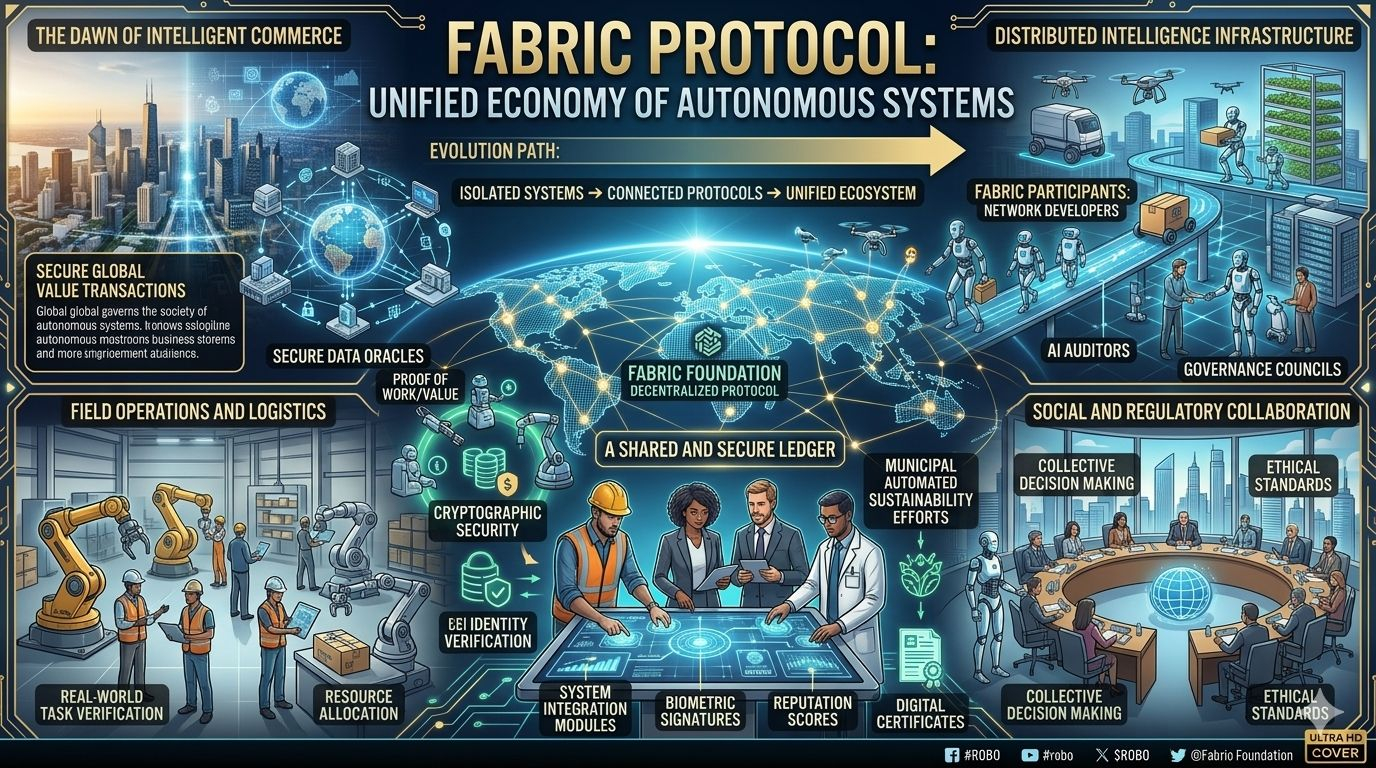
Fabric aims to do something similar for robotics.
In this ecosystem, robots can be assigned verifiable digital identities, almost like passports in a global network. That identity records their hardware capabilities, operational history, and performance data. Over time, a robot can develop a track record—proof that it successfully completed certain tasks or contributed useful information.
This might sound abstract at first, but reputation is one of the most important currencies in human economies. A skilled electrician earns trust by consistently doing good work. A reliable courier builds credibility by delivering packages on time. Fabric explores the idea that robots could accumulate similar reputational signals within decentralized networks.
Alongside identity comes something even more unusual: economic participation.
Through the network’s native token, known as $ROBO, machines operating within the ecosystem can theoretically receive and send payments tied to verifiable work. When a robot performs a task that can be validated—whether it’s inspecting infrastructure, collecting environmental data, or transporting goods—that activity can be recorded and rewarded through the protocol.
In other words, the machine is no longer just executing instructions; it is contributing measurable value inside a digital economy.
This concept sits at the intersection of several technological movements unfolding at once. Artificial intelligence has made robots far more capable of navigating unpredictable environments. Sensors and computer vision systems allow machines to interpret the world with increasing accuracy. Meanwhile, blockchain networks have demonstrated that decentralized systems can coordinate complex activity without relying entirely on centralized authorities.
Fabric blends these threads together.
Instead of treating robots as isolated tools, the protocol treats them as nodes in a network where data, computation, and physical action all interact. A robot gathering environmental data might contribute that information to a shared dataset. Another robot could use that data to plan efficient routes or maintenance schedules. Payments and verification occur through decentralized infrastructure, ensuring that contributions are recorded transparently.
This is sometimes described as the emerging “machine economy.” It sounds futuristic, but the basic idea is surprisingly straightforward. Machines perform services, machines generate data, and machines exchange resources with other machines. Humans remain deeply involved—not as replaced workers, but as architects of the systems that guide machine behavior.
Fabric’s design attempts to align incentives within this ecosystem. Developers building robotic applications may stake tokens to participate in the network. Organizations deploying robots use the token to coordinate tasks and compensate services. Communities holding tokens can participate in governance decisions about how the protocol evolves.
The goal is not simply to create another cryptocurrency project but to experiment with how robotic infrastructure might be governed collectively rather than controlled entirely by a few large technology companies.
Of course, turning this vision into reality will not be easy. Software can scale globally almost overnight, but robotics lives in the physical world. Machines require manufacturing, maintenance, power, and regulatory approval. Deploying a robot in a city street or a hospital environment involves safety standards and oversight that software developers rarely encounter.
There are also social questions that cannot be ignored. As robots become more capable, people naturally wonder how automation will reshape labor markets. Some worry about displacement, while others see opportunities for entirely new industries built around robotic services.
Fabric does not claim to solve those debates, but it does raise an important perspective: if robots are going to participate in economic systems, the structure of those systems matters. Open infrastructure could allow communities, developers, and smaller organizations to participate in the robotic economy rather than leaving control entirely in the hands of a few dominant companies.
Seen from this angle, the protocol feels less like a technical product and more like a social experiment about the future relationship between humans and machines.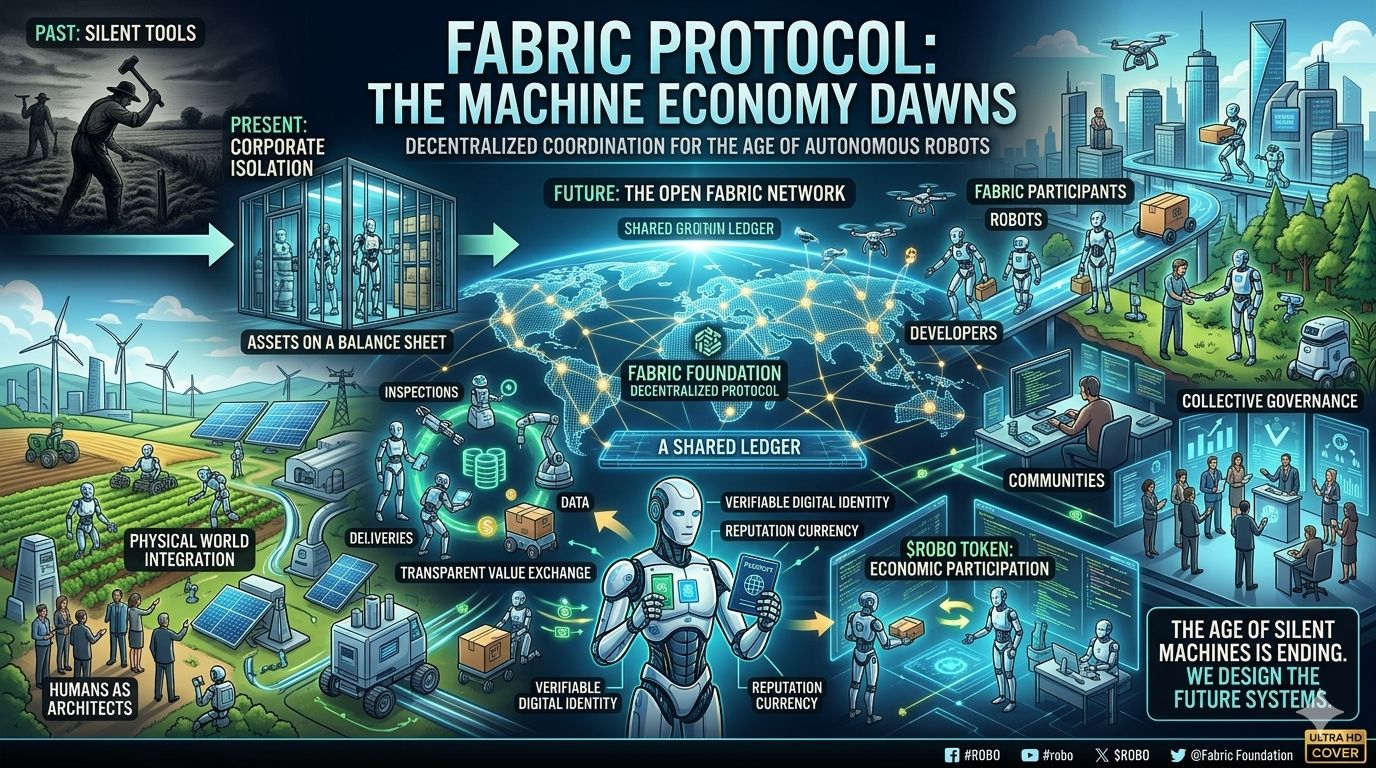
Imagine a world twenty years from now where robots maintain city infrastructure, monitor forests, deliver supplies to remote areas, and assist elderly populations. Instead of being owned exclusively by massive corporations, many of those machines could operate within shared networks where communities coordinate their use and share the benefits they generate.
A robot inspecting a bridge might submit verifiable proof of its work to a decentralized system. Payment could be triggered automatically. The data collected during the inspection might help engineers predict structural problems before they become dangerous. Each small action becomes part of a larger web of machine activity supporting human life.
This kind of future will not arrive overnight. It will grow slowly through experiments, prototypes, and early ecosystems that test whether decentralized coordination can actually function at the scale required for robotics.
Fabric Protocol is one of those early experiments.
Its significance lies less in the current state of the technology and more in the question it asks. For centuries, machines have amplified human productivity without participating in the systems that distribute the value they create. Now that machines are becoming more autonomous, society must decide how those systems should work.
Should robotic infrastructure belong entirely to centralized corporations, or should parts of it remain open and collectively governed?
Fabric offers one possible answer. It proposes that the robotic economy could be built on shared networks where machines, developers, and communities collaborate within transparent protocols.
Whether that vision succeeds will depend on technological progress, regulatory environments, and the willingness of people to experiment with new economic structures. But the idea itself reveals something important about the direction technology is moving.
The age of silent machines may be ending.
And the systems we design today may shape how humans and intelligent machines live, work, and create value together for generations to come.#ROBO #robo @Fabric Foundation $ROBO
