
A few days ago I watched a delivery rider outside a small shop trying to confirm a package pickup through his phone. The order was ready, the rider was there, and the shop owner was waiting. But the app kept refreshing without confirming the transaction. For a couple of minutes nothing moved. The product existed, the people involved were ready, and the job itself was simple. What was missing was the invisible layer that coordinates trust between all parties. Without that layer, even the simplest exchange becomes uncertain.
Moments like that remind me how much modern systems depend on coordination infrastructure that most people never see. Payment networks verify transactions. Logistics platforms confirm deliveries. Identity systems make sure the right person is performing the right task. These layers quietly sit underneath daily activity, making complex interactions between strangers possible.
That perspective is useful when thinking about something like Fabric Protocol.
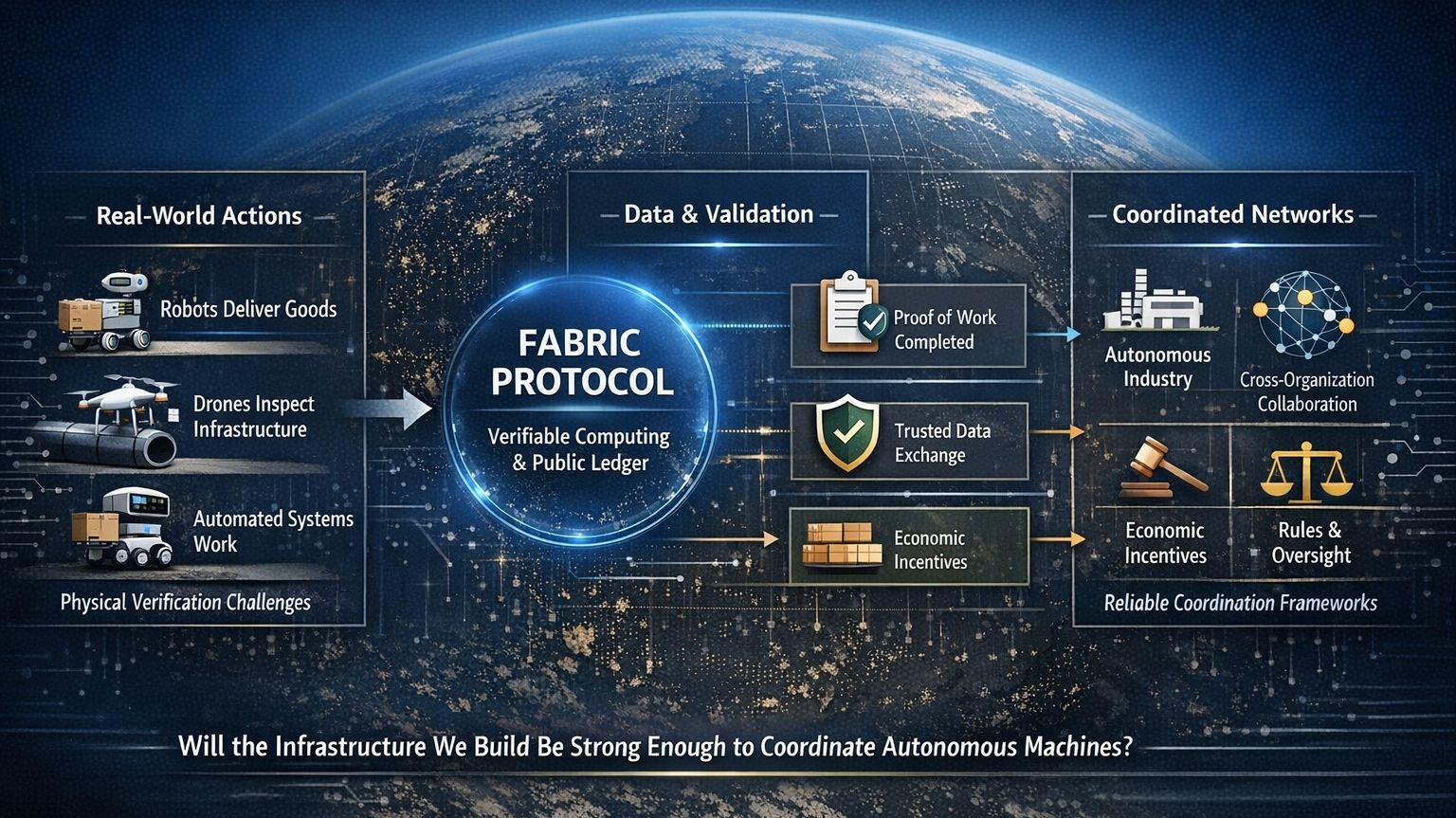
At its core, Fabric Protocol is trying to address a question that becomes more important as machines become more capable: how do autonomous systems coordinate work, prove that work was actually completed, and participate in economic systems without relying on a single central authority?
The project is supported by the Fabric Foundation, a non-profit organization, and it proposes an open network where robots, software agents, and human operators can interact through verifiable computing. Instead of relying entirely on centralized platforms to coordinate machine activity, Fabric attempts to create a shared infrastructure where data, computation, and governance can be recorded and verified through a public ledger.
In simple terms, the idea is to give machines a kind of operational framework. If a robot performs a task, the system should be able to verify it. If a machine generates data, others should be able to trust it. And if an automated agent creates value, there should be a reliable way for that value to be exchanged.
The logic behind this approach is easy to understand. Machines are increasingly performing tasks that used to require direct human supervision. Robots inspect infrastructure, autonomous vehicles transport goods, and automated systems handle digital operations. As these systems become more independent, they also become participants in economic activity.
But participation in an economy requires more than capability. It requires trust, verification, and coordination.
Fabric attempts to address this through what it calls verifiable computing and agent-native infrastructure. The idea is that machines can generate proofs about their computations or actions, allowing other participants in the network to verify outcomes without needing to fully trust the machine itself. In theory, this creates a system where robots can collaborate across organizations while maintaining a level of transparency and accountability.
Still, the concept becomes more complicated when it touches the real world.
Digital systems are relatively easy to verify because their operations happen entirely inside computation. Physical systems are different. A delivery robot might claim it reached a location. A drone might report that it inspected a pipeline. A warehouse robot might report that it sorted hundreds of packages. Recording those claims on a ledger is straightforward. Proving that the physical events actually occurred is much harder.
Industries that deal with physical verification already know this problem well. Logistics companies rely on sensors, audits, and multiple layers of monitoring to confirm events in the real world. Even with those safeguards, errors still happen. Sensors malfunction, data can be manipulated, and hardware fails in unpredictable ways.
Any network that tries to coordinate machines across environments will eventually face those same challenges.
Another issue that deserves attention is incentives. Systems rarely break because of technology alone. They break when participants find ways to exploit incentives that the designers did not anticipate. If a machine operator benefits from exaggerating productivity, the system must have mechanisms that discourage or detect that behavior. If data providers can submit inaccurate information without consequences, the reliability of the entire network declines.
Traditional institutions handle these risks through legal agreements, regulatory oversight, and economic penalties. A protocol like Fabric may automate some verification processes, but it cannot fully replace the broader institutional structures that enforce accountability.
This is where governance becomes an important piece of the puzzle. The fact that Fabric is supported by a foundation suggests that its creators are aware of the need for coordinated rule-making rather than purely automated systems. Infrastructure evolves over time, and governance structures determine how networks respond when unexpected problems appear.
History shows that successful infrastructure rarely emerges fully formed. The internet itself evolved through decades of experimentation, institutional negotiation, and technical revision. What began as a set of protocols eventually became a global coordination layer for communication.
Fabric appears to be attempting something similar, but focused on machine activity rather than human communication.
Of course, technical design alone does not determine whether infrastructure succeeds. Adoption is ultimately driven by economics. Companies will only integrate systems like this if they reduce operational friction, lower costs, or create new opportunities that did not exist before.
A logistics company might adopt such a network if it simplifies coordination between autonomous fleets. A manufacturing firm might find value if robots from different vendors can collaborate through a shared framework. A service platform might use it to verify automated work performed by distributed machines.
These are practical questions that can only be answered through real-world testing.
For now, Fabric Protocol looks less like a finished system and more like an early attempt to design infrastructure for a future where machines operate with increasing independence. The idea of giving robots verifiable identities and participation in economic networks is interesting, but it also introduces layers of complexity that are easy to underestimate.
Personally, I see Fabric as a thoughtful experiment rather than a guaranteed solution. The challenge it addresses is real: machines are becoming economic actors, and the systems that coordinate them will eventually need to evolve. Whether Fabric becomes that coordination layer will depend less on theory and more on how it performs under real-world pressure.
If it can prove reliability, handle adversarial conditions, and align incentives between participants, it may become a meaningful piece of machine infrastructure. If not, it will still have contributed something valuable by pushing the conversation forward about how humans and machines might coordinate in the decades ahead.
Fabric Protocol might become a foundational layer for that world, or it might simply be an early blueprint others improve upon. Either way, experiments like this are where tomorrow’s infrastructure quietly begins.
@Fabric Foundation #ROBO $ROBO
