
As technology evolves at an incredible pace, robotics is becoming one of the most transformative innovations of the modern era. From manufacturing lines and warehouse logistics to healthcare and transportation, robots are increasingly becoming part of everyday systems. However, one major challenge remains: how to coordinate, manage, and improve robotic systems on a global scale.
This is where Fabric Foundation and its project Fabric Protocol aim to make a significant impact. The protocol introduces a decentralized infrastructure designed to support the development, coordination, and governance of robotic systems worldwide.
A New Approach to Robotics Development
Traditionally, robotics development has been dominated by a small number of large companies. These organizations often build closed ecosystems where innovation happens internally, limiting collaboration and knowledge sharing.
Fabric Protocol proposes a different model. Instead of centralized control, it promotes an open and decentralized ecosystem where developers, researchers, startups, and communities can collaborate. This approach encourages faster innovation and allows contributors from different parts of the world to participate in building advanced robotic technologies.
By enabling open participation, the protocol could accelerate progress in robotics and reduce barriers for smaller teams or independent developers who want to build new robotic applications.
Interoperability Between Robotic Systems
One of the most important challenges in robotics today is interoperability. Robots are built using different hardware, software frameworks, and operating systems. As a result, systems often struggle to communicate with each other.
Fabric Protocol focuses heavily on solving this issue by creating standardized frameworks that allow different robotic systems to communicate and cooperate. Whether robots are used in logistics warehouses, hospitals, or smart transportation networks, interoperability ensures they can operate within the same environment efficiently.
This capability could be particularly valuable in industries such as:
Manufacturing automation
Supply chain and logistics
Healthcare robotics
Autonomous transportation
If successful, Fabric Protocol could help create a shared robotic ecosystem where machines work together rather than operating in isolated systems.
Transparency and Verifiable Computation
As robots begin to perform more critical tasks, trust becomes an essential factor. Businesses and users need assurance that robotic operations are reliable and that computations performed by machines are accurate.
Fabric Protocol aims to address this challenge by introducing verification mechanisms that allow robotic actions and computations to be validated. This means participants in the network can confirm that a robot performed a task correctly without relying on centralized authorities.
Such transparency could play a key role in building trust across industries where robotics is used for important operations.
Global Collaboration and Open Innovation
Another important goal of Fabric Protocol is to encourage global collaboration. By creating an open infrastructure, the protocol allows different stakeholders to contribute to its development.
Participants could include:
Robotics engineers
AI researchers
Technology startups
Academic institutions
Open-source communities
Through this collaborative environment, new robotic applications and tools could emerge faster than in traditional development models.
Collective Learning for Robots
One particularly interesting idea within the Fabric ecosystem is the possibility of collective learning. Robots connected to the network may be able to benefit from knowledge generated by other robots.
For example, if one robotic system learns how to optimize a specific task, that information could potentially be shared across the network. This would allow robots to improve more quickly and become more efficient over time.
Such a distributed learning approach could significantly accelerate progress in robotics and artificial intelligence.
The Concept of a Robotic Marketplace
Fabric Protocol also explores the idea of a robotic marketplace. In this environment, robotic services, data, and computational resources could be exchanged between participants.
This marketplace could enable:
Robots to access specialized services
Developers to monetize robotic algorithms
Organizations to share robotic capabilities
The network’s ecosystem is connected to the ROBO token, which may be used for transactions, incentives, and governance within the protocol.
A Vision for the Future
The long-term vision of Fabric Protocol is to build a world where robotics systems are open, collaborative, and transparent. Instead of isolated machines controlled by centralized companies, robots could operate within a decentralized network that supports verification, coordination, and continuous improvement.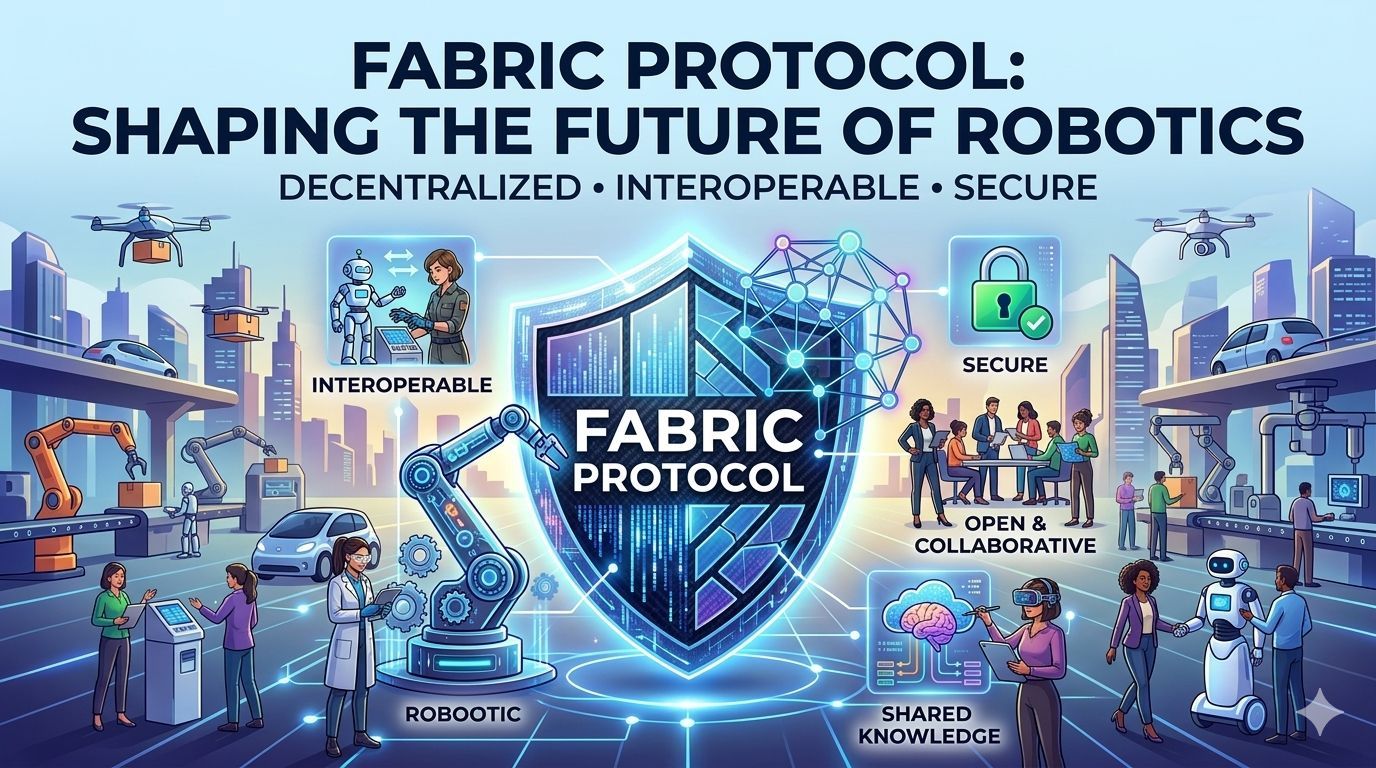
If this vision becomes reality, Fabric Protocol could play an important role in shaping the next generation of robotics and automation technologies.
As industries continue to adopt automation, projects like Fabric Protocol may help create a global infrastructure where robots are able to work together, learn from each other, and contribute to technological progress.#robo $ROBO @Fabric Foundation