Look, I’ve seen this movie before.
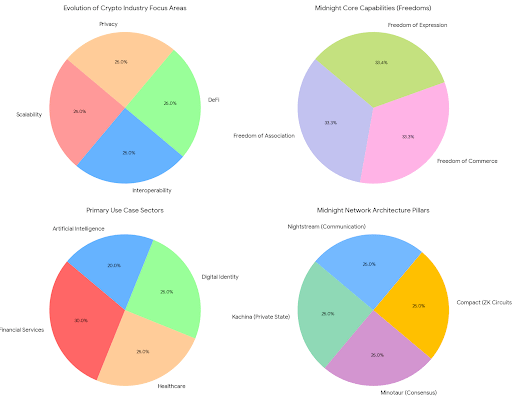
Every few years the crypto industry discovers a new problem it suddenly claims to fix. Scalability. Interoperability. Decentralized finance. Now it’s privacy. This time the banner reads Midnight Network, a blockchain built around zero-knowledge proofs that supposedly lets systems operate publicly without revealing sensitive data.
It sounds tidy. On paper, at least.
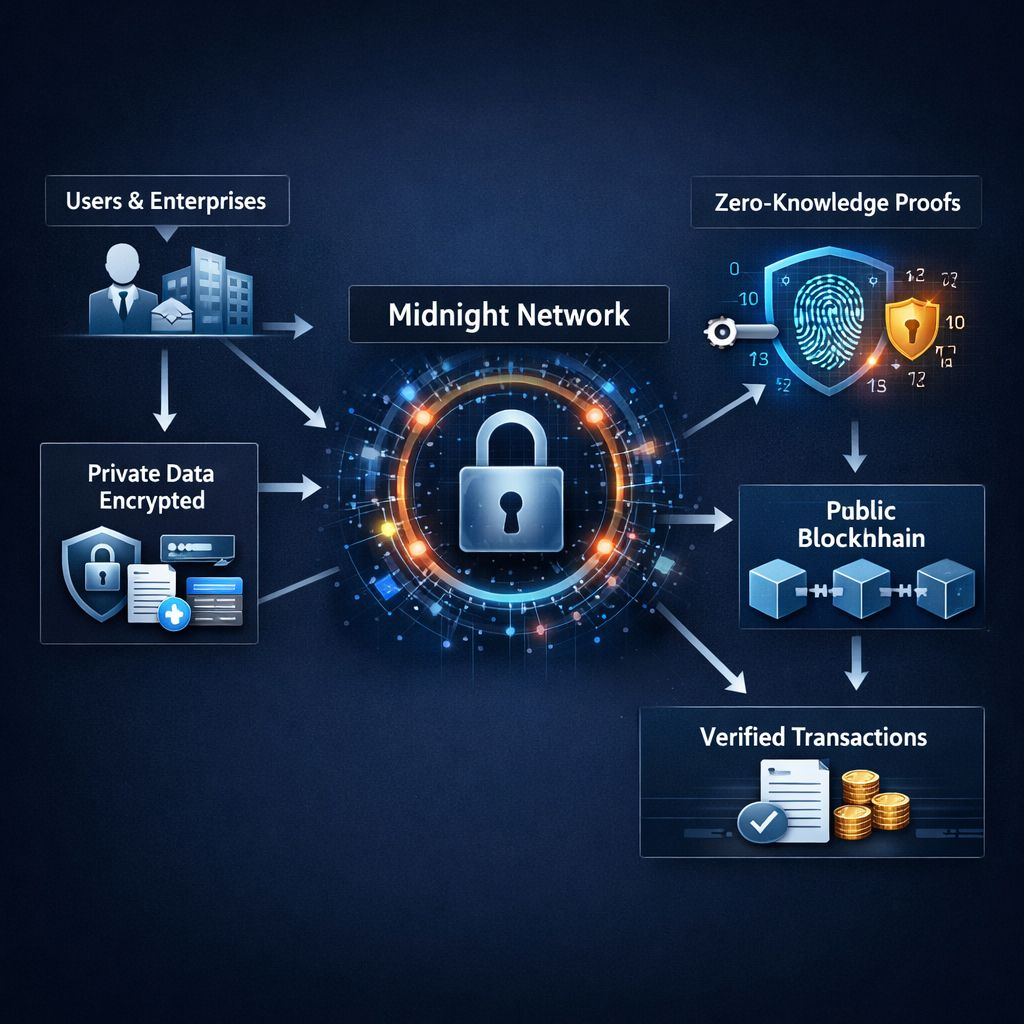
A blockchain where companies can transact, verify rules, and coordinate systems without exposing their data to the entire internet. Compliance without disclosure. Transparency without transparency. The pitch practically writes itself.
But when something sounds that neat in crypto, it usually means the hard parts are being quietly pushed offstage.
Let’s start with the core problem they say they’re solving.
Public blockchains are radically transparent. Every wallet balance, every transaction, every contract call sits there for anyone to inspect. That’s great for verifying the system works. It’s terrible for businesses. No serious company wants its financial flows, supplier relationships, or internal operations permanently visible on a global ledger.
Banks can’t do it. Corporations won’t do it. Governments absolutely won’t do it.
So the industry keeps circling the same idea. What if you could keep the blockchain, but hide the data?
That’s where Midnight steps in. The project leans heavily on zero-knowledge cryptography, which allows someone to prove that something is true without revealing the information that proves it. Instead of showing the network the transaction details, you show it a cryptographic proof that the transaction followed the rules.
The network checks the math.
Not the data.
On a whiteboard, it looks elegant. A perfect compromise between transparency and privacy. But systems don’t live on whiteboards.
They live in messy infrastructure, human organizations, and regulatory frameworks that rarely cooperate with theoretical elegance.
Here’s the first crack in the story.
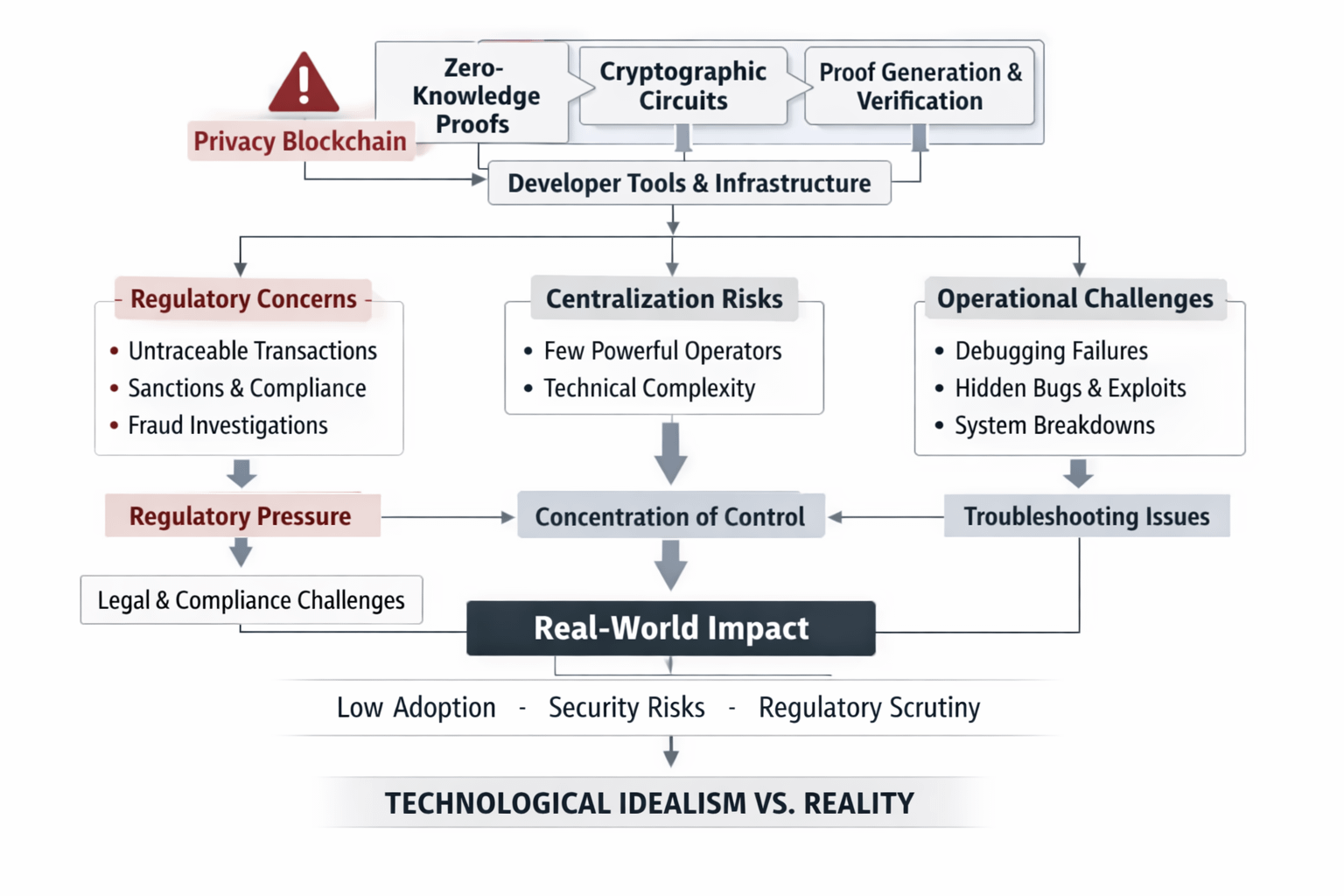
Zero-knowledge proofs are computationally heavy. Generating them takes serious processing power. Verifying them adds overhead. The more complex the application becomes, the more expensive the proof generation process tends to be.
So the “solution” to blockchain transparency is essentially this: wrap the entire system in layers of cryptographic machinery so the network can confirm something happened without seeing what happened.
Which sounds clever.
Until you realize what that actually means in practice.
More complexity.
More computation.
More ways for things to break.
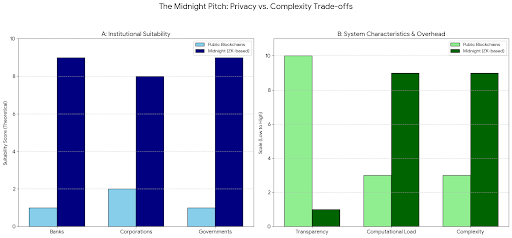
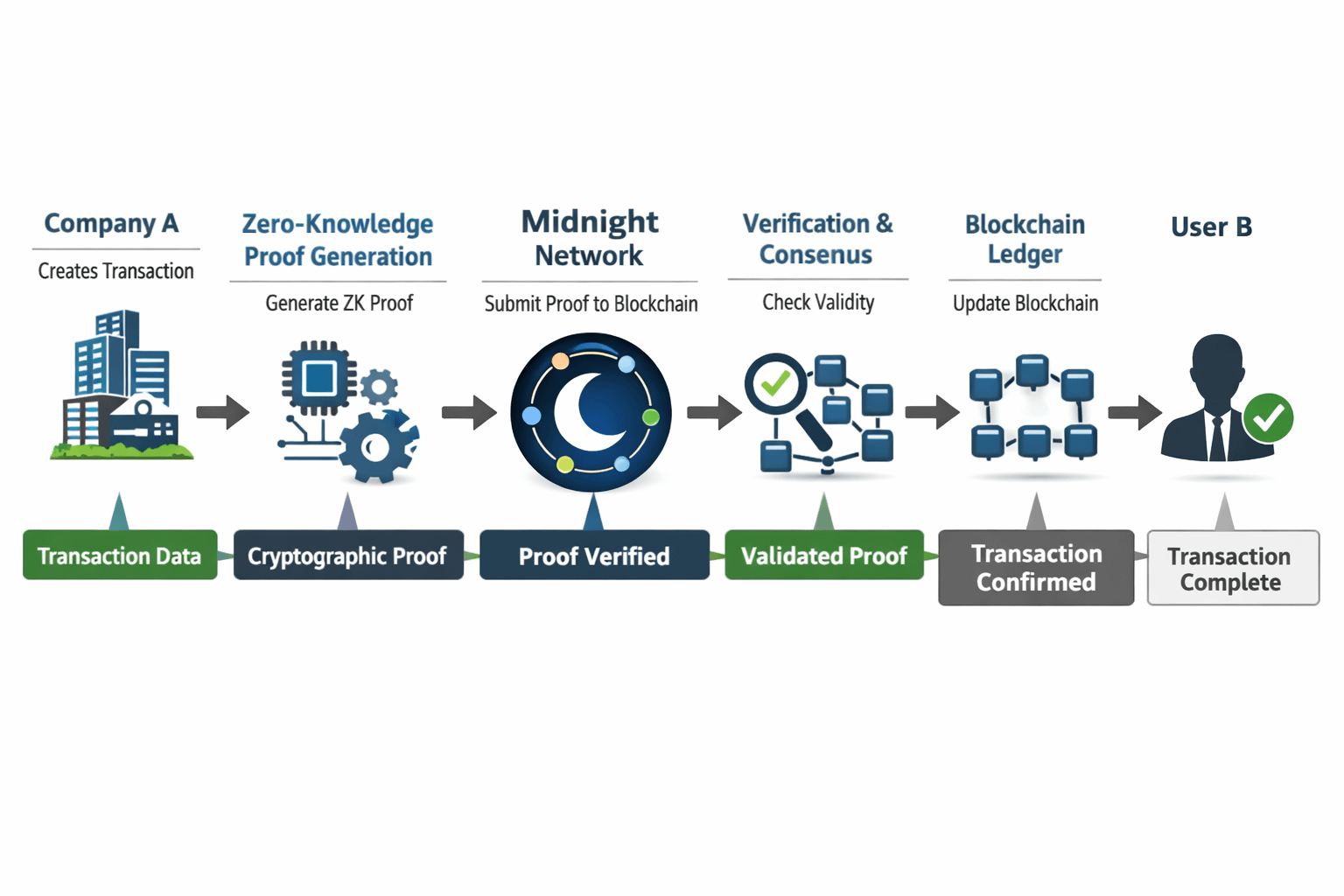
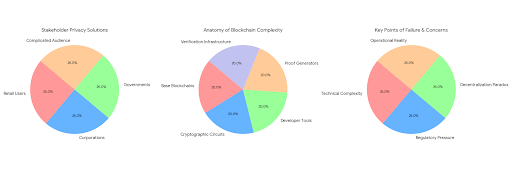
Blockchains were already complicated systems. Now imagine adding entire frameworks of cryptographic circuits on top of them, plus developer tools, plus proof generators, plus verification infrastructure. Every layer meant to solve one weakness introduces two new points of failure.
I’ve watched this pattern repeat for two decades in tech.
Elegant systems collapse under operational reality.
And then there’s the incentive question, which the marketing brochures rarely linger on.
Who actually needs this?
Retail users already get privacy from banks and payment processors. Corporations keep their data in private databases. Governments demand audit trails. Most industries prefer systems where someone is clearly responsible when things go wrong.
So the audience for privacy-heavy public blockchains becomes… complicated.
Because the groups that truly need untraceable financial infrastructure are not usually the ones regulators feel comfortable supporting.
Which brings us to the next problem: regulation.
Crypto privacy technologies tend to make regulators nervous. Not mildly nervous. Extremely nervous. Financial systems are required to track money flows, enforce sanctions, and investigate fraud. If transactions become mathematically verified but practically invisible, regulators start asking uncomfortable questions.
And when regulators start asking uncomfortable questions, projects often discover how little “decentralization” protects them.
Then there’s the decentralization story itself.
Most blockchain networks claim to be distributed. In reality, the infrastructure often ends up concentrated among a small number of technically sophisticated operators. With zero-knowledge systems, that concentration risk gets worse, not better.
Running the infrastructure required to generate and verify these proofs isn’t trivial. It favors organizations with serious technical resources. Over time, that tends to pull power toward a handful of operators who can actually maintain the system.
So you start with a promise of decentralization.
You end up with a handful of entities running the complicated machinery while everyone else just uses the interface.
Again. I’ve seen this before.
And finally there’s the human problem. The one engineers tend to underestimate.
What happens when something breaks?
Because complex systems always break eventually. Code has bugs. Cryptographic assumptions fail. Economic incentives get exploited. Someone discovers an edge case nobody predicted.
When that happens inside a privacy-heavy blockchain, diagnosing the issue becomes harder. The very feature designed to hide sensitive information can make debugging failures far more difficult.
You can’t easily inspect the data.
You can only inspect the proof.
That’s a lovely idea in theory. It becomes a headache when the system starts behaving in ways nobody understands.
Look, none of this means the cryptography isn’t impressive. It is. The mathematics behind zero-knowledge proofs is some of the most fascinating work happening in computer science right now.
But impressive math and practical infrastructure are two very different things.
Crypto has spent fifteen years building increasingly complicated ways to solve the problems it created for itself. Midnight Network may genuinely push the technology forward. It may produce useful research. Some developers will certainly build interesting experiments on top of it.
But the industry has a habit of mistaking technical cleverness for real-world demand.
And when you strip away the glossy diagrams and carefully worded promises, Midnight still rests on a very old assumption.
That if you add enough cryptography to a blockchain, the real world will eventually bend around it.
History suggests the real world usually does the opposite.