In the exploding intersection of AI, robotics, and blockchain, Fabric Protocol stands out as a foundational layer for what many are calling the "robot economy" — a world where general-purpose robots aren't just tools but autonomous economic actors that can coordinate, earn, transact, and evolve independently.Powered by the Fabric Foundation (a non-profit overseeing long-term development) in close partnership with OpenMind (the core contributor building the OM1 open-source OS for intelligent machines), Fabric creates decentralized infrastructure for robot identity, coordination, verifiable computing, and secure machine-to-machine interactions. Think of it as the "nervous system" or peer-to-peer backbone (like a decentralized GPS + VPN + handshake) that lets AI-powered robots verify identities, share context, execute tasks trustlessly, and participate in real-world economies — from household assistants to industrial fleets.What makes ROBO truly unique is its role as the utility and governance token fueling this entire ecosystem:
Utility: ROBO powers payments for robotic services and tasks, network fees, staking (e.g., robot operators stake as "work bonds" to register hardware and gain priority), and incentives via mechanisms like Proof of Robotic Work (PoRW). It creates a self-sustaining loop where robots earn $ROBO for completed verified tasks, humans/developers get rewarded for building/upgrading models or providing compute, and the network burns fees or buys back tokens from revenue to drive deflationary pressure.
Governance: Holders vote on upgrades, fee structures, economic parameters, and protocol evolution — ensuring alignment across humans, developers, and machines.
Incentives Alignment: ROBO bridges the gap in a multi-sided economy: robot owners/operators earn from physical labor/output, developers contribute AI models/OS improvements, and the protocol rewards verifiable contributions. With a fixed 10B total supply (circulating ~2.2B as of mid-March 2026), protocol revenue supports buybacks, creating long-term demand.
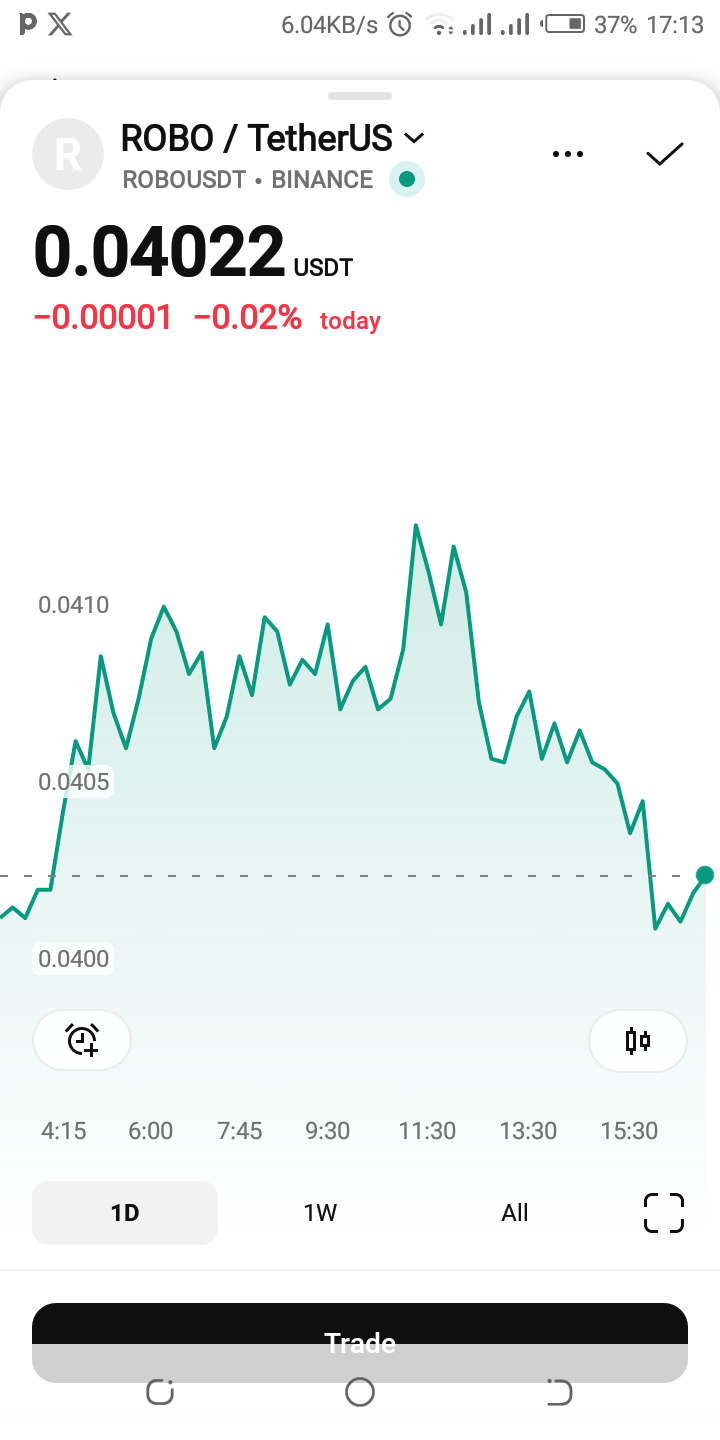
As of March 15, 2026, ROBO trades around $0.040–$0.041, with a market cap of ~$90–92M (FDV ~$410M), 24h volume in the $30–40M range, and recent listings on major exchanges like Binance (with Seed Tag), and others boosting liquidity. The narrative is red-hot amid 2026's physical AI boom — autonomous agents, humanoid robotics (e.g., integrations with partners like UBTech), and DePIN trends where machines become first-class participants.Community momentum is surging on Binance Square via the active CreatorPad campaign, where verified creators post quality content about Fabric/ ROBO compete for token rewards (similar to recent drives unlocking shares of millions in tokens). This is drawing eyes from builders and traders betting on robotics as the next trillion-dollar frontier beyond pure software AI.Fabric's vision isn't hype — it's infrastructure for safe, open, human-aligned robot integration into everyday life. With OpenMind's OM1 enabling cross-platform robot intelligence and Fabric handling the economic/governance layer, ROBO sitions itself as the "hard currency" for automated productivity. Early movers see massive upside as adoption grows.Bullish on robots going on-chain? $RO$ROBO ld be the underrated play in physical AI.
What’s your take — stacking for the robot revolution or waiting for more real-world integrations?#ROBOEurope #robo #EuropeanCrypto #CryptoEurope #ROBOTradersEU @Fabric Foundation $ROBO