
The further I was seated with Fabric testing the less was I concerned with the pitch of the robots and the more was a quieter trouble harassing me.
Permissions.
Not the stifling app-settings meaning. In the real-world sense. What is permitted a machine to do. Where it is allowed to do it. Who recognizes that right. Who can revoke it. What occurs when the machine is moving out of one environment and into another. What is transferred, and what is pushed out into manual control.
It is where the entire story began taking a new form in my mind.
So many robot stories continue to have the capability sound like the tough one. Make the machine, enhance the logic, save in hardware cost, and other things would follow. The farther I stared at it the less plausible that seemed. It can be a machine that is helpful and yet becomes operationally awkward as soon as its permissions cease to be evident.
There the friction begins to be felt.
A robot can be capable of doing the job. It does not imply that it has the prerogative to get into the workflow surrounding the task. Can it access the location. Can it trigger the service. Can it settle the action. Will another player have faith in the boundary it is operating within. Does the machine have the known permissions of more than one private system to execute, or must all still be hand wrapped, hand approved, and hand interpreted.
That is not a side issue. It alters the native or fragile feeling of machine work.
What continued to appeal to me was the extent to which the activity of the present-day robots remain in the realm of something that only endures because a company is hovering over it and sewing the approval all together under the carpet. The robot walks though the control surrounding the robot is still manual. It has already been determined by somebody where it can go, what it can touch, what it can trigger and how exceptions are processed. That functions within a closed circuit. It begins to be thin as soon as you start to envision machine labor spreading to more participants, more setting, and more commercial relations.
It is at that point that Fabric began to seem interesting to me.
No, it did not exaggerate the robot tale. It complicated the problem of hidden boundaries since it could no longer be neglected.
The further I stared at it the less the project made me think the robots were about to be amazing and more so the robots would like a better means to coexist within a common framework. Not just identities. Not just payments. Permissions. The authority to operate within a process in a workflow without all the steps being reverted to individual, manual control.
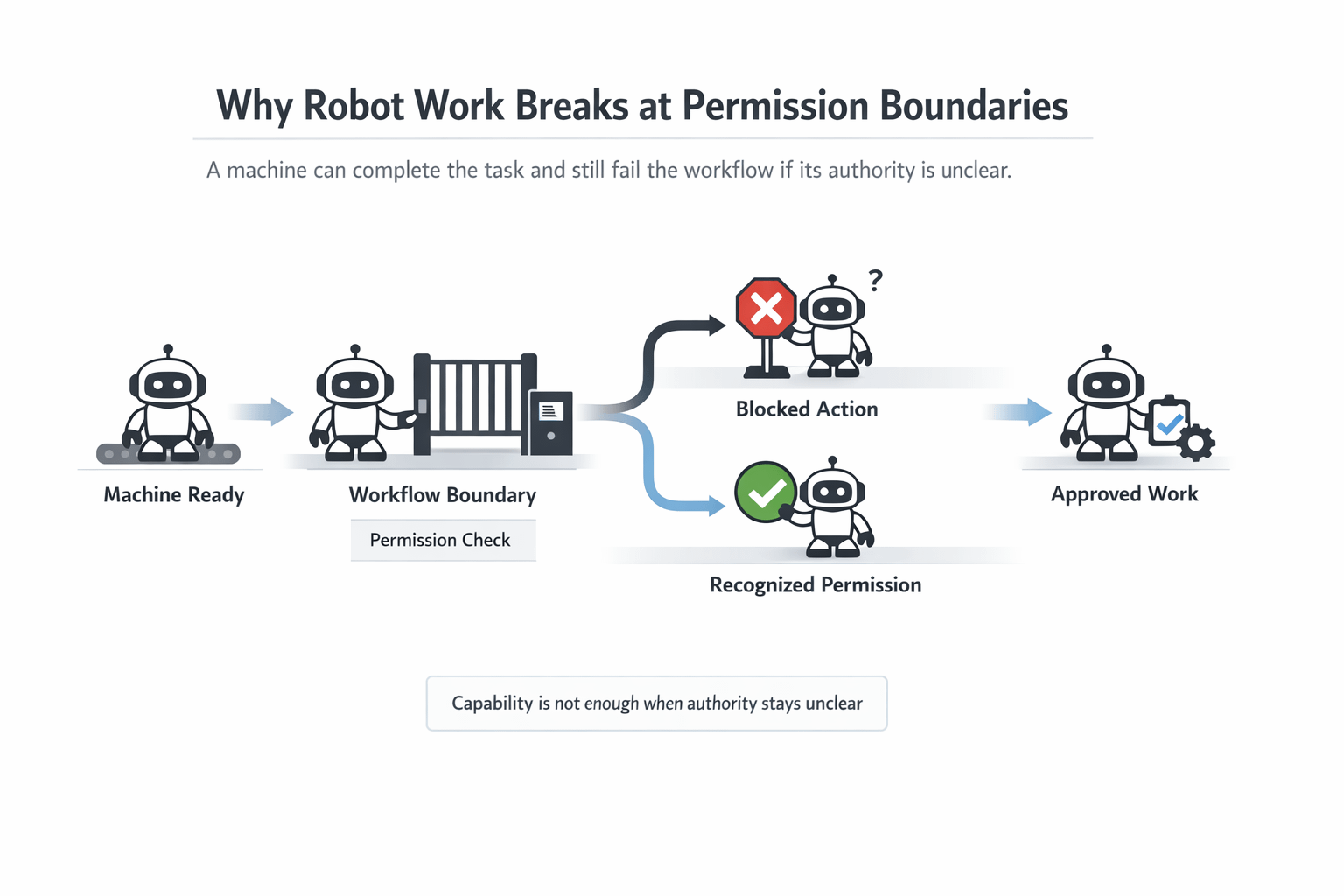
This altered my approach to reading the entire category.
I ceased to ask the question whether a machine could do useful work. I began inquiring as to whether the machine could not perform beneficial work without dragging some human permission layer behind it in the process. That is an even more awkward question, as it renders much of the so-called autonomy look as thin as the title makes it sound.
A machine may be independent in movement and even rely in composition.
That difference matters.
When authorizations are locked up in a small number of silos, machine work will always remain fragile. A machine may be trusted by one of the operators. Another may not. A single environment can accept its role. The other can push the entire process all the way back with manual inspections. A single workflow can be used to settle the service by the machine. The other can consider it as a mistrusted actor which requires human wrapping around all the important things.
It is at this point that scale begins to lose its expansionary appearance and resemble a repetitive re-authorization.
And it is costly re-authorization.
It slows task flow. It narrows participation. It continues to render the machine not a genuine economic agent and makes it appear more a helpful instrument which nevertheless is incapable of moving freely within a larger framework. The longer I sat there with that, the more it began to look like one of the actual bottlenecks of the story of robot-economy.
That too transformed my perception of $ROBO .
I no longer viewed it as a part of a theme when this permissions layer clicked. The more applicable lens turned to be whether the token is near the segment of the system the machine activity is made known, channeled and established within clearer demarcations. Borrowing attention to AI is a far less interesting job than that.
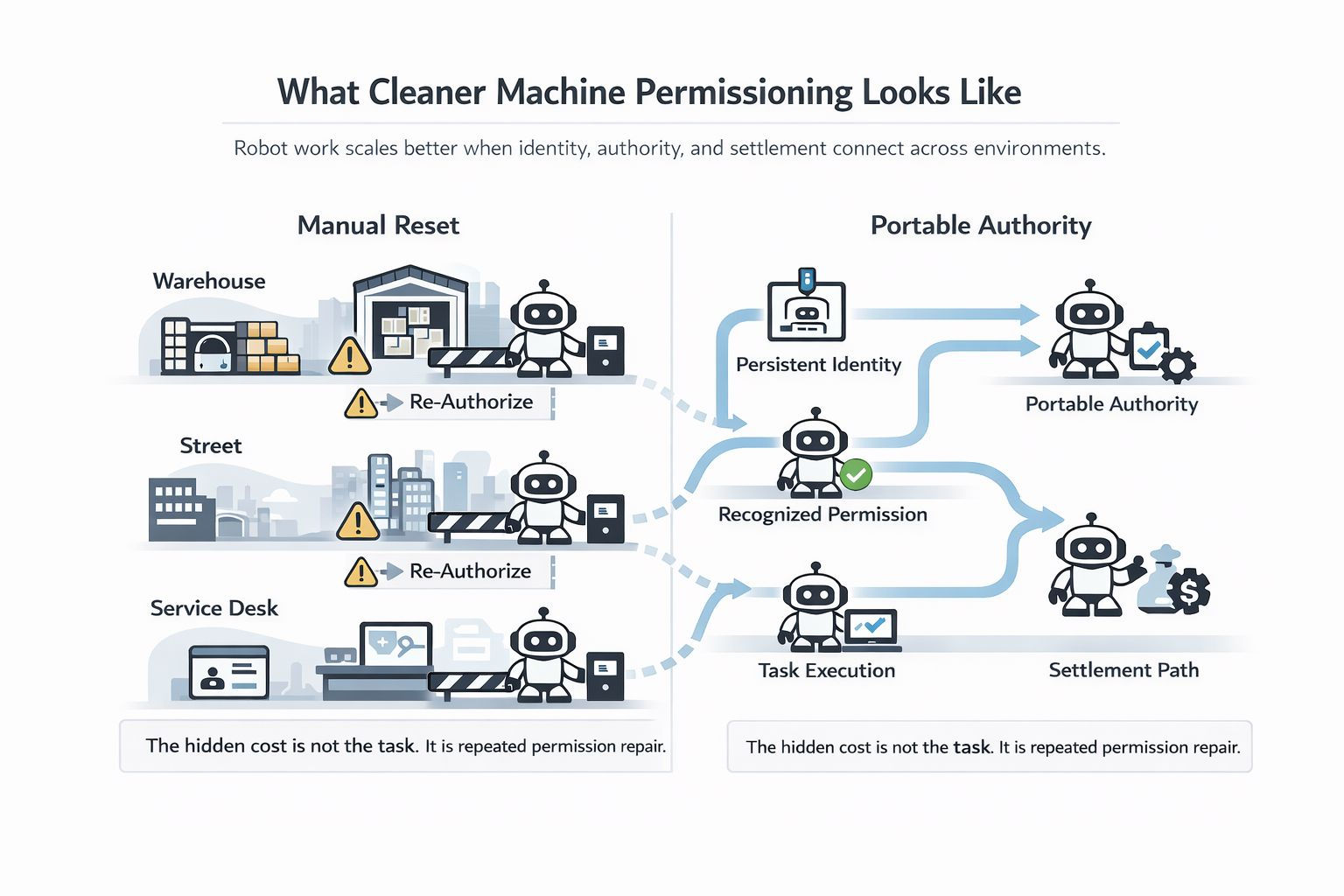
Even now it does not make the thesis easy.
As a matter of fact, this is precisely such a notion that sounds fancy until the problems start appearing. The permissions can be defined in a clean diagram. When machines switch among the participants having varying incentives, varying standards and varying risk tolerance, they become harder. It is the section that I would continue watching. Does the system render machine participation to cross the boundaries cleaner or does the identical manual overhead insidiously creep back in? Do permissions get more transportable or are they confined within the loop with whichever operator that already owns the loop? Will robot work start to be felt by the rest of the system around it, or will it continue to rely on secretive human work by stitching?
Those were the questions that remained in my head as compared to the common robotics talking points.
Since I had begun to view the category in terms of permissions, much of machine labor no longer seemed as mature as it initially seemed. The machine may be capable. The task may be real. The output may be useful. However, when the power surrounding the machine is still reinstated each time the environment is altered, then the economy surrounding that work remains small and delicate than individuals believe.
This is the reason why Fabric attracted my attention.
It is not that the story of robots is difficult to locate.
Since permissioning is like one of those unsightly infrastructure issues which everybody relies upon and almost no-one would prefer discussing, unless it has begun to scale.
And the more I saw it, the more that began to look like the actual issue beneath the surface.
@Fabric Foundation #ROBO $ROBO
