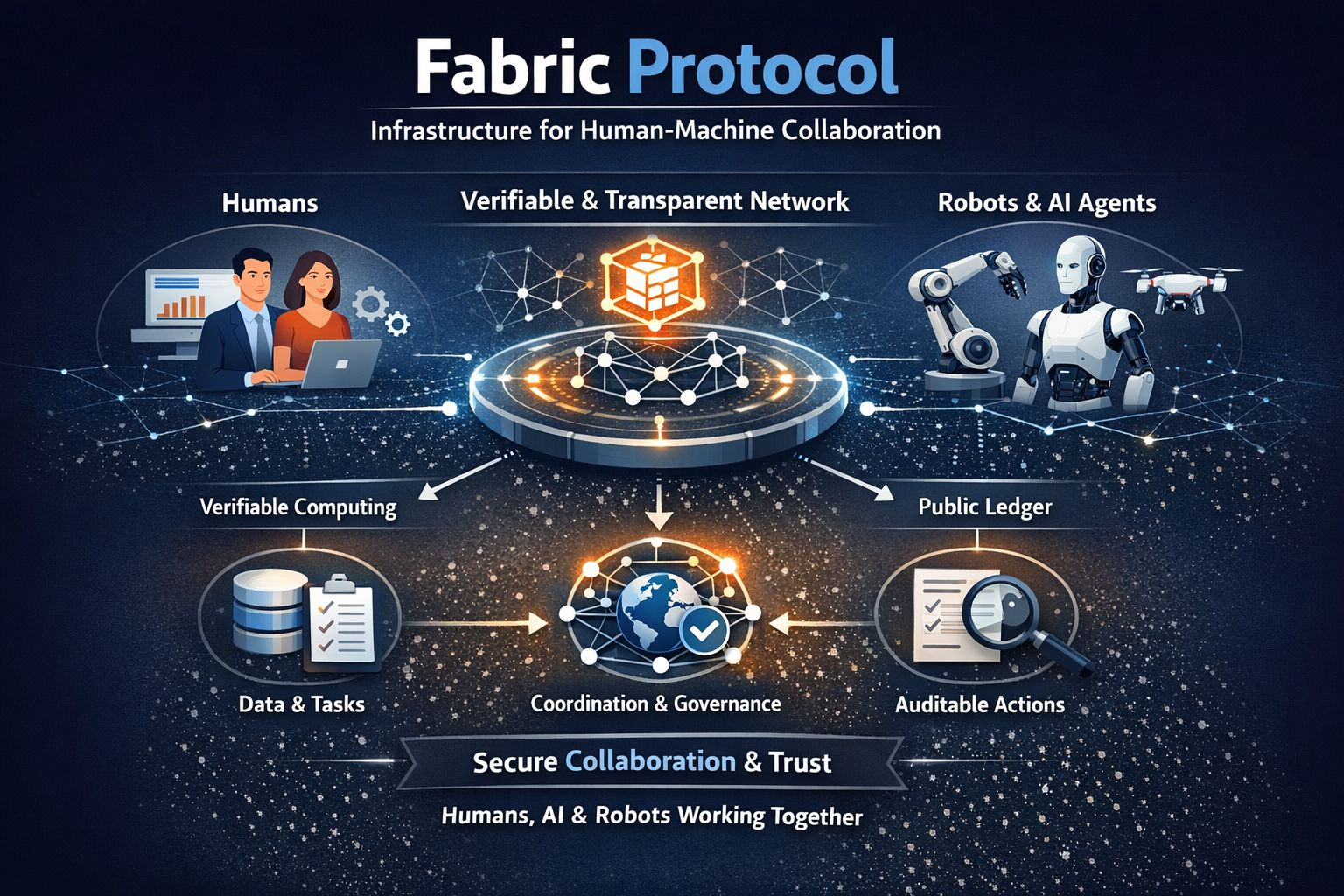
The Next Challenge for Digital Networks
As artificial intelligence and robotics evolve at an extraordinary pace, digital infrastructure is entering a new era. Until now, networks have primarily been designed for human users. But the future will likely look very different.
Soon, autonomous AI agents, robots, and intelligent systems may become active participants in digital networks—interacting with services, exchanging information, and even making decisions independently.
This shift introduces a critical question:
How can machines participate in networks in a way that is transparent, verifiable, and governed responsibly?
Addressing this challenge may become one of the most important technological problems of the coming decade.
Introducing Fabric Protocol
While exploring this topic, I came across @Fabric Foundation Protocol, an initiative backed by the Fabric Foundation that aims to build the infrastructure for a future where humans and machines collaborate seamlessly online.
At its core, Fabric Protocol is designed as a global open network where developers, organizations, and communities can build and coordinate general-purpose robotic and autonomous systems.
The vision is ambitious:
Create a digital environment where humans, AI agents, and machines can operate within the same infrastructure while their actions remain transparent and verifiable.
Verifiable Computing: Trust for Machine Activity
One of the biggest challenges with modern AI systems is opacity. Many decisions made by AI models happen inside black boxes that cannot easily be inspected or verified.
Fabric attempts to solve this using verifiable computing combined with a public ledger.
This approach enables:
Machine-generated computations to be cryptographically verified
Activity and data to be audited by the network
Decisions made by autonomous systems to be transparent and accountable
Instead of trusting closed platforms, participants can rely on open infrastructure where machine actions can be validated by anyone.
This creates a foundation of trust, which is essential if autonomous systems are going to operate widely across industries.
An Agent-Native Network
Another distinctive feature of Fabric Protocol is its agent-native architecture.
Most existing networks were designed for humans first and only later adapted for automation. Fabric flips that model.
The network is built from the ground up for autonomous agents.
This means AI agents and machines can:
Interact with each other directly
Exchange data and services
Coordinate tasks
Operate under shared and verifiable rules
Because these interactions occur within the network’s framework, every action can be validated and governed collectively.
Why This Matters for the Future of Automation
Automation is expanding across nearly every industry—from logistics and manufacturing to healthcare, finance, and digital services.
As machines become more capable, they will increasingly need to coordinate with humans and with other machines.
But without the right infrastructure, this coordination could become chaotic, opaque, or unsafe.
Protocols like Fabric aim to provide:
Transparency
Accountability
Governance
Trust
These qualities are essential if society is going to integrate large-scale autonomous systems into everyday operations.
The Next Evolution of Web3
For years, much of the conversation around Web3 has focused on finance, tokens, and digital ownership.
Fabric suggests a broader possibility.
The next phase of Web3 could evolve into something much larger:
a global trust and coordination layer for intelligent machines.
If that vision becomes reality, digital networks will not just connect people.
They will coordinate entire ecosystems of humans, AI agents, and robots working together.