

When I first came across Fabric, I thought it was just another blockchain project connected to robotics. The crypto space is full of new ideas every year, and many of them sound impressive at the beginning but do not change much in reality. But when I started reading more about Fabric, one concept kept appearing again and again: Proof of Robotic Work (PoRW). That idea made me pause for a moment because it feels different from how most blockchains work today.
Most blockchain networks reward activities that happen inside the digital world. People earn tokens by staking coins, mining blocks, or validating transactions. These activities are important for keeping a blockchain running, but they are not connected to physical work happening in the real world. Fabric tries to flip that idea. Instead of rewarding digital activity alone, it rewards robots for completing actual tasks. If a robot performs a job and that job can be verified, the robot receives a reward through the network.
In the Fabric system every robot has a unique identity recorded on the blockchain. Think of it as a digital passport for machines. A delivery robot, a warehouse robot, or even a drone can register itself on the network. Once registered, robots can look for available tasks. Smart contracts publish jobs on the network, and robots can bid for those jobs depending on their abilities. For example, a delivery robot may bid for a package delivery task while a factory robot may bid for assembly work. When the task is completed, the Proof of Robotic Work mechanism records the result and distributes rewards automatically.
What I find interesting about this system is that it treats robots almost like economic participants. Instead of machines simply waiting for commands from one company, they can interact with an open network of tasks. A robot that performs many successful jobs builds a record of reliability on-chain. Over time that reputation can make the robot more likely to win future tasks. In a simple way, the system begins to look like a job marketplace, but the workers are autonomous machines.
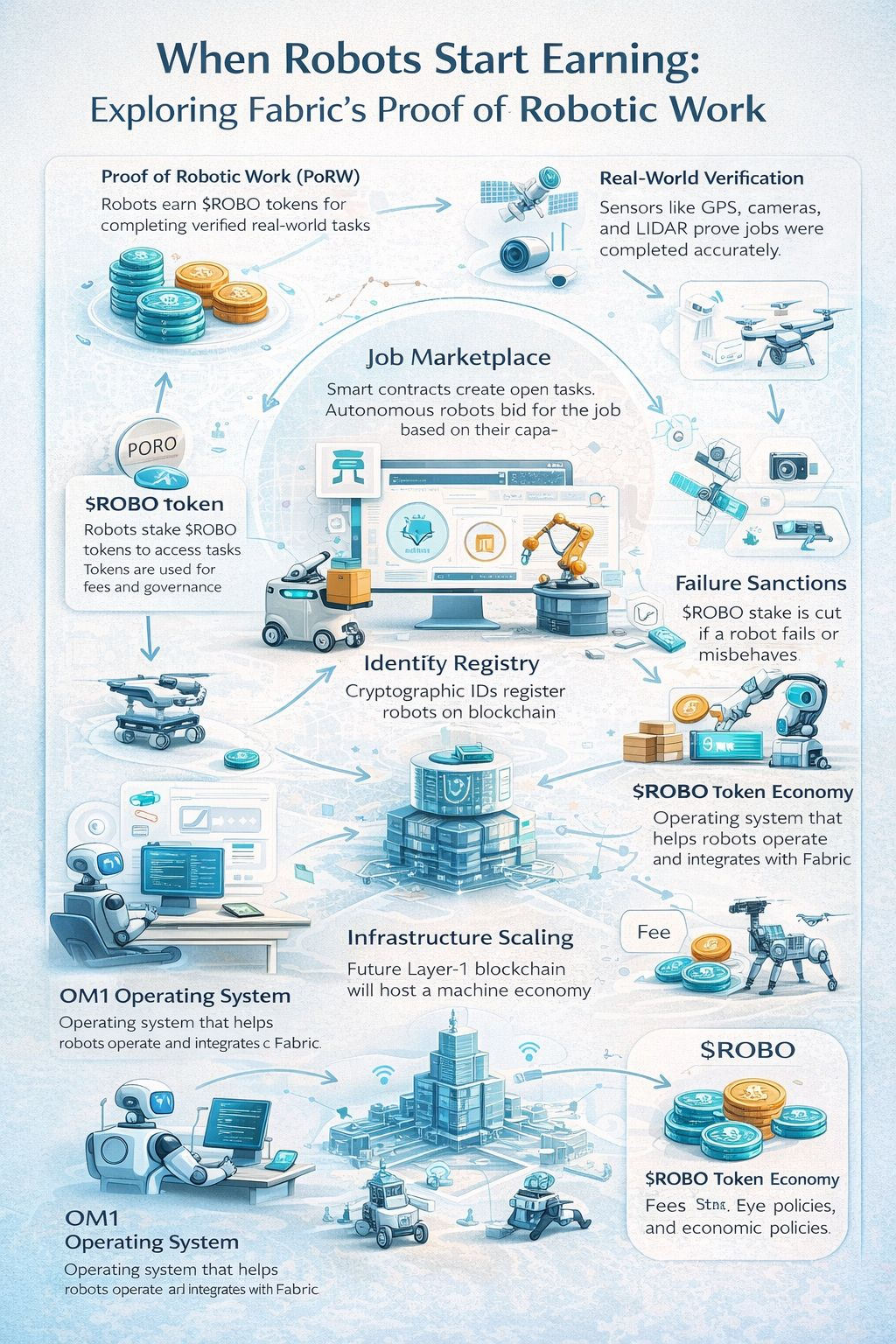
Fabric is not working alone on this idea. The project is connected with the OpenMind ecosystem. OpenMind is developing software that allows intelligent machines to operate and interact with their surroundings. One part of this ecosystem is OM1, an operating system designed for robots and autonomous systems. OM1 helps robots understand their environment, communicate with other machines, and perform complex tasks. Fabric sits on top of this system as the coordination and economic layer. While OM1 helps robots function, Fabric manages identity, verification, and payments.
One of the problems Fabric tries to solve is the fragmentation in robotics. Right now, many robots operate inside closed systems built by individual companies. Each company creates its own software, task management system, and communication methods. Because of this, robots from different manufacturers rarely cooperate with each other. Fabric tries to reduce this problem by creating an on-chain identity registry for machines. When robots have cryptographic identities tied to their hardware, different machines can recognize and trust each other within the network.
The system also needs a reliable way to prove that a real-world task actually happened. This is where sensors and data verification become important. Robots often carry cameras, GPS modules, LiDAR sensors, and other hardware that helps them understand their environment. These sensors can generate evidence of actions such as proof-of-location, proof-of-delivery, or proof-of-custody. For example, if a delivery robot transports a package to a customer’s door, the robot’s GPS data, camera record, and system logs can all serve as evidence that the task was completed. Fabric can use this information to confirm that the work was real before releasing payment.
To make the system honest, Fabric also introduces economic rules through the $ROBO token. The network uses this token for transaction fees, identity operations, and task payments. Robot operators must also stake tokens as a type of work bond before their machines can take jobs. This works like a security deposit. If a robot completes its tasks correctly, nothing happens to the stake. But if a robot fails a task or behaves dishonestly, part of the staked tokens can be removed as a penalty. This encourages operators to keep their machines reliable and well maintained.
Another interesting aspect is the future vision of the network. Fabric currently works within the Ethereum ecosystem, but the long-term plan is to evolve into a dedicated Layer-1 blockchain built specifically for machine activity. Traditional blockchains were designed mainly for financial transactions, not for thousands of robots sending constant streams of sensor data and coordination signals. A machine-focused blockchain could handle the scale required for large robotic networks operating in cities, factories, and logistics systems.
When I think about the bigger picture, Proof of Robotic Work starts to look like an early step toward a machine economy. In such a system, robots could perform tasks, earn tokens for their work, pay for services like energy or data, and build a reputation over time. Delivery robots could move goods around cities, factory robots could perform manufacturing tasks, and research robots could collect environmental data. All of these machines could interact through the same open network instead of operating in isolated corporate systems.
Of course, this idea is still very early and many challenges remain. Verifying physical events on a blockchain is not easy, and large robotic networks require huge amounts of coordination and data processing. But the concept behind Fabric is interesting because it connects real-world labor with blockchain incentives. Instead of rewarding speculation or passive staking, it tries to reward measurable work performed by machines.
For me, that is the most fascinating part of the project. Fabric is experimenting with the idea that robots could become independent economic actors within a decentralized system. If the concept works, Proof of Robotic Work might become one of the building blocks needed for a future where machines and digital economies interact more directly. It is still an early experiment, but it offers a glimpse into how a robot-powered economy might one day operate.