When people think about robots, they usually imagine sci-fi machines from movies. But the real robots shaping our world look very different. They’re scanning inventory in supermarkets, moving packages in warehouses, and gradually entering factories. Every year they’re getting smarter, more capable, and cheaper.
Yet there’s a major limitation most people overlook: robots cannot participate in the economy.
A robot can work for hours, but it can’t:
Pay for its own electricity
Tip a charging station
Enter into a contract
Prove it completed a task and receive payment
In simple terms, robots are economically dependent on humans for every financial interaction. This is the core problem that Fabric Foundation is trying to solve.
Fabric’s Vision: Giving Robots Economic Independence
Today, most robots operate inside closed ecosystems. A company buys a fleet of machines, and those robots function only within that company’s software, databases, and rules.
They don’t have identities outside that system. They can’t verify themselves to robots from other manufacturers. And they definitely can’t earn or spend money independently.
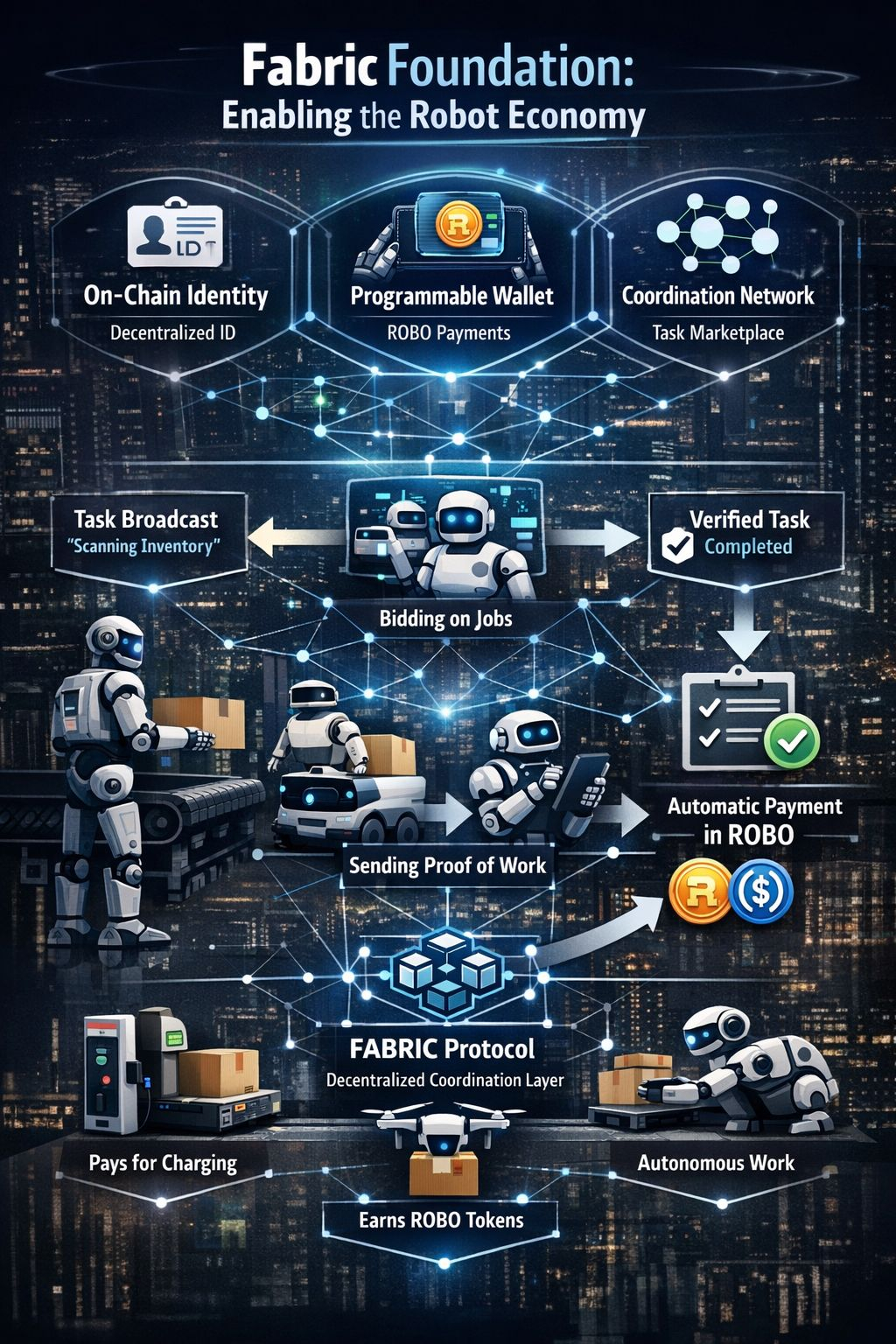
Fabric’s approach is to give robots three fundamental capabilities:
A verifiable on-chain identity
A programmable wallet
A coordination layer for finding work and receiving payment
The ROBO token powers this entire system, acting as the economic fuel that enables transactions between robots, services, and infrastructure.
The Team and Backing Behind Fabric
What makes Fabric stand out from many crypto projects is the team building it.
The platform is developed by OpenMind, a Silicon Valley robotics company founded by Stanford professor Jan Liphardt. The team includes engineers from MIT CSAIL and Google DeepMind, bringing strong academic and technical credibility.
Fabric has also raised $20 million in funding from major investors including:
Pantera Capital
Coinbase Ventures
Digital Currency Group (DCG)
These backers typically focus on projects with serious long-term potential rather than speculative ideas.
OM1: An Operating System for Robots
At the core of the ecosystem is OM1, an operating system designed for robots.
You can think of OM1 as Android for robotics. It is:
Hardware-agnostic
Open source
Designed for cross-platform deployment
Developers can build software once and run it across different robotic systems without rewriting everything.
OM1 is already running on robots from manufacturers such as:
UBTech
AgiBot
Unitree
This helps solve one of robotics’ biggest challenges: fragmentation between hardware platforms.
The FABRIC Protocol: A Coordination Network for Robots
Above the operating system sits the FABRIC protocol layer, which connects robots economically.
Here’s how it works:
Each robot receives a decentralized on-chain identity.
Tasks are broadcast across the network.
Robots bid for tasks based on capabilities and location.
After the work is verified, payment settles automatically in ROBO tokens.
The goal is to remove manual approvals and invoices, allowing machines to coordinate work autonomously.
Proof of Robotic Work
One of the more unique aspects of Fabric is its Proof of Robotic Work (PoRW) mechanism.
Instead of generating tokens through traditional crypto methods like mining or staking, new ROBO tokens are created based on verified real-world robotic tasks.
Examples could include:
Servicing charging stations
Scanning inventory
Completing deliveries
Performing maintenance tasks
This means the token supply is theoretically tied to real economic activity performed by robots.
ROBO Token Launch and Ecosystem Growth
The ROBO token launched on February 27, 2026 through Virtuals Protocol’s Titan mechanism.
It is currently trading on:
Virtuals Protocol
Uniswap V3 (on the Base chain)
Virtuals provided $250,000 in liquidity, representing 0.1% of the total ROBO supply.
The token has also been listed on several major exchanges, including:
Kraken
Bybit
Gate
Bitget
Partnership with Circle and Autonomous Payments
Another key development is Fabric’s partnership with Circle, the company behind the USDC stablecoin.
Through integration with OpenMind’s x402 protocol, robots will be able to autonomously pay for:
Electricity
Data services
Charging stations
Infrastructure usage
In the future, a robot could theoretically drive up to a charging station, plug itself in, and pay automatically without human involvement.
Risks and Tokenomics Considerations
Despite the ambitious vision, there are real risks investors should understand.
Token supply structure
Total supply: 10 billion ROBO
Over 80% is locked and scheduled to unlock gradually over several years.
Market volatility
Price swings of 20–30% are common.
Circulating supply
Currently around 22.3%
This creates both upside potential and dilution risk. If adoption grows faster than token unlocks, scarcity could push prices upward. But if unlocks outpace demand, the market could face significant selling pressure.
Why This Project Matters
The world is moving toward an economy where millions of machines perform productive work.
Those machines cannot realistically operate on thousands of separate corporate systems and proprietary ledgers. For a robot economy to function at scale, shared infrastructure will be necessary.
Fabric is betting that this infrastructure should be:
Open
Permissionless
Decentralized
Whether the project ultimately succeeds or fails, it is addressing an important question: how robots will interact economically in the future.
The robot economy is coming. The real question is what infrastructure will power it.
@Fabric Foundation #robo $ROBO