I remember a phase during the last AI boom when almost every new token seemed to promise the same future. Artificial intelligence would transform everything, blockchain would coordinate it all, and somehow a token would sit at the center of the entire system. The charts looked impressive, trading volume was rising, and social media was full of confident predictions about the next technological revolution.
At the time I believed those narratives more than I probably should have. If the market was excited and liquidity was flowing, I assumed the infrastructure must be coming soon after. But when I started looking deeper into some of those projects, I realized the story was often moving much faster than the technology behind it.
The token existed, the market was active, but the systems needed to support real AI activity were still early or unclear. That experience changed how I evaluate projects today. Instead of focusing on how exciting the narrative sounds, I try to understand the mechanics underneath it and ask a simpler question: can this system actually support real economic activity?
That perspective is part of why Fabric Protocol caught my attention recently.
Not because it promises another AI narrative. Crypto already has plenty of projects trying to attach tokens to artificial intelligence. Most of those stories revolve around AI agents, data markets, or decentralized computing networks.
But Fabric raises a slightly different question. Instead of focusing purely on AI software, the project is trying to build infrastructure that allows robots to participate in economic systems.
In other words, it asks something that sounds almost unusual in crypto: if robots begin performing tasks in the real world, how do they interact with markets, payments, and incentives?
So the real question becomes this: can a blockchain network coordinate robot activity in a way that turns machines into economic participants?
According to Fabric’s documentation, the protocol is designed to act as coordination infrastructure for robots, operators, and developers. Instead of treating robots as isolated pieces of hardware, the system attempts to connect them to a network where tasks, incentives, and verification can be managed collectively.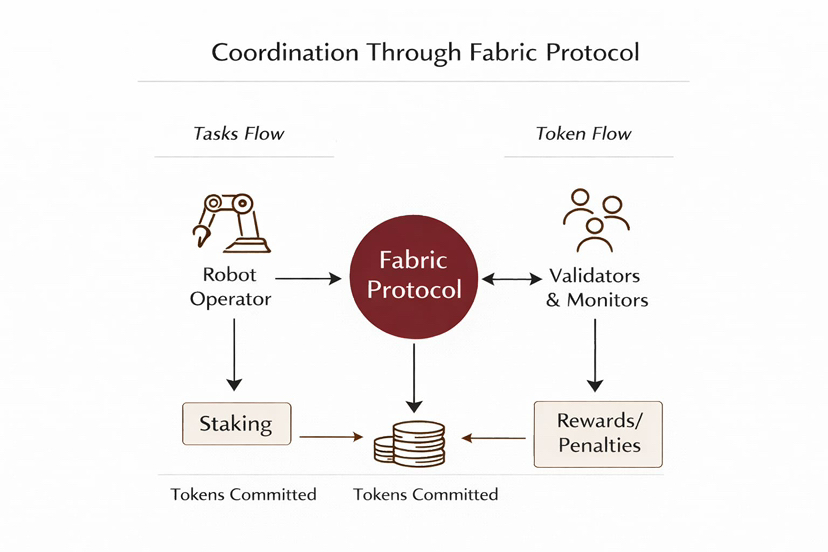
The protocol works by combining robotic services with economic rules. Robots or their operators can perform tasks such as data collection, automation services, or other operational work. When these tasks are submitted to the network, the system uses validators and monitoring participants to verify whether the work was performed correctly.
To align incentives, operators may need to commit tokens or stake resources before completing certain tasks. That stake acts as a form of collateral that encourages honest behavior.
Think of it like margin in trading. Before opening a leveraged position, traders must lock collateral so the system knows they can absorb potential losses. Fabric applies a similar concept to robot operations. If a robot operator wants to perform work through the network, they may need to lock value as proof that they are willing to stand behind the results.
Validators or other network participants can then review the task outcomes. If the work is correct, the operator receives rewards. If the work fails or appears fraudulent, the protocol can apply penalties.
This structure matters because it turns robotic work into something closer to an economic transaction. Robots perform services, the network verifies results, and incentives determine whether participants continue providing those services.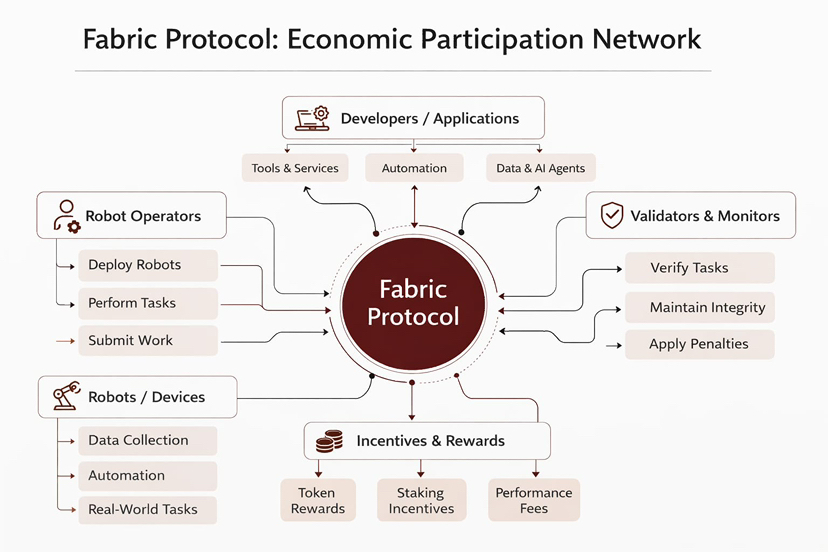
In theory, this creates a feedback loop where machines can earn value by contributing useful work.
The market is already paying attention to the idea behind Fabric.
As of mid-March, the ROBO token has been trading around the $0.04 range, with a market capitalization close to $90 million depending on the data source. Circulating supply sits in the low billions relative to a much larger maximum supply, placing the fully diluted valuation considerably higher.
Daily trading volume has frequently reached tens of millions of dollars, which suggests that the token has already attracted active participation from traders. Liquidity is present across exchanges, and the project has gained visibility among investors watching the intersection of robotics and blockchain.
Holder counts have also grown into the tens of thousands of addresses according to various tracking platforms. That indicates that interest in the project is spreading beyond early participants and into the broader crypto market.
These numbers tell us something important about how the market currently sees Fabric. Traders are already pricing the possibility that a robot-focused infrastructure network could become valuable in the future.
But this is also where the real test begins.
Because the biggest challenge for Fabric is not whether the robot economy narrative sounds interesting. Crypto markets have shown repeatedly that compelling narratives can attract attention very quickly.
The real challenge is retention.
Turning robots into economic participants requires more than a token and a story. It requires a network where developers, operators, and validators consistently interact with the system.
If operators deploy robots through the network only once, the economy never forms. If developers experiment briefly but then move on, the infrastructure never gains depth. And if validators stop verifying tasks because incentives fade, the entire coordination mechanism weakens.
In other words, Fabric’s long-term success depends on whether participation becomes habitual rather than experimental.
Think of it like launching a new digital marketplace. At first, curiosity brings people to the platform. Early users want to explore what it can do. Developers test the tools, operators experiment with the system, and traders speculate on the token.
But real marketplaces only survive when people return repeatedly. Sellers keep listing products, buyers keep coming back, and the platform gradually becomes part of everyday activity.
Fabric is attempting something similar with robots.
If robotic services continue appearing on the network, if developers build tools around that infrastructure, and if validators maintain oversight of the system, the protocol could gradually evolve into a functioning coordination layer for machine activity.
But if participation remains temporary, the network risks becoming another idea that the market priced faster than the infrastructure could grow.
So what would make me more confident that Fabric is actually moving in the direction of a real robot economy?
First, I would want to see developers building services or applications that rely on the protocol’s infrastructure. Networks only gain durability when builders depend on them.
Second, I would look for consistent activity from robot operators performing tasks through the network. Real usage patterns matter much more than theoretical capabilities.
Third, I would watch whether validators or monitoring participants remain engaged in verifying tasks and maintaining system integrity. Coordination systems depend on ongoing oversight.
On the other hand, I would become more cautious if a different pattern emerges.
If trading volume continues expanding while observable network activity remains limited, it may suggest the market is valuing the narrative faster than the system itself is developing. Similarly, if token speculation grows faster than builder participation, the gap between price and infrastructure could widen.
These outcomes are common in early-stage crypto projects, where markets often anticipate success long before it becomes visible.
So if you’re watching Fabric Protocol, don’t just watch the token chart.
Watch whether robots, operators, and developers keep interacting with the network over time.
In emerging markets like this, the difference between speculation and real infrastructure is rarely obvious at the beginning. It usually becomes clear later, when the systems that looked promising start attracting participants who return again and again.
Because in the end, a real economy whether it involves humans or robots only exists when participation becomes routine rather than temporary.