
@Fabric Foundation For most of human history, tools have quietly waited for us to give them instructions. A hammer does not decide when to build a house, and a computer does not question the program it runs. Yet something subtle has been changing in the past decade. Machines are becoming more autonomous, more intelligent, and increasingly capable of interacting with the world without constant human supervision. At the same time, another revolution has been unfolding in parallel: decentralized networks that operate without central control. When these two trajectories begin to intersect, the result is a fascinating new frontier. Fabric Protocol is one of the projects attempting to explore that intersection.
The idea behind Fabric Protocol does not start with robots alone. It starts with a bigger question: how can machines participate in open networks the same way humans do? Blockchain technology already allows people across the world to coordinate value, data, and governance without trusting a central authority. But machines, particularly autonomous robots, have not yet been fully integrated into these decentralized systems. Fabric Protocol aims to change that by creating a global open network where robots, developers, and users can collaborate through verifiable computation and agent-native infrastructure.
In many ways, the concept feels like the natural evolution of both robotics and crypto. Robotics has traditionally relied on closed ecosystems controlled by corporations or research labs. A robot’s capabilities were limited to the software written for it and the data stored in private systems. Meanwhile, blockchain introduced a model where networks are open, transparent, and governed collectively by participants. Fabric Protocol attempts to merge these worlds, allowing robots to operate within a decentralized environment where their actions, data, and coordination can be verified on a public ledger.
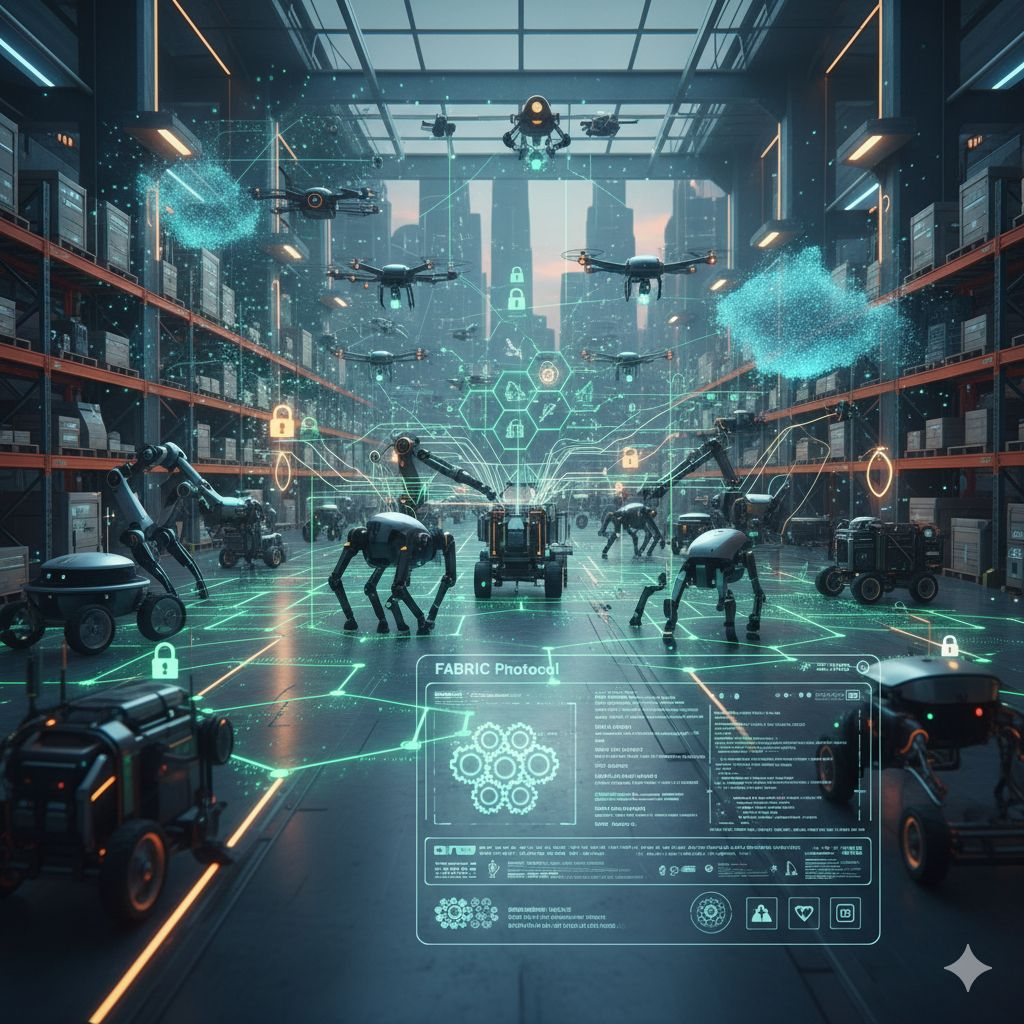
This approach opens a surprisingly large range of possibilities. Imagine a robot performing tasks in a warehouse while recording its operations on a decentralized network. Instead of relying solely on a company’s internal system, its work could be verified through cryptographic proofs. Data about its performance, environment, and decision-making could be securely shared with other machines or developers. Over time, robots across different locations could collectively improve through shared learning, creating a collaborative intelligence rather than isolated machines.
The protocol relies heavily on the idea of verifiable computing. In simple terms, this means that complex computations performed by machines can be proven correct without exposing all the underlying data. For robotics, this becomes incredibly valuable. Autonomous systems often process massive amounts of sensor information and make decisions based on complex algorithms. Verifiable computing allows these processes to be trusted by the network while maintaining privacy and efficiency.
Fabric Protocol also introduces what it describes as agent-native infrastructure. In the world of decentralized systems, an “agent” refers to an autonomous entity capable of interacting with the network. Traditionally, these agents have been humans using wallets or applications. Fabric extends this idea to machines. Robots can become network participants, capable of exchanging data, executing tasks, and coordinating with other agents through programmable rules embedded in the protocol.
This concept may sound futuristic, but it reflects a broader trend already emerging across technology. Autonomous vehicles, warehouse robots, delivery drones, and AI-driven machines are becoming more common each year. Yet the infrastructure for coordinating them globally is still fragmented. Each company builds its own system, each robot operates within its own environment, and data rarely moves freely between them. Fabric Protocol proposes a different vision: a shared infrastructure layer where machines can interact safely and transparently.
One of the more intriguing aspects of the protocol is its emphasis on governance. Decentralization is not only about technology; it is also about decision-making. If robots and machines begin to operate within open networks, questions of regulation, accountability, and oversight become extremely important. Fabric addresses this by coordinating not just data and computation, but also regulatory frameworks through its public ledger.
In practical terms, this means that rules governing machine behavior could be encoded into the network itself. For example, certain safety standards or operational limits could be enforced through smart contracts. When a robot performs a task, the network can verify whether it complied with these rules. If something goes wrong, the system provides a transparent record of what happened. This type of accountability could become essential as autonomous machines become more integrated into daily life.
Another important dimension of Fabric Protocol is its modular infrastructure. Instead of building a single monolithic platform, the protocol is designed as a set of interoperable components. Developers can build specialized modules for computation, data storage, governance, or machine learning. These modules can then interact with each other through standardized interfaces, creating a flexible ecosystem where innovation can happen quickly.
For the broader crypto industry, this approach is significant because it expands the idea of what blockchain networks can support. Many early blockchain applications focused on finance, from digital payments to decentralized exchanges. Over time, the scope expanded to include gaming, digital identity, and decentralized social platforms. Fabric Protocol suggests another major frontier: the machine economy.
The machine economy refers to a world where autonomous systems can perform tasks, earn rewards, and exchange services without direct human management. A robot delivering packages, for example, could receive payments through a decentralized network. A fleet of machines performing environmental monitoring could share data with researchers and receive compensation from organizations that use the information. These interactions would occur automatically, governed by cryptographic rules rather than centralized intermediaries.
What makes this particularly interesting is the role of open collaboration. In traditional robotics development, innovation often happens within closed corporate environments. Fabric Protocol encourages a more decentralized approach. Developers, researchers, and organizations can contribute to the network, share improvements, and collectively evolve the capabilities of machines connected to the system.
This collaborative model mirrors the open-source movement that helped shape the modern internet. Just as developers around the world contribute to shared software projects, Fabric aims to create an environment where improvements in robotics can propagate through the network. A machine learning model developed in one region could benefit robots operating thousands of miles away. New safety protocols or operational frameworks could be adopted globally through network governance.
Of course, building such an ambitious system is not without challenges. Robotics and blockchain are both technically complex fields, and integrating them introduces additional layers of difficulty. Issues like scalability, real-time processing, and secure data exchange must be carefully addressed. Autonomous machines often require extremely fast decision-making, while blockchain networks traditionally operate at slower speeds. Balancing these requirements will be a critical part of Fabric’s development.
There are also broader societal questions to consider. As machines become more autonomous and interconnected, the relationship between humans and technology will continue to evolve. Systems like Fabric Protocol aim to create frameworks where collaboration between humans and machines remains safe, transparent, and beneficial. Achieving that balance will require thoughtful design and responsible governance.
Yet despite these challenges, the vision behind Fabric Protocol captures something important about the direction technology is heading. The future will likely not belong solely to humans or machines, but to networks where both coexist and cooperate. Decentralized infrastructure may become the invisible layer that allows this cooperation to happen at scale.
If the internet connected people, and blockchain connected value, the next phase of innovation may connect intelligence itself human and machine within shared networks of trust.
And perhaps the most fascinating question is not whether machines will become more capable, but whether we are building the right systems today to guide how they collaborate with us tomorrow.
$ROBO #robo @Fabric Foundation
