

I’ve been watching NIGHT since the Binance listing hit, and honestly, the more I look at the numbers the more convinced I get that the story everyone’s chasing ZK privacy hype, Cardano crossover, shiny new L1 narrative is missing the actual setup that matters right now.
What stands out to me isn’t the tech roadmap or the marketing. It’s that the tokenomics have already done the heavy lifting on ownership before the real utility flywheel even starts turning. The randomized unlocks and the way DUST gets auto-generated from every single held token have created a holder base that feels sticky by design, not by accident. Most fresh tokens launch with 70-80% still locked behind team or investor wallets and everyone braces for the dump waves. NIGHT flipped that script early. The bulk of supply is already out there, spread across real participants instead of concentrated wallets waiting for their moment to sell.
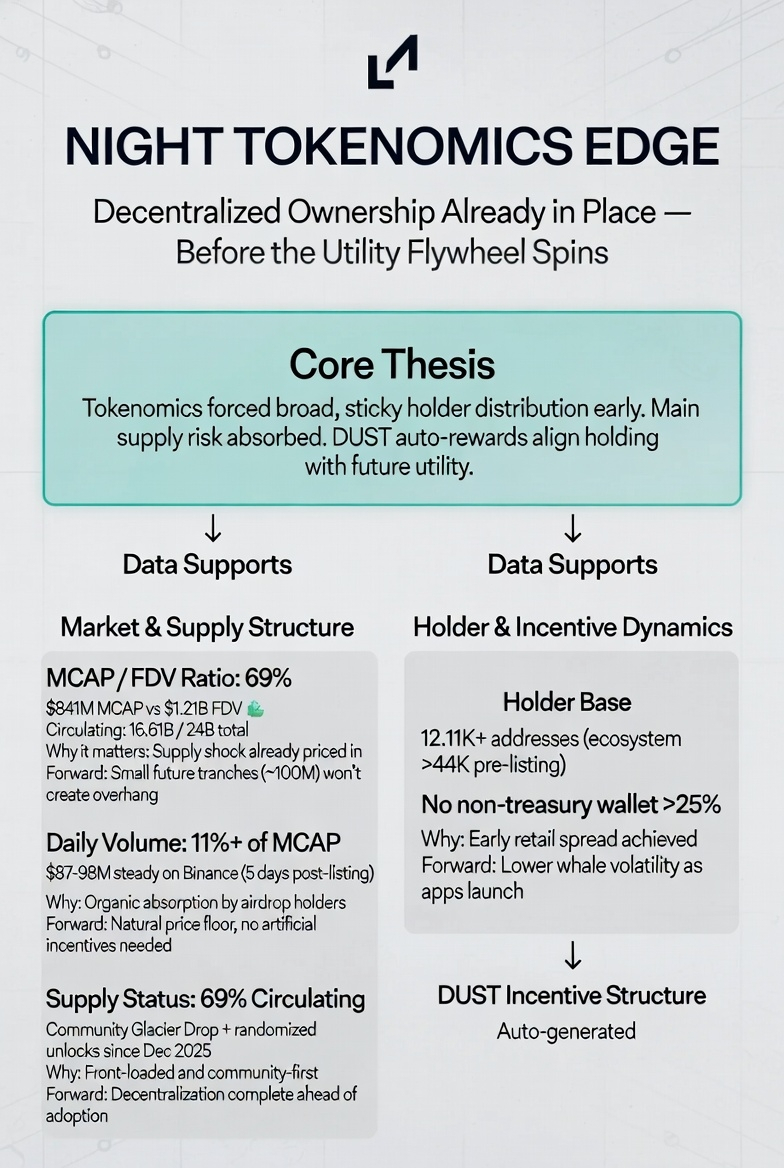
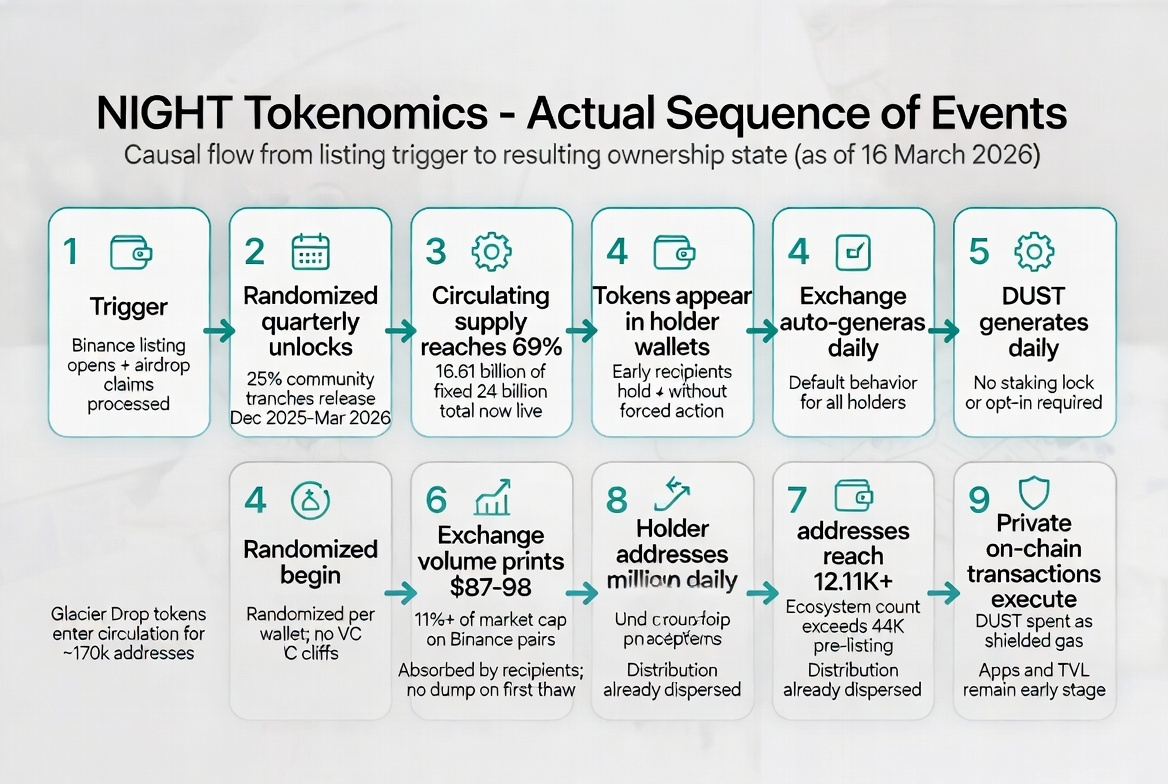
Look at the market cap to FDV picture first. Right now it’s sitting at roughly 69% $841 million market cap against a $1.21 billion fully diluted value on both CoinMarketCap and CoinGecko as of today. Circulating supply is already 16.61 billion of the fixed 24 billion total. That ratio hasn’t budged much since the March 11 listing even with the airdrop inflow, which tells me the market has already absorbed the main supply shock. Future quarterly tranches are small enough (next one under 100 million tokens) that they probably won’t create the kind of overhang you see in most other launches.
Then there’s the volume behavior. We’re seeing $87–98 million in daily trading that’s over 11% of the entire market cap and it’s holding steady five days after listing, almost all on Binance pairs. This isn’t low-float noise or paid liquidity. It feels like actual absorption from airdrop recipients and early claimers who are choosing to stay rather than flip. That kind of organic turnover this early gives the price a natural floor most narrative coins don’t get until much later.
The supply distribution itself is the part that keeps surprising me. The community-heavy Glacier Drop and follow on rounds pushed circulating supply to 69% almost immediately after the staggered unlocks began late last year. The remaining locked portion is mostly foundation and reserve for emissions, not giant investor cliffs. Because the thaw was randomized and community first, the ownership spread happened before any meaningful on chain activity kicked off. No single non-treasury wallet dominates beyond about 25%, and holder addresses jumped from the initial 12k to over 44k pre-listing. That kind of early decentralization is rare, and it happened while the price was still finding its feet.
Even the exchange dynamics line up. Volume stays elevated without any artificial incentives, and the on-chain explorer shows transaction counts and early TVL signals growing quietly through the Cardano bridge. No big dump on the first major thaw window. The structure rewards people who simply hold DUST accrues automatically and becomes the gas for private transactions so the same wallets that received tokens at launch are now positioned to use them as the apps come online. That creates a usage loop you can’t fake with marketing.
Of course I have to flag the obvious counter. The foundation and reserve slices still represent north of 30% of total supply. If development slows, if the shielded DeFi and data apps stay mostly theoretical, or if the dual-ledger private state doesn’t pull in real enterprise users beyond Cardano bleed-over, that overhang could finally show up and pressure price. Early explorer activity is live but nowhere near scale yet the risk is real.
What would actually confirm this thesis for me over the next two quarters? On-chain transaction volume and DUST usage climbing 5–10x while holder count pushes past 50k, price holding comfortably above $0.04 through the remaining 2026 unlocks, and that volume-to-market-cap ratio staying north of 8% without any CEX carrots. That would show retention and organic utility are beating the last bits of emission.
Conversely, if we see a clean break below $0.03 right after the next quarterly release, paired with flat or declining on-chain activity and holder growth stalling, then yeah this was just another airdrop rotation play and the early distribution didn’t stick.
To me the data is pretty clear: NIGHT already handled the hardest part getting broad, decentralized ownership in place while the market was still treating it like every other fresh token. Most people are still pricing it as if the supply risk is ahead of us. I think it’s already behind us. That’s the specific edge I’m watching, and the one that feels genuinely different.
@MidnightNetwork #night $NIGHT
