
Some technologies don’t announce their importance loudly. They arrive quietly, solving a problem people didn’t even realize had a name. In crypto, many innovations have promised speed, cheaper transactions, or new forms of finance. But very few have tried to solve a deeper tension that sits at the heart of the digital world: how can people use technology openly without exposing everything about themselves? This question has followed the internet for decades, and today blockchain developers are exploring one of the most fascinating answers yet — zero-knowledge technology.
When people first discovered blockchain through Bitcoin, the idea of transparency felt revolutionary. Every transaction could be verified by anyone. It was a system built on mathematical trust rather than institutional authority. But over time, that same transparency revealed an uncomfortable truth. While blockchains are pseudonymous, they are not truly private. Anyone with enough patience and analytics tools can trace activity across wallets, link identities, and map financial behavior.
For a technology meant to empower individuals, that raises a dilemma. Transparency is essential for security and trust, yet total transparency can expose users to surveillance, exploitation, or loss of control over personal data. The digital economy increasingly runs on data, and most people have little ownership over the information they generate. Social networks harvest it. Platforms monetize it. Corporations analyze it. Meanwhile, users often trade privacy for convenience without fully realizing the long-term consequences.
This is where zero-knowledge proofs begin to feel almost philosophical in their elegance. The concept sounds abstract at first, but its core idea is surprisingly simple: prove something is true without revealing the underlying information. Imagine confirming you are old enough to enter a venue without showing your exact birthdate, or proving you have enough funds for a transaction without exposing your wallet balance. The system verifies the truth of the statement, yet the data itself remains private.
In the context of blockchain, this capability transforms how networks can operate. Instead of forcing users to reveal all transaction details to maintain security, a blockchain using ZK proofs can verify computations or transfers while keeping the sensitive parts hidden. The network still reaches consensus, the rules are still enforced, but the information that belongs to the user stays under their control.
The significance of that shift becomes clearer when we think about the broader digital landscape. For years, the internet evolved around centralized platforms that act as gatekeepers of information. These platforms collect enormous datasets because they must verify identities, manage interactions, and ensure security. The more data they gather, the more power they accumulate. Blockchain promised an alternative by removing centralized authorities, but it introduced a different trade-off: radical transparency.
Zero-knowledge technology attempts to balance those extremes. Instead of choosing between surveillance and blind trust, it offers verification without exposure. In a ZK-powered blockchain environment, users can participate in decentralized applications, financial systems, or identity networks without broadcasting every detail of their activity to the world.
This has enormous implications for how utility can evolve on-chain. Consider decentralized finance. DeFi protocols currently operate with open ledgers where balances and transactions are visible to anyone who knows the address. While transparency helps prevent fraud and maintain accountability, it also creates vulnerabilities. Traders can be tracked. Strategies can be copied. Large transactions can attract unwanted attention from automated bots or malicious actors.
With zero-knowledge proofs integrated into blockchain systems, DeFi applications could maintain the integrity of transactions while shielding sensitive financial information. Users could demonstrate that collateral requirements are met, or that liquidity conditions are satisfied, without revealing the exact composition of their holdings. The protocol remains secure, but the individual regains privacy.
Another powerful use case lies in digital identity. Today, identity verification on the internet usually involves sharing far more information than necessary. When signing up for services, users might submit passports, addresses, or full personal details just to confirm eligibility. This information often sits in centralized databases that can be hacked or misused.
A ZK-enabled identity system could change that model entirely. Instead of storing sensitive personal records on servers, individuals could hold verifiable credentials in secure wallets. When a platform needs proof of eligibility — age, citizenship, membership — the user could provide a zero-knowledge proof confirming the requirement without revealing the full document. The platform gets certainty, and the user keeps control over their data.
This idea resonates deeply with one of the original promises of crypto: self-sovereignty. Ownership in the digital world should not only apply to assets but also to identity and information. If blockchain represents the infrastructure of decentralized finance, zero-knowledge technology may become the infrastructure of decentralized privacy.
There is also an interesting technical dimension that often gets overlooked. Beyond privacy, ZK proofs can dramatically improve scalability. Certain blockchain architectures use ZK systems to compress large amounts of transaction data into concise proofs that the network can verify quickly. Instead of processing every computation individually, the blockchain only needs to verify the proof representing thousands of operations.
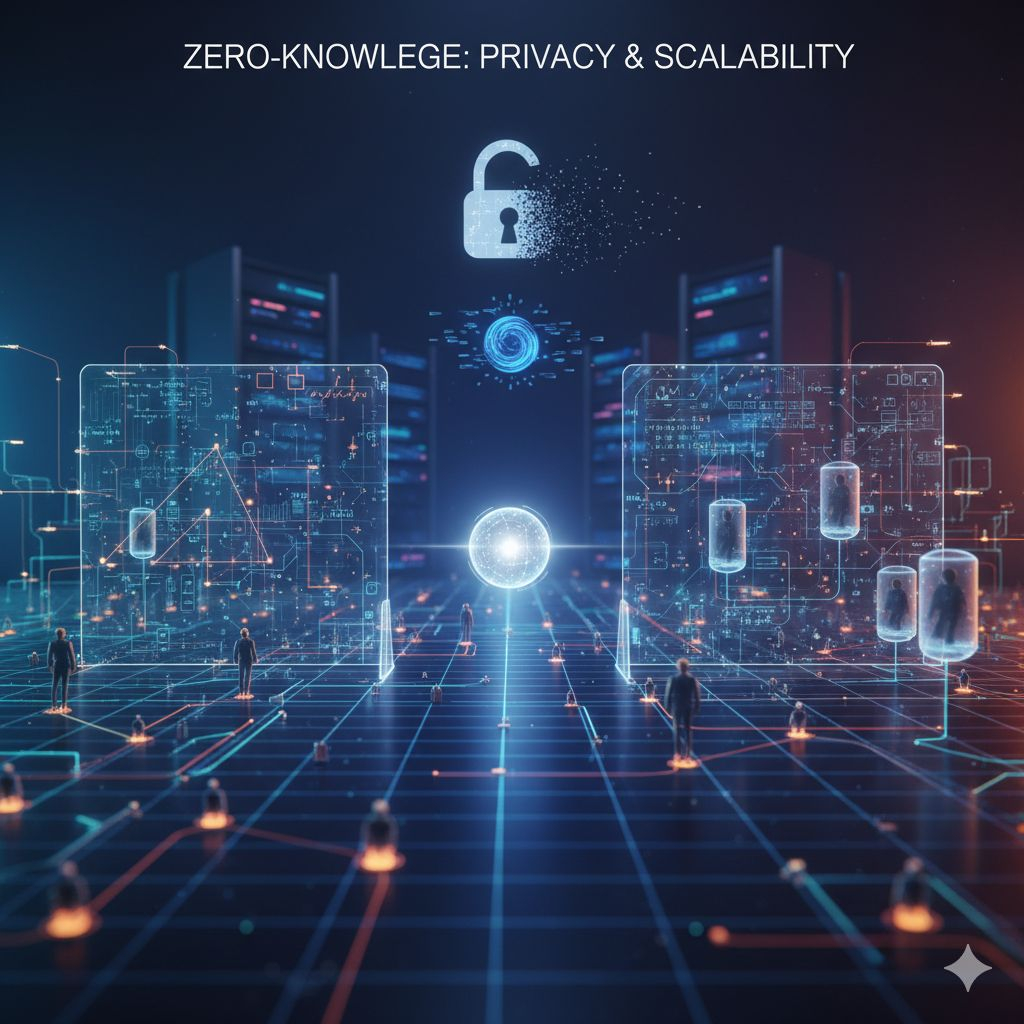
This approach reduces congestion, lowers fees, and allows networks to scale without sacrificing security. In other words, zero-knowledge proofs are not just about hiding data — they are also about making blockchain systems more efficient. Privacy and scalability, two challenges that once seemed separate, are suddenly connected through the same mathematical innovation.
Of course, the technology is still evolving. ZK cryptography involves complex mathematics and demanding computational processes. Developers continue to refine tools, frameworks, and infrastructure that make it easier to integrate into real-world applications. The ecosystem is experimenting rapidly, exploring how these proofs can support everything from decentralized gaming to secure voting systems.
What makes this moment exciting is the sense that crypto is entering a new phase of maturity. Early blockchains proved that decentralized money could exist. The next generation is trying to solve deeper problems around usability, privacy, and real-world adoption. Technologies like zero-knowledge proofs suggest that blockchain does not need to compromise between transparency and personal freedom.
If the internet’s first era was about connecting people, and its second era was about platforms controlling data, the next era might be defined by individuals reclaiming ownership of their digital lives. Blockchain provides the rails for decentralized value, while zero-knowledge technology quietly protects the autonomy of the people using it.
And perhaps that is the most fascinating part of all. The future of crypto may not be shaped by louder systems or bigger networks, but by quieter mathematics — proofs that reveal nothing, yet somehow prove everything about a world where technology finally learns how to trust without needing to see.
$NIGHT #night @MidnightNetwork
