

It's past midnight and I'm still staring at a token built around robots that don't fully exist yet, coordinating tasks on a blockchain that's currently borrowing someone else's foundation. I genuinely don't know whether to find that fascinating or just close the laptop and go to sleep. We keep constructing elaborate systems on ground that was only broken yesterday, and then seem genuinely surprised when something shifts underneath us.
Fabric Protocol is what I can't stop turning over in my head tonight. Not because I'm convinced. More because it arrived at precisely the moment the market needed a new story, wrapped in language that sounds almost inevitable when you read it quickly. Robots. Open networks. Verifiable machine labor. Autonomous systems with their own economic identities. Say that out loud slowly and it sounds either visionary or completely detached from reality, depending on what kind of day you've had.
Their whitepaper landed late 2025 with a deliberately unsettling opening — AI performance on benchmarks that were supposed to remain permanently out of reach had jumped fivefold in under a year. The framing is intentional. They want you to feel the ground moving. They want you to feel like you've already missed something important. It's an effective opening move and I'll acknowledge that, even while recognizing I've watched variations of the same move get executed across multiple market cycles. The urgency is always real until it isn't.
I've been around through enough of these seasons to know the pattern by heart. Every cycle finds its anchor story. The story always sounds like it was written specifically for this moment. The mechanics underneath almost never are. What rotates is the surface layer — the vocabulary, the aesthetic, the particular flavor of futurism being sold. Right now that flavor involves physical machines operating on open protocols, and I honestly cannot determine whether this represents the early foundation of something genuinely transformative or just the most sophisticated narrative trade I've watched get assembled in a while.
The decision to launch on an existing Layer 2 rather than building proprietary infrastructure immediately makes practical sense. Borrowing established rails when you're early and moving fast is just rational. But there's already a longer-term vision being discussed involving a purpose-built chain designed specifically for machine activity. I've watched this exact progression enough times that it triggers a particular kind of wariness in me. The migration phase is where projects discover what they're actually made of. Technical obligations compound quietly. Communities develop fracture lines that weren't visible before. Liquidity that was never genuinely attached to the protocol itself — only to the broader ecosystem it was sitting inside — disappears without ceremony. Roadmaps make migration look like a scheduled upgrade. In practice it tends to feel more like open-water surgery.
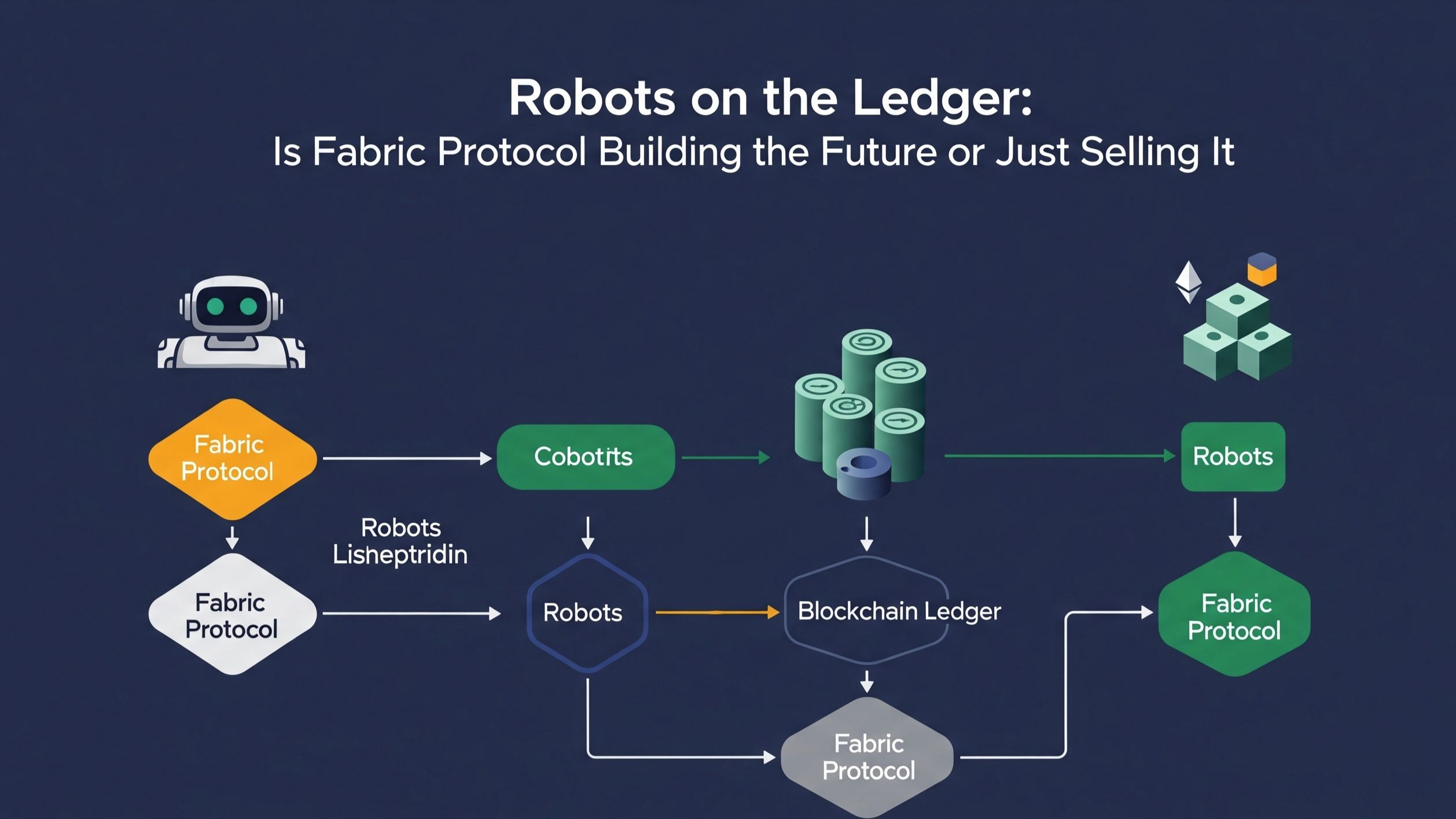
What actually holds my attention here, past the narrative surface, is the underlying coordination mechanism. The loop is straightforward enough to grasp: a robot completes a verifiable real-world task, that completion gets confirmed on-chain, and a reward follows. Each machine carries a unique identity recorded on the ledger. Smart contracts handle task distribution, letting machines effectively compete for work based on demonstrated capability. That's a more grounded feedback loop than what most projects in this space offer. Most innovation here is just restructured incentive layers dressed in new terminology. This at least requires something tangible to happen before anything gets paid out. Whether that loop holds its integrity at scale is a separate question, and that question never gets answered inside a whitepaper.
More than 80 percent of the token supply sits locked, subject to future vesting. I noticed that figure and I keep noticing it. Most people currently buying haven't spent much time thinking about what the market looks like when those schedules begin unwinding. They're watching price movement, not reading dilution timelines. That's not a unique failure of this particular community — it's just how attention distributes itself in these markets. People chase the story. The unlocks arrive later, quieter, and less discussed, but they always arrive.
The January 2026 token sale closing oversubscribed within hours says something true and something almost meaningless simultaneously. It confirms the appetite. It confirms that the combination of machine intelligence, physical robotics, and open network infrastructure carries enough narrative weight right now to pull capital quickly and with minimal friction. What it doesn't confirm is whether a single one of those buyers has witnessed this protocol coordinate an actual machine doing actual work, or how many of them are positioned for the long development arc rather than the short sentiment trade. Oversubscription is a measurement of market mood. We consistently treat it as evidence of something more substantive than that.
Broad exchange listings arrived fast after launch — spot markets, derivatives, multiple jurisdictions within weeks of the token going live. Wide access accelerates a lot of things. Liquidity formation, yes, but also volatility compression, and the particular kind of price discovery that happens when a token is tradable everywhere before its infrastructure has been seriously tested anywhere. What you end up with is a market cap that's really just a collective probability estimate about a future that hasn't materialized yet. Which means everyone's essentially trading belief, and the most dangerous thing about trading belief is that it feels indistinguishable from trading fundamentals until the moment it doesn't.
Other projects have spent years working in adjacent territory — decentralized coordination, token-incentivized machine networks, open infrastructure for autonomous systems. Their adoption curves have been long, uneven, and perpetually framed as approaching an inflection that keeps getting deferred. Fabric's explicit focus on physical machines doing physical tasks in the real world is at least a conceptual separation from purely digital coordination networks. Whether that distinction translates into a different trajectory in practice is genuinely unknowable from where I'm sitting, and I've learned to be skeptical of anyone who speaks about it with confidence.
The milestone I keep returning to is the first window where measurable robot-driven transaction volume is supposed to become visible. That's the only number that will matter when the time comes, and it's the question almost nobody is asking publicly right now because it doesn't compress into a price prediction or a viral take. Everyone's positioning ahead of imagined catalysts. The real examination never comes during the hype phase. It arrives later, when actual usage generates actual load, when the coordination layer encounters real-world unpredictability that no testnet ever fully simulates, when the token economics get interrogated by operators who care about unit economics rather than governance participation.
I've watched enough things unravel not because the technology was fundamentally broken but because the distance between what was promised at launch and what could actually be sustained under real operating conditions was simply too wide. The chain didn't fail. The concept didn't fail. The gap between the stated vision and the operational reality — that's the place where things go quiet without anyone formally announcing it.
What I keep sitting with tonight is something that sounds strange when I try to say it plainly. We are constructing the economic infrastructure for autonomous machines during a period when those machines still require significant human involvement for anything that genuinely matters. We are pricing robot labor before the robots are ready to price it themselves. And we're doing this on this particular timeline because the capital is available now, the story lands now, and the people involved operate on human financial timescales rather than whatever timescale the actual machine economy will eventually run on. That gap — between the pace of technological development and the pace at which capital needs to find its returns — is where this industry has quietly buried more promising ideas than most people want to count.
Maybe Fabric closes that gap.Maybe the machines develop fast enough to meet the expectations that have already been priced in. Maybe this is the rare occasion where the infrastructure gets built before the narrative burns through its own fuel. I don't know. And I've been paying attention long enough to distrust anyone who speaks about it like they do.
The chart will still be moving in the morning. Pricing a future that may arrive on schedule, or may arrive years late, or may arrive looking nothing like what anyone currently imagines. That uncertainty isn't a flaw in the investment thesis. It is the investment thesis. And somewhere in that fact lives everything both honest and exhausting about this industry.
@Fabric Foundation $ROBO #ROBO
