
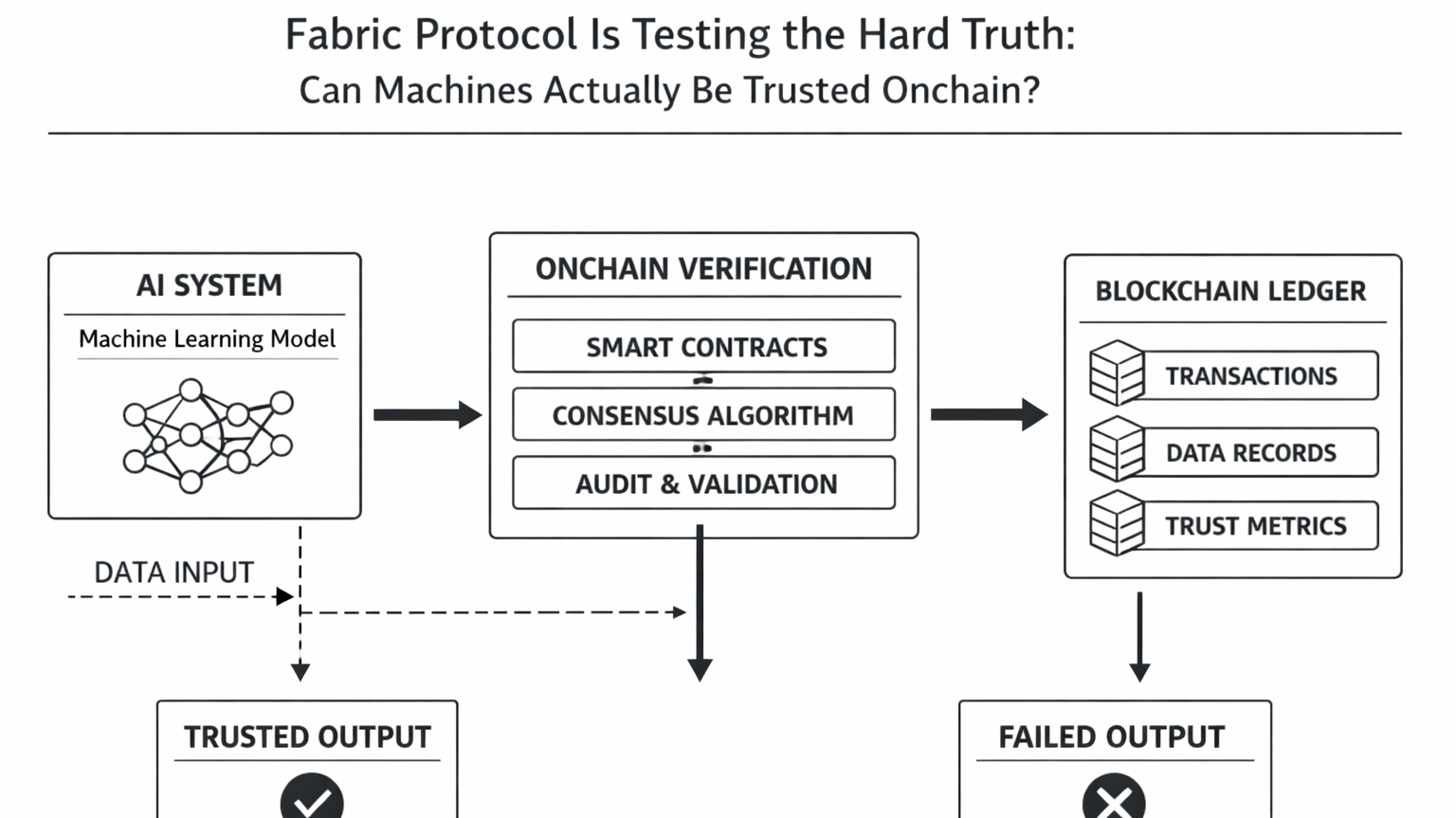
@Fabric Foundation feels a bit different from the usual projects in this space. Most of the time, you see the same pattern. A trend gets popular, a token is added, big claims are made, and it gets labeled as innovation. But underneath, it is often the same story repeated again.
Fabric seems to be looking at a tougher problem. If machines are going to do real work on their own, someone has to check that work, decide who gets paid, and deal with mistakes when things go wrong. That is not the exciting part, but it is the part that actually matters.
People like the idea of smart machines, but they rarely talk about what happens after something fails. Wrong data, incomplete tasks, disputes, all of that shows up quickly in real use. Fabric appears to be built with those situations in mind instead of ignoring them.
It does not read like a typical AI pitch. It feels more like a system trying to set clear rules. Machines have identities, tasks are assigned, results are checked, and there are rewards or penalties depending on what happens. These are simple ideas, but they are what make a system hold together.
ROBO also makes more sense in this setup. It is not just there for attention. It is meant to be used in a system where people commit value, verify results, and stay honest because there is something at stake. That at least gives it a reason to exist.
Still, there are questions.
A lot of projects look solid on paper but struggle when they face real use. So the real test for Fabric is not how it sounds, but how it behaves when things get messy. What happens when checking work becomes expensive? What happens when incentives do not line up the way they should?
That is where many ideas fall apart.
To its credit, Fabric seems to understand that this is not just about making machines smarter. It is about making them reliable and accountable. Machines need to be tracked, checked, and sometimes corrected. Without that, nothing really works.
Another thing that stands out is that the project is not trying too hard to look flashy. It seems more focused on building the core system behind everything. That is usually a better sign, because real systems are built through solving problems, not just creating excitement.
But it is still early.
There is a real idea here, but it is not proven yet. Fabric is trying to deal with a problem that most projects avoid, and that makes it interesting. At the same time, crypto has a history of ideas that sounded good but did not last.
So it comes down to this.
If Fabric can actually make machine work verifiable and dependable in real conditions, then it could matter. If it cannot, it will end up like many others that looked promising but could not handle reality.
For now, it is still an open question.