There’s something about blockchain design that keeps bothering me.
For years, the space has been moving fast—new chains, new narratives, new promises. But underneath all of that, there’s one problem that still feels unresolved.
We want privacy.
Not surface-level privacy, but real confidentiality. The kind where your identity isn’t public by default. Where your financial activity isn’t traceable by anyone with a block explorer. Where business logic—especially for enterprises—doesn’t get exposed to the entire world.
At the same time, we also want usability.
We want applications that feel fast. Systems where multiple users can interact at once. Markets that update in real time. Contracts that don’t feel like they’re running on outdated infrastructure.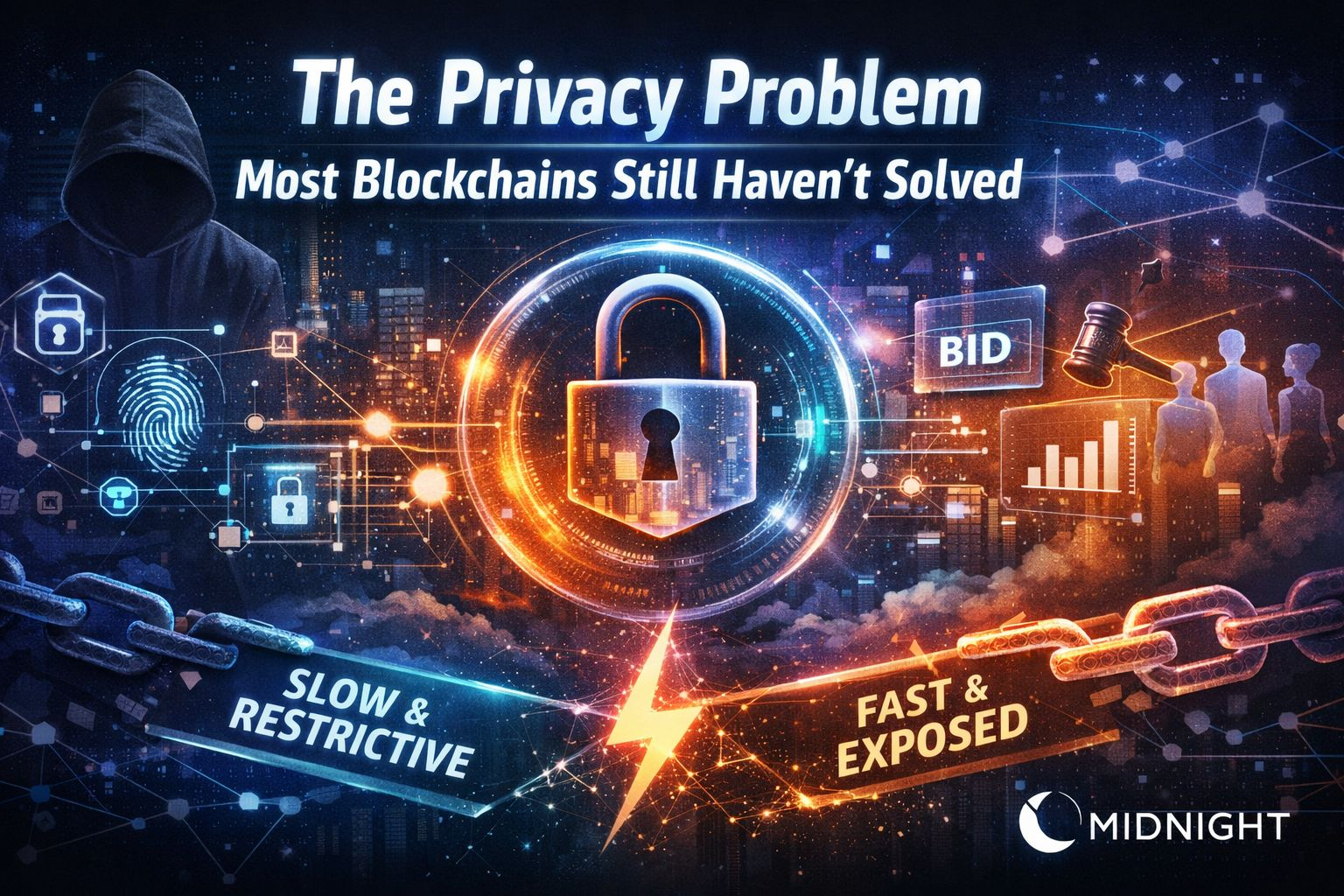
And here’s the issue:
Those two goals have historically been at odds.
Where Things Start Breaking
Most privacy-focused blockchain systems work… but only up to a point.
They handle single-user interactions fairly well. But the moment you introduce multiple participants interacting with the same state, things get complicated very quickly.
Imagine a private auction:
Multiple users placing bids
Each bid needs to stay hidden
The system still needs to determine a winner fairly
Or think about shared financial systems:
Updating balances
Coordinating transactions
Maintaining confidentiality at every step
This is where traditional designs struggle.
To preserve privacy, many systems enforce strict ordering. Transactions are processed one by one in a controlled sequence. It works—but at a cost.
You lose speed.
You lose responsiveness.
And the system starts to feel restrictive.
On the other hand, if you relax those constraints to improve performance, you risk leaking information.
So developers are forced into a +:
Privacy or performance
Security or usability
Very few systems have been able to escape that.
Midnight’s Approach Feels Different
This is exactly the gap Midnight is trying to address.
Instead of treating privacy and usability as opposing forces, it’s attempting to design around both from the ground up.
One of the most interesting ideas here is something called Kachina.
At a high level, Kachina is about solving the concurrency problem in private systems. It creates a structured way for multiple users to interact with private smart contracts at the same time, without exposing the underlying data.
That might sound abstract, but it has very real implications.
It means:
Private auctions that don’t leak bids
Multi-party applications that don’t expose internal state
Systems that behave like real-world software, not limited experiments
Because the truth is, most meaningful applications are not single-user. They involve coordination, interaction, and parallel activity.
Without concurrency, private smart contracts remain a niche concept.
With it, they start to look like real infrastructure.
A Stack Built for the Long Term
The more you look into Midnight’s architecture, the more it feels like a system designed with future constraints in mind.
There’s a strong focus on private execution. Contract logic runs in a local, confidential environment before interacting with the broader network. So instead of exposing everything on-chain, only necessary outputs or proofs are shared.
Then there’s Nightstream, the networking layer.
This might not sound exciting at first, but it addresses a real issue. Privacy systems often struggle with communication overhead. Encrypting and coordinating data between nodes can introduce latency.
Nightstream aims to keep those interactions fast and efficient, which is essential if you want these systems to feel usable in practice.
The Smart Bet on Hardware Trends
One of the most overlooked—but important—parts of Midnight’s design is its approach to zero-knowledge proofs.
Generating these proofs is expensive. It’s one of the biggest bottlenecks in scaling privacy systems.
Midnight tackles this with something called Tensor Codes, which are optimized to run efficiently on GPUs.
That’s a subtle but powerful decision.
Because right now, the world is investing heavily in GPU infrastructure—largely driven by AI. As GPU power becomes more accessible and cheaper, the cost of generating privacy proofs naturally decreases.
Instead of fighting the limitations of current hardware, Midnight is aligning itself with where hardware is going.
That kind of thinking tends to age well.
Rethinking Consensus and Scale
On the consensus side, Midnight introduces Minotaur, a hybrid model combining proof-of-work and proof-of-stake.
The idea isn’t just technical novelty. It’s about flexibility—pulling security from multiple economic models rather than relying on just one.
There’s also a technique called Folding, which helps compress large zero-knowledge proofs.
This becomes critical as systems scale.
Because if privacy is going to support real-world applications—financial systems, enterprise workflows, even AI-driven processes—the underlying computations will grow. And without efficient proof compression, verification becomes impractical.
The Bigger Vision: An Intention-Based Future
Perhaps the most forward-looking idea in Midnight is what they describe as an Intention Layer.
Today, smart contracts are highly procedural. Developers define every step:
Validate this
Transfer that
Update storage
It’s rigid, and it requires precision at every stage.
Midnight imagines a different model.
Instead of specifying every action, you define the outcome you want. The network then figures out how to execute that intention—privately, and potentially across multiple systems.
At first glance, that sounds like abstraction.
But when you connect it to the rise of AI, it becomes much more interesting.
In a world where autonomous agents act on behalf of users—trading, negotiating, coordinating—they won’t just need execution. They’ll need:
Privacy
Flexibility
The ability to operate across multiple environments
That’s where this model starts to make sense.
Why This Matters Right Now
The timing of all this is important.
We’re entering a phase where:
Privacy is becoming a requirement, not a feature
Institutions are paying closer attention to confidentiality
AI is beginning to intersect with blockchain systems
And most existing infrastructure isn’t designed for that combination.
Midnight is still early, and there’s a long road ahead. Execution, developer adoption, and real-world use cases will ultimately decide its success.
But the direction it’s taking is worth paying attention to.
Because it’s not just trying to improve what already exists.
It’s trying to solve a problem that most blockchains haven’t fully addressed yet.
Final Thoughts
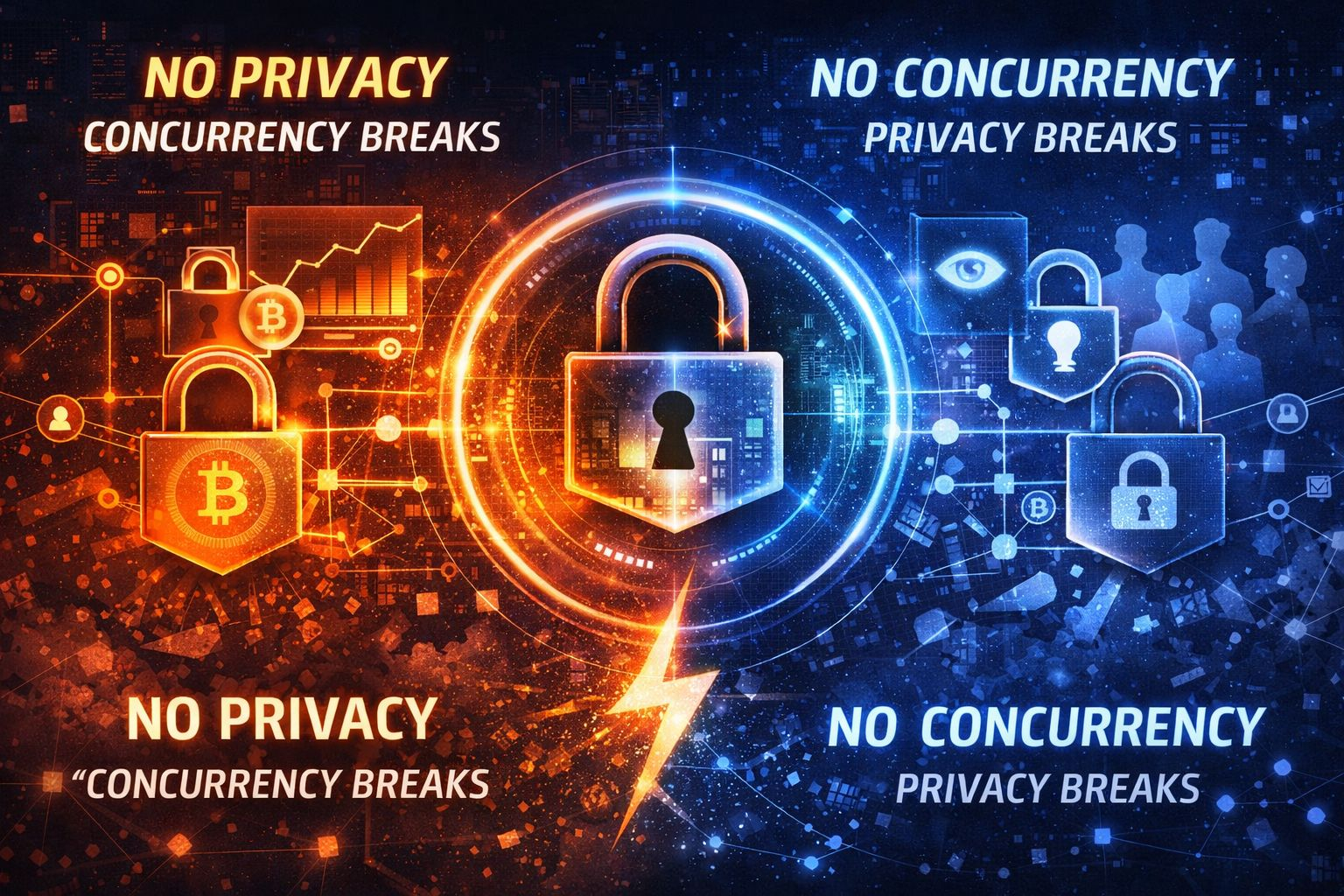
If blockchain is going to evolve beyond simple transactions and into complex, multi-user systems, privacy and concurrency can’t remain trade-offs.
They have to work together.
That’s the challenge Midnight is taking on.
And whether it succeeds or not, it’s pushing the conversation into territory the industry can’t ignore for much longer.