Beyond Anonymity: How Midnight Network’s ‘Rational Privacy’ is Bridging Blockchain and Compliance
If you’ve spent any time around blockchain, you’ve probably noticed a constant tug-of-war. On one side, there’s transparency—everything visible, everything traceable. On the other, there’s privacy—often so strong it raises eyebrows with regulators. For years, it felt like you had to pick one.
That’s where Midnight Network steps in with something refreshingly different: rational privacy.
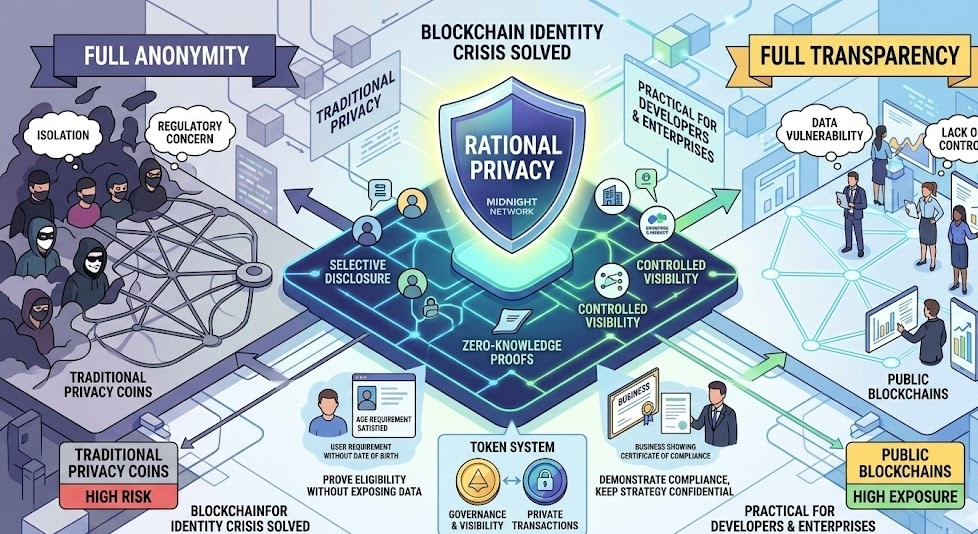
At its core, rational privacy isn’t about hiding everything. It’s about control. Instead of full anonymity or full transparency, it lets users decide exactly what information to reveal—and when. Technically, this works through zero-knowledge proofs, which allow someone to prove something is true without exposing the underlying data.
Think of it like showing your ID at a store. You prove you're old enough, but you don’t hand over your entire life history. Simple, right? That same idea is now being applied to blockchain.
This approach solves a big problem. Traditional public blockchains expose too much, while privacy coins often hide too much. Midnight sits in the middle. It allows selective disclosure, meaning businesses can stay compliant without sacrificing sensitive data.
And that’s where things get interesting for the real world.
Imagine a company verifying customer eligibility without storing personal details on-chain. Or a financial institution proving compliance without revealing internal strategies. Midnight’s design makes these scenarios possible by combining private smart contracts with a public, auditable layer.
Even its token system reflects this balance. One token handles governance and visibility, while another powers private transactions. It’s a clever separation that keeps operations confidential but still accountable.
What I personally find most promising is how practical it feels. This isn’t just theory—it’s built with developers and enterprises in mind. The tools are designed to be accessible, not overly cryptographic or niche.
In a way, Midnight is trying to fix blockchain’s identity crisis. It asks a simple question: why should users have to choose between privacy and compliance?
The answer, increasingly, is—they shouldn’t.
As blockchain moves closer to mainstream adoption, this middle-ground approach might be exactly what the industry needs. Not total secrecy. Not total exposure. Just smart, controlled privacy that actually works in the real world.