

When I first started researching the Fabric Protocol, I realized there’s a fundamental concept that often gets overlooked: protocol‑level transactions. People know $ROBO powers robot payments, identity, and market coordination, but most don’t grasp how transaction mechanics themselves define the very economic infrastructure that lets robots act as autonomous economic actors. This isn’t theory — it’s built into Fabric’s core architecture as described in official documentation.
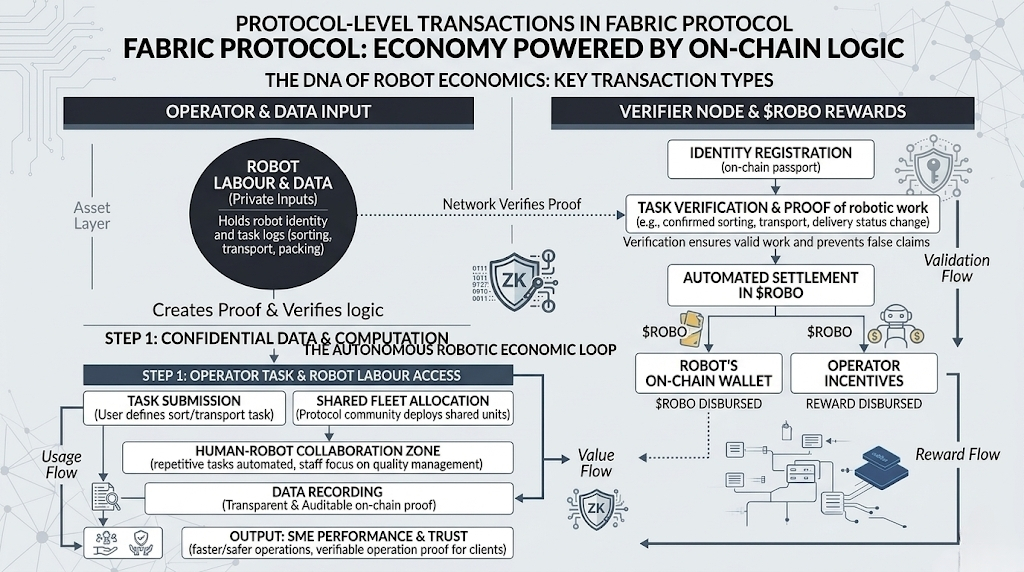
1. What Does “Protocol‑Level Transaction” Really Mean?
In simple terms, a protocol‑level transaction is any state change that happens on the Fabric network as part of the protocol’s core logic. These are not just user payments or token transfers — they include:
Identity registration events, where a robot’s cryptographic identity is written to the ledger.
Task verification and settlement executions, where task results trigger automated reward distribution.
Coordination actions, such as staking ROBO or participating in decentralized robot deployment pools.
These aren’t transactions happening at the application layer — they are the network’s economic rules in action. Unlike traditional systems where a side‑chain or secondary system handles business logic, in Fabric the protocol itself embeds these rules on chain. This means every economic decision is transparent, verifiable, and traceable back to network state history.
2. The Core Role of Protocol-Level Transactions
From my personal deep dive into the Fabric whitepaper and official blog posts, here’s how I break it down:
📌 Identity + Verification
Before any economic interaction can occur, a robot needs a globally recognized identity. When this identity is recorded on chain, it is a protocol transaction. On chain identity means:
Others can verify who is working.
Robots can prove permissions.
Historical performance is auditable.
Fabric treats this as a core transaction, not a peripheral feature.
📌 Task Execution & Proof of Work
In Fabric’s economic model (aligned with its Proof of Robotic Work mechanism), a robot’s completion of a task is not simply “flagged” somewhere — it’s confirmed by consensus and recorded as a transaction. That status change triggers settlement and reputation updates.
📌 Automated Settlement Events
Once verification nodes agree that a task is complete, the protocol automatically executes ROBO settlements. This settlement — the transfer of ROBO from the employer to the robot — is itself a protocol transaction.
When I looked closely at Fabric’s published structure, everything from staking for network access to worker coordination happens as on‑chain operations instead of off‑chain batches. That makes Fabric verifiable at every step, which is essential for an open robot economy.
3. Why This Matters in the Robot Economy
Understanding protocol‑level transactions explains why Fabric isn’t JUST a marketplace or settlement layer — it’s an economic engine written into a blockchain. Here’s what this enables:
Transparency: Every action — from identity creation to settlement execution — has on‑chain proof.
Interoperability: Robots from different manufacturers operate under the same global ruleset.
Programmable Coordination: Network logic drives task allocation, payouts, and incentives automatically.
Contrast this with traditional robotics: closed corporate fleets, opaque payment structures, and privately controlled identity systems. Fabric flips that model on its head by making economic coordination protocol first, and incentives native to the chain. That’s what makes the movement from siloed operations to a truly open robot economy so meaningful.
4. A Closer Look at Real Examples
From my own research and the published Fabric documentation, protocol‑level transactions show up in real scenarios such as:
Robot Deployment Pools
When communities stake stablecoins and $ROBO to deploy fleets, protocol transactions govern how those funds are allocated and how participation weight is calculated during task allocation phases.
Identity Lifecycle Changes
A robot’s permissions and historical performance aren’t stored off chain — they update the ledger, so anyone can verify provenance and current status.
Settlement Distribution
This is not a human‑signed payroll or database record — it is a verified on‑chain transaction that changes wallet balances across the network.
When these things happen at protocol level, the system becomes far more than a payment rail — it becomes an autonomous economic substrate.
5. How This Changes the Game Compared to Traditional Web2 Systems
Here’s what I realized after mapping this against enterprise automation platforms:
✦ Off‑Chain Data Siloes vs On‑Chain Proof
Web2 systems keep task logs and payments inside private servers. Fabric uses a public blockchain so stakeholders can audit and verify everything without middlemen.
✦ Manual Reconciliation vs Automated Settlement
In corporate robotics, reconciliations often require manual or semi‑automated processes. Fabric’s protocol transactions settle in real time automatically.
✦ Central Control vs Open Coordination
Traditional fleet models lock you into a single operator’s rules. Fabric’s transactions enforce open network rules for all participants.
6. Final Thought: Protocol‑Level Transactions Are the DNA of Robot Economics
If robots are going to move beyond being industrial tools to economic agents, we need more than payment rails — we need a transparent, programmable, verifiable economic substrate. That’s exactly what protocol‑level transactions provide in Fabric: every fundamental action — identity changes, task proofs, rewards, coordination mechanics — becomes part of a secure, global ledger.
When I saw all of this come together in the official docs, I realized that Fabric isn’t just another ledger for robots, it’s the economic logic of a distributed robotic workforce, built into the blockchain itself. And that’s why protocol‑level transactions matter far more than most people realize.