

Over the past few years, crypto has mostly operated in the digital world. It has been effective at recording transactions, managing assets, and executing logic through smart contracts. At the same time, AI and robotics have been advancing in a different direction, interacting directly with the physical world.
Now, these two paths are starting to converge.
This creates a deeper question. If machines are increasingly performing real world tasks, how should those tasks be coordinated, tracked, and rewarded without relying on centralized systems?
Blockchains are designed to handle digital certainty. A transaction can be verified, and a contract can be executed exactly as written. But physical work does not behave the same way.
When the robot performs the work, the blockchain cannot see it. It relies on external input, and this may not be perfect. This is where the problem of uncertainty arises and leads us to a trusted intermediary.
The @Fabric Foundation tackles this problem from a different perspective.
It does not concentrate on the confirmation of the result. Instead, it is concerned with the development of a system in which machines will be able to take part as active economic actors.
In this case, the machines will not be treated as passive means of getting the work done. They will be provided with their own identity and will be able to interact with the system.
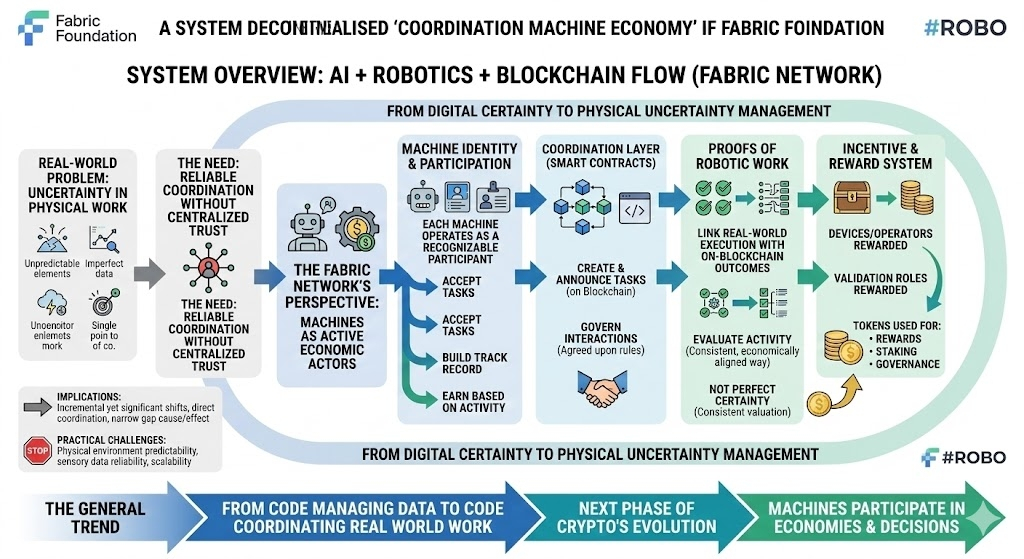
Each machine operates as a recognizable participant. It can accept tasks, build a track record, and earn based on its activity. This shifts the system from isolated automation toward a coordinated machine economy.
At the heart of #ROBO is a coordination layer based on smart contracts.
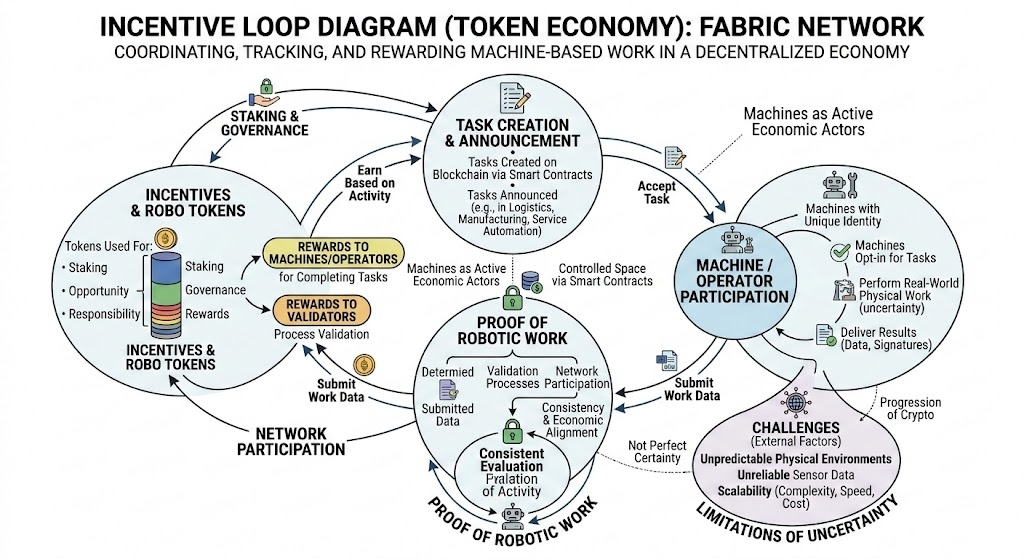
Tasks can be created and announced on the blockchain. Devices or operators can opt to perform these tasks, execute them in the real world, and deliver the results back to the network. The blockchain doesn’t seek to directly observe the real world, but it does offer a controlled space in which interactions are governed by clear and agreed upon rules.
To link real world execution with on blockchain outcomes, Fabric offers the concept of Proof of Robotic Work.
It’s a process that links tasks with economic rewards. Instead of relying on a single source of truth, the system uses submitted data, validation processes, and network participation to determine whether work meets the required conditions. The goal is not perfect certainty, but a consistent and economically aligned way to evaluate activity.
Incentives are an important component of this process.
There are rewards for contributing to the network. Devices/Operators are rewarded for completing tasks, while others may be involved in validating the process. Tokens are used as rewards, as well as in staking, for governance, so that there’s a balance of opportunity and responsibility.
This is a system where machines aren't simply executing code, but rather participating in an economic system.
The implications of such a system are incremental, yet significant.
In a traditional system, coordination of physical activity is often reliant upon centralized platforms, manual reporting, and delayed settlement. However, with a system such as Fabric, these processes could potentially be made more direct. This is because tasks, execution, and settlement could potentially be more closely related, thus narrowing the space between cause and effect.
This could potentially have implications for a system such as logistics, manufacturing, or even service automation, where coordination is inherently complex, especially where trust is fragmented. This is because, with a shared coordination system, there is less need to have single points of control.
There are practical challenges to address.
Physical environments are unpredictable, and data from sensors or machines is not always reliable. While the system introduces structured ways to evaluate activity, it cannot fully remove uncertainty.
Scalability is another consideration. Coordinating real world tasks involves more complexity than processing purely digital transactions, which may affect speed and cost.
Adoption may be the most important factor. For this model to work, it must integrate into existing industries without adding unnecessary friction.
However, it is clear that the general trend is becoming more evident.
As machines get more powerful, it is not just that they will be able to get things done; they will be able to participate in decisions and economic systems as well.
This requires a system that is capable of facilitating and rewarding this kind of machine based work in a way that is open and standardized.
Fabric proposes that this is something that blockchains are capable of facilitating.
Rather than just being concerned with assets and transactions, they will be able to start facilitating real world activity in a way that is programmable. This is a move from merely recording value to actually structuring how value is created.
From a personal standpoint, this just feels like a progression.
The early crypto systems made it so that trust in digital systems was no longer necessary. The next step is not to get rid of uncertainty in the physical world; it is simply to manage it in a more open and systematic way.
Fabric does not try to solve everything at once; it simply tries to provide a system in which machines are able to act, interact, and earn in a decentralized way.
And that shift from code managing data to code coordinating real world work may define the next phase of crypto’s evolution.
Disclaimer
The views expressed in this article are the author’s observations and research perspectives on the development of blockchain and robotics technologies. This article is not investment advice or a recommendation to buy or sell any cryptocurrency.