

I’ve been staring at charts for years, and if there’s one thing I’ve learned, it’s that the blockchain world is obsessed with "extremes." We are constantly told we have to choose: either you embrace the radical transparency of Bitcoin where the whole world can see your wallet’s "laundry," or you go full-dark with privacy coins that eventually get hunted down by regulators. I’ve always found this binary choice to be a bit of a trap.
Lately, I’ve been spending my nights—no pun intended—digging into the architecture of Midnight ($NIGHT). I’m not looking at it as a "investor" looking for a quick pump, but as a researcher who’s grown skeptical of the "privacy vs. compliance" debate.
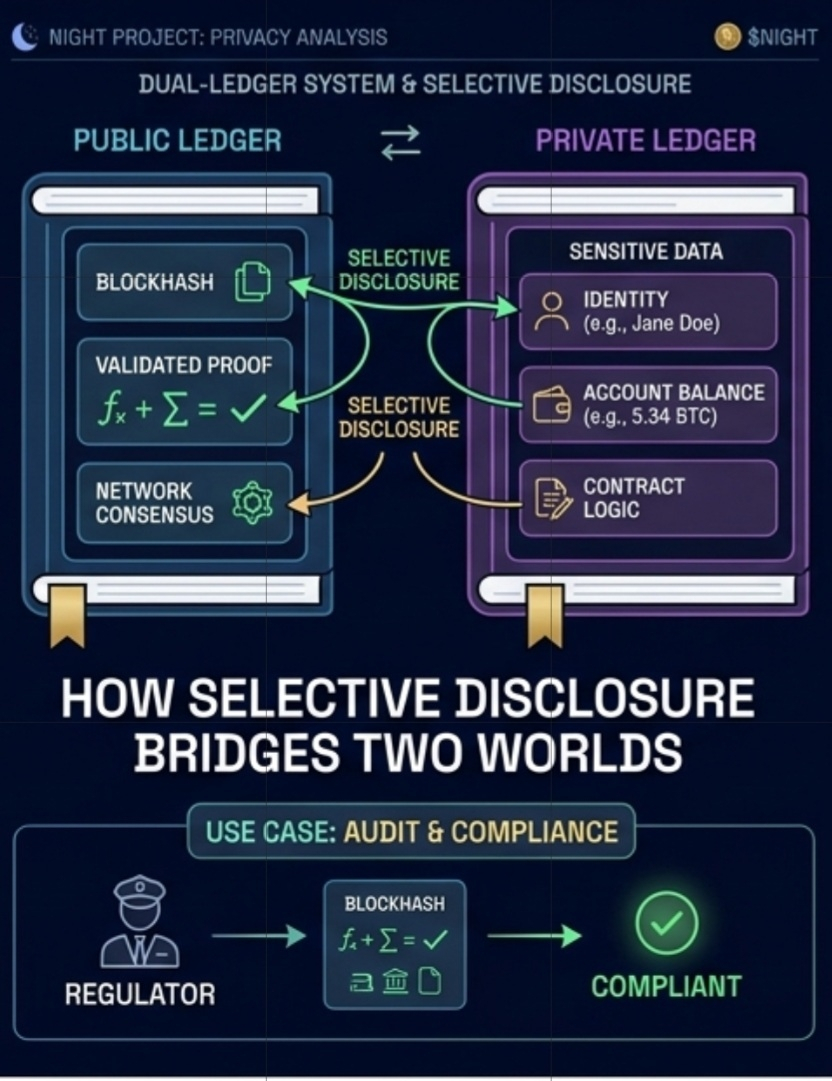
The Dual-Ledger: A Conversation Between Two Realities
When I first looked at the "Dual-Ledger" system in Midnight, I didn't see just another technical gimmick. I saw a mirror of how the real world actually works. Think about it: in your daily life, you have a "Public Ledger" (your reputation, your job title, the car you drive) and a "Private Ledger" (your bank balance, your health records, your private conversations).
What I’m observing here is a protocol that finally stops trying to force everything into the light. It splits the world into two:
The Public Layer: This is the "Social Contract." It’s where the network agrees that something happened.
The Private Layer: This is where the substance lives.
From my perspective, the brilliance isn't just in the split; it’s in the "Selective Disclosure." I’ve seen too many projects fail because they were "too private" to be legal or "too public" to be useful for a real business. Midnight feels like it’s trying to build a bridge. I’m still watching how the synchronization between these two ledgers holds up under heavy load, but the logic is sound: reveal only what is necessary, hide what is sacred.
ZK-Proofs: Verification Without the "Strip Search"
I’ve been a long-time fan of Zero-Knowledge (ZK) technology, but I’ve always been wary of how it’s implemented. Usually, it feels like a "black box" that asks for blind trust. But in the context of $NIGHT, I see a very clear, almost surgical separation between Data and Truth.
Here is my take: The network doesn't need to know who you are or how much you sent to know that you aren't cheating. It’s like showing a bouncer an ID that only displays a green light if you’re over 18, without revealing your name, address, or birth date.
I observe this as the ultimate "Verify, Don't Trust" mechanism. The Truth (the result of the transaction) is verified publicly, but the Data (the sensitive inputs) stays with you. This isn't just a feature; it's a fundamental shift in the power dynamic between the user and the infrastructure.
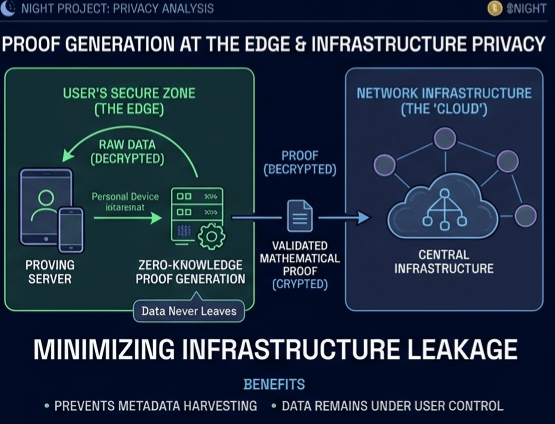
The Proving Server: Keeping the "Secrets" Local
This is where I get really analytical. In most "privacy" chains, the moment you broadcast a transaction, you’re already leaking metadata to some node in a basement somewhere.
I’ve been researching the Proving Server model Midnight uses, and it’s a clever move. By allowing the "Proof" to be generated locally—or on a dedicated server you control—the project is effectively shrinking the "attack surface." I’m always skeptical of infrastructure, so seeing a design that assumes the infrastructure might be compromised and builds defenses accordingly is refreshing. It’s about minimizing leakage at the source.
The Wallet Architecture: More Than Just a Balance
When I look at the wallet structure they’ve proposed, I don't see a simple interface. I see a complex system designed for the "Machine Economy." You have your regular assets, your shielded assets, and your fees.
To me, this tells a story. It says that privacy isn't a "cloak" you put on; it’s a part of the engine. I’ve been watching how these three elements interact, and it’s clear they are trying to solve the "gas" problem—how do you pay for a private transaction without that payment itself revealing who you are? It’s a delicate balance, and I’m still monitoring the UX to see if it’s truly "human-ready."
My Critical Take: Is This the "Goldilocks" Solution?
I’m always searching for the "catch." No project is perfect. But my point of view on Midnight is that it’s asking the right questions. It isn't promising a utopia of total invisibility, nor is it surrendering to total surveillance.
It’s an educational moment for the whole industry. We are learning that privacy is a "Trust Layer," not a "Dark Layer." As someone who’s spent four years grinding in this space, I see this as a necessary evolution. We need tools that allow us to be compliant enough for an audit, but private enough to remain free individuals.
I’ll keep watching. I’ll keep analyzing the "Truth" vs. the "Data." But for now, NIGHT feels like one of the few projects actually trying to solve the paradox .rather than just ignoring it
$NIGHT @MidnightNetwork #night
