
Most people who hold a token never ask where the block rewards actually come from. they assume there's a pool, the pool pays out, and eventually the pool runs out. that's roughly true for most chains. but Midnight's reward system has a specific formula behind it and understanding that formula tells you something important about how the whole thing is designed to last.
the starting point is a value called R. this is the base distribution rate a constant that determines what percentage of the remaining Reserve tokens gets distributed with every single block. not a flat number of tokens. a percentage of whatever is left. that distinction matters enormously.
heres the formula for R. first you calculate the annual base distribution rate, called Ra:
Ra = π × (1 - B - T) ÷ B
then you divide Ra by γ to get the per-block rate:
R = Ra ÷ γ
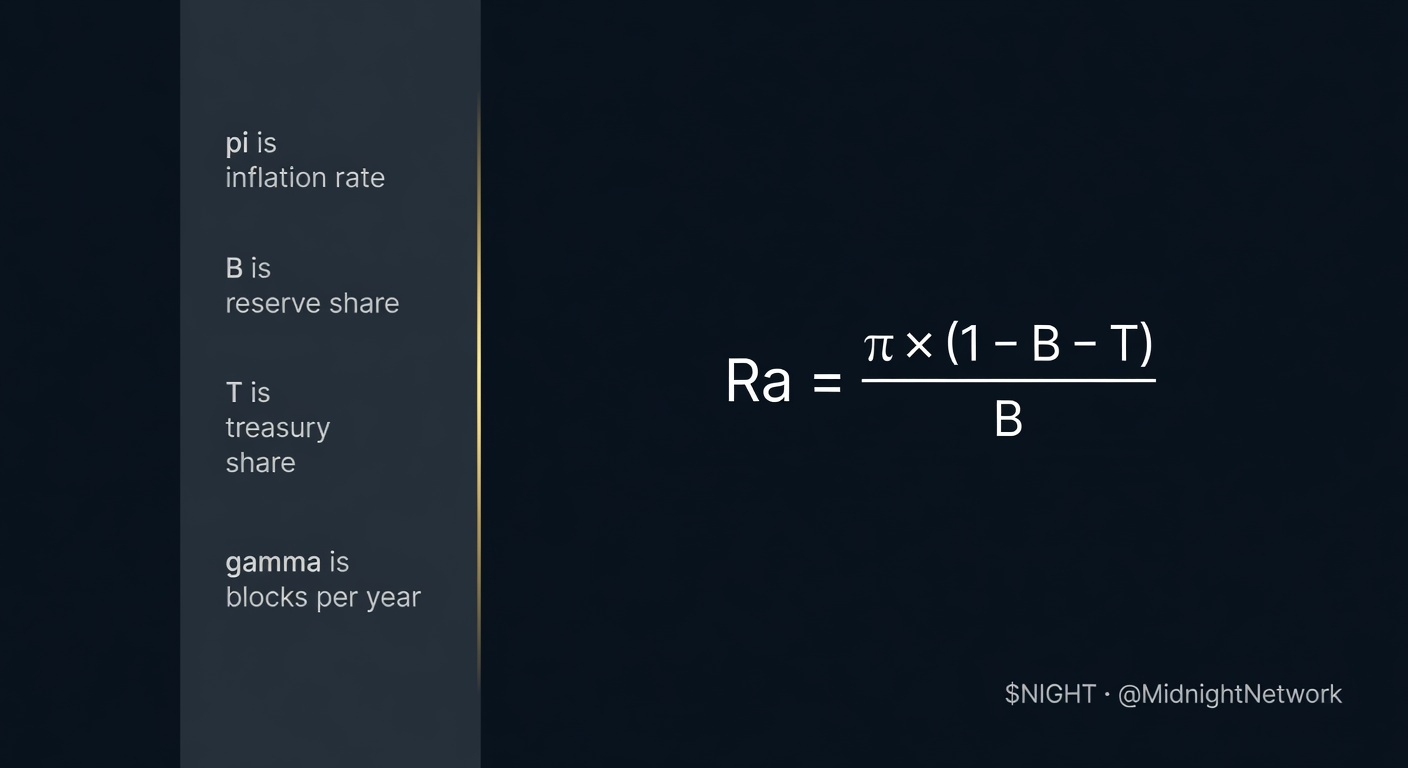
let me break down every variable so nothing is ambiguous. π is the initial annual inflation rate for the circulating supply the whitepaper sets this lower than Ethereum's 5% and Cardano's 7%, close to what economists consider a healthy rate. B is the percentage of total NIGHT supply allocated to the Reserve by the end of token distribution. T is the percentage allocated to the on-chain Treasury. γ is the number of blocks produced in a year which depends on blocktime, expected to fall between 1 and 10 seconds at mainnet launch but not yet finalized.
the whitepaper gives a concrete example to make this real. if the Reserve B is 40% of total supply and Treasury T is 12%, and you want to achieve roughly 3.14% inflation in the circulating supply during the first year, then Ra works out to approximately 4.16%. that means 4.16% of whatever is in the Reserve leaves it annually as block rewards.
once R is known, the base reward per block called Nb is simply:
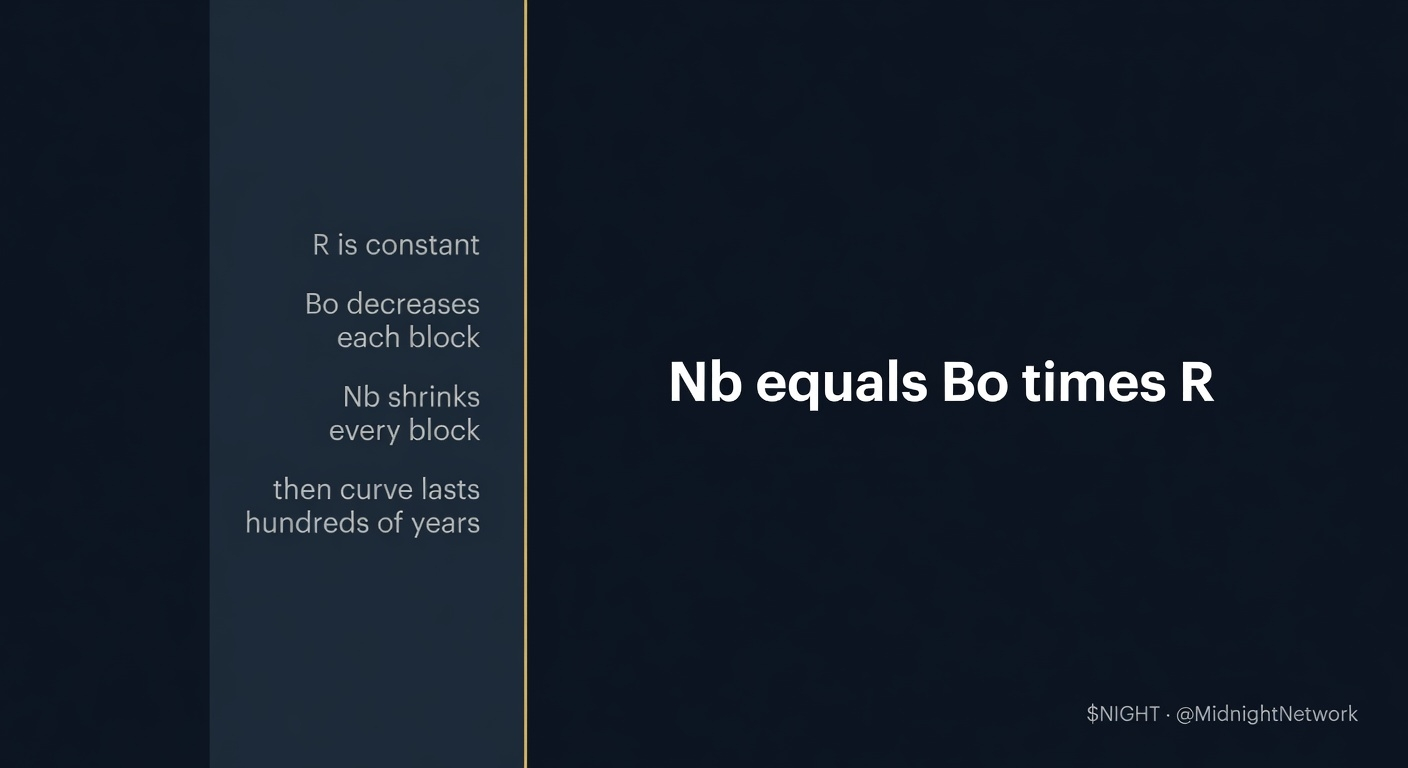
Nb = Bo × R
where Bo is the current number of tokens outstanding in the Reserve at that moment. this is where the decreasing curve comes from. every block that gets produced reduces Bo by Nb. so the next block's reward is calculated on a slightly smaller Reserve. the rate R stays constant. the absolute number of tokens distributed per block keeps shrinking.
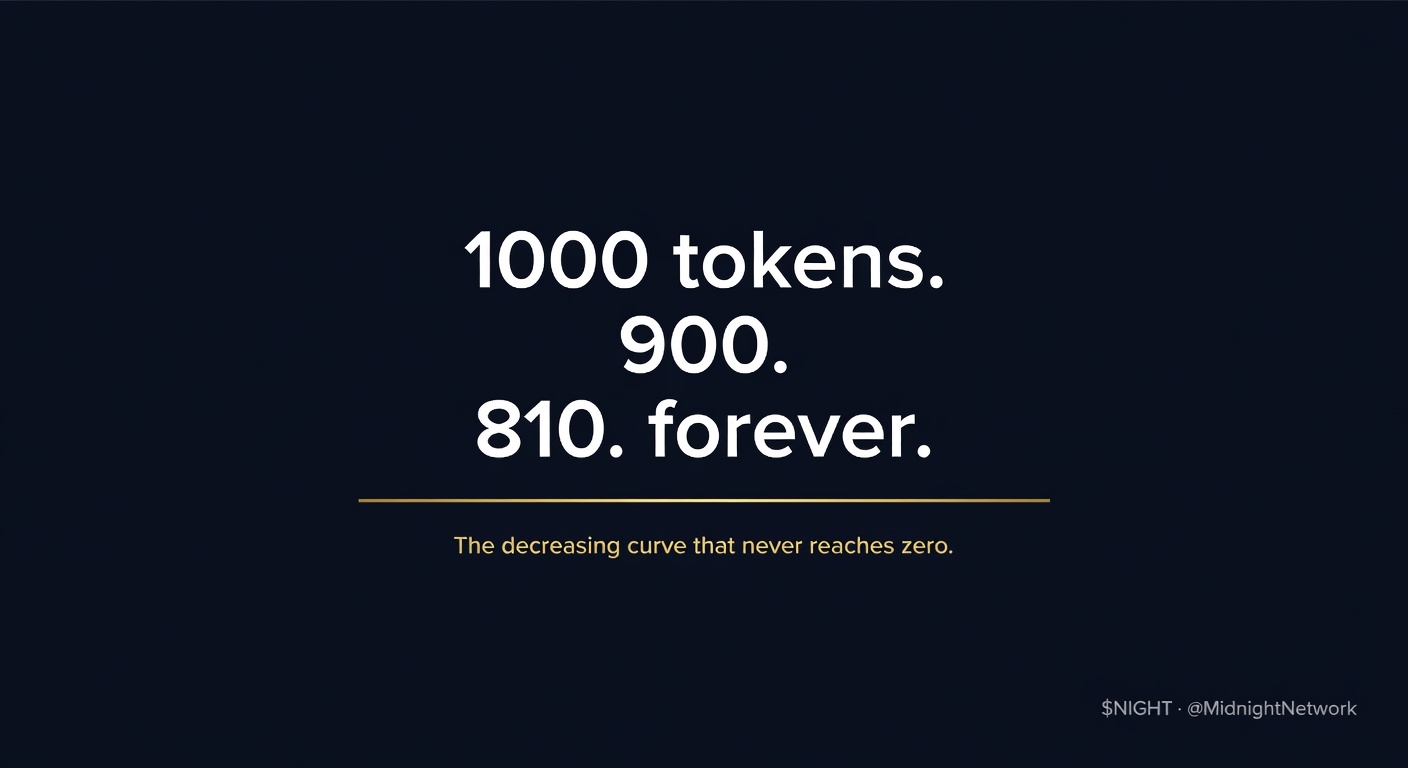
the whitepaper illustrates this with a clean example. start with 1000 tokens in Reserve, distribute 10% per block. block T distributes 100 tokens, leaving 900. block T+1 distributes 90, leaving 810. block T+2 distributes 81. each step smaller than the last but the curve never hits zero. mathematically, this pattern means the Reserve can sustain rewards for hundreds of years. not because the pool is enormous, though it is. but because each distribution takes a percentage of what remains, not a fixed slice.
what this means for predictability is significant. at any point in time, a block producer can calculate exactly what their expected reward will be. they know R. they know Bo. they know their relative stake. the math is fully transparent and auditable nothing about the reward calculation is hidden or discretionary.
the R value itself cant be set until the token distribution ends, because B and T arent known until then. how much ends up in the Reserve depends on how much the community claims during Glacier Drop and Scavenger Mine. the formula is fixed but the inputs are live which means the actual per-block reward number is a function of how broad the participation was in the distribution phases.
theres a design philosophy embedded in all of this. Midnight deliberately chose a decreasing curve over a fixed emission schedule. the curve never fully depletes the Reserve it just approaches zero asymptotically. the implication is that block production rewards, in theory, continue indefinitely. not at meaningful scale forever, but the system never formally runs out.
most blockchains tell you there are X tokens for block rewards. Midnight tells you the exact formula that governs how those tokens leave the Reserve, block by block, for as long as the chain runs.
if you could see the current value of R on mainnet, what would you do with that information?
#night #NIGHT $NIGHT @MidnightNetwork
