
The workflow felt free.
That was the first thing that bothered me.
Not cheap. Not efficient. Free.
A user opened the application, clicked through a private contract flow, and the result came back cleanly. The state updated. The proof verified. Nothing looked broken. Nothing even looked expensive. Just a smooth Midnight interaction moving through the system without the usual little moment of pain most blockchains force on you.
No obvious fee sting.
No visible token drain at the point of action.
Just a clean result and a ledger entry confirming it.
At first that looks like progress. Honestly, maybe it is. Midnight separates the system in a way most chains never do. The computation runs privately, the proof reaches the network, validators confirm correctness through the proof verification layer, and the chain records the result without exposing the execution itself. At the same time, the execution resource doesn’t behave like a normal public gas token either. NIGHT sits in the visible layer. DUST handles execution in the background.
Which means two things disappear at once.
You don’t see the computation.
And you don’t really feel the cost.
That’s a bigger shift than it sounds.
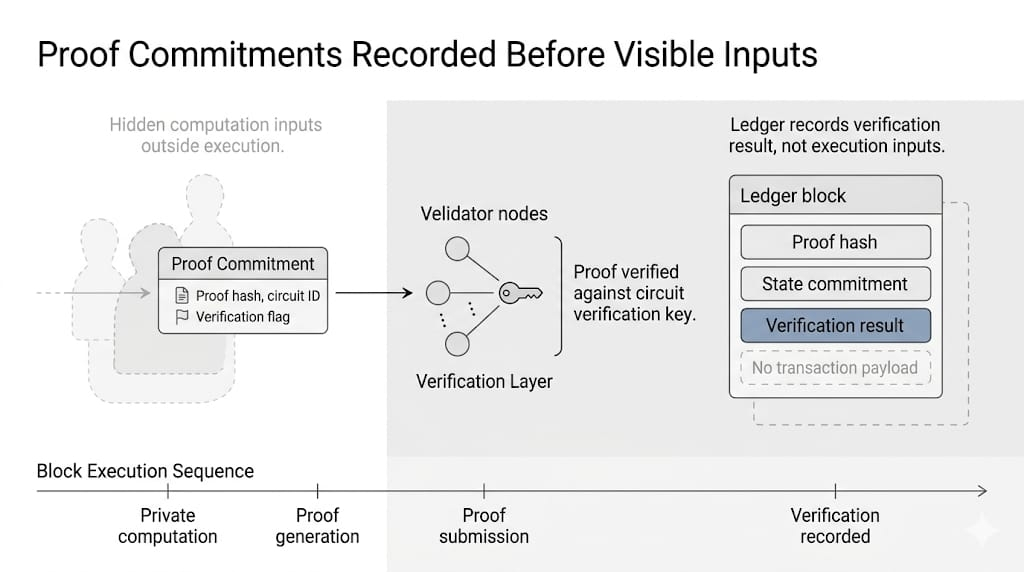
On most chains, the psychological model is crude but effective. You do something, you pay for it, you watch the token leave your wallet, and whether you like it or not, the system teaches you that execution has weight. Midnight smooths that entire surface out. The computation happens inside a confidential environment. The network only sees proof commitments, verification metadata, and the resulting state change. Meanwhile DUST can be generated, designated, consumed, regenerated, even decayed over time without presenting itself to the user like a normal payment event.
So the user experience gets lighter.
Maybe too light.
Because when the application works well, the interaction starts feeling detached from both of the things that usually make blockchains feel real: visible execution and visible cost. The user doesn’t watch the contract run. The user doesn’t necessarily feel the resource being spent. Midnight turns the workflow into something closer to an interface event followed by cryptographic confirmation.
Click.
Proof.
Result.
Done.
Elegant system.
But that elegance pushes pressure somewhere else.
Now the developer has to think about the Midnight verification keys, the local execution flow, the proof generation path, the contract circuits, and a DUST balance that may be quietly absorbing usage in the background. The operator has to think about regeneration, decay, capacity, and whether the application is teaching users a dangerous lesson: that private execution is somehow costless because the cost no longer appears at the moment of interaction.
It isn’t costless.
It’s abstracted.
And abstraction is great right up until someone has to account for it.
That’s the part I keep coming back to. Midnight solves one of blockchain’s ugliest problems by hiding the wrong things less and the right things more. Sensitive data stays private. Public verification stays intact. Fee friction softens. The whole experience becomes more usable, more institutionally legible, more human at the interface layer.
But once both computation and cost move out of sight, the system starts depending on a different kind of literacy.
Someone still has to understand what happened.
Someone still has to understand what it consumed.
And if the workflow keeps feeling effortless while the resource underneath keeps draining quietly in the background, the real question may not be whether Midnight made blockchain interaction smoother.
It may be whether Midnight made the system easier to use…
or just easier to stop noticing.