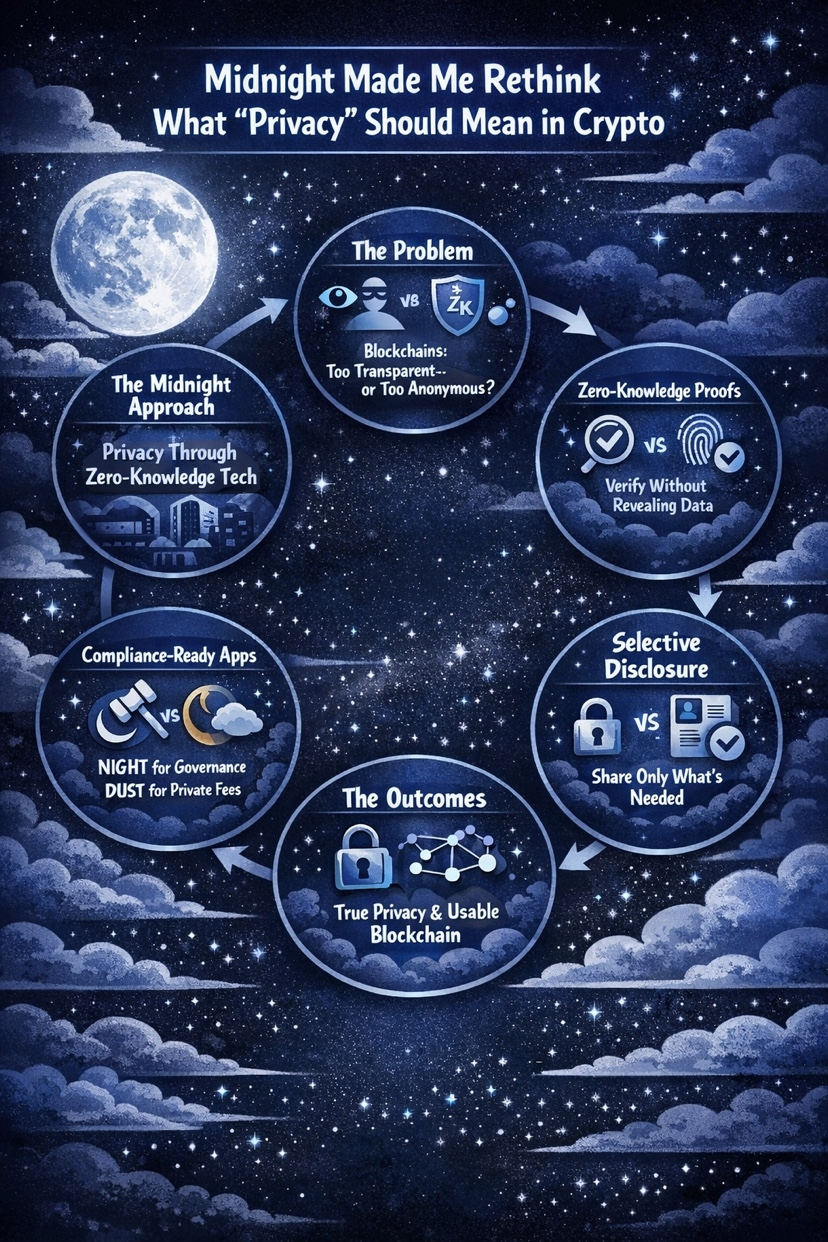
I’ll be honest — when I first heard about Midnight Network, I had the same reaction I get with most privacy projects: here we go again. Another chain promising privacy, another “next big thing,” another set of words that sound perfect until real users show up and the system gets stressed.
But the more I read, the more I realized Midnight isn’t trying to sell “hide everything.” It’s trying to sell something I actually care about: privacy you can still prove. And that’s a very different goal.
I think the real problem isn’t transparency… it’s forced transparency
People love saying “blockchains are transparent, that’s the point.” And yes, transparency builds trust. But full transparency also creates a weird, broken reality where every wallet balance, every payment, every behavior trail becomes public forever.
If I’m a normal user, I don’t want that.
If I’m a business, I definitely don’t want that.
And if crypto wants to become something bigger than trading screens, it can’t keep pretending that public exposure is a feature everyone will accept.
That’s why Midnight’s “selective disclosure” idea clicks with me. The concept that you can prove you’re eligible, compliant, or honest without revealing your raw data feels like the direction blockchains eventually have to move toward.
Zero-knowledge proofs feel like “math magic”… but I respect them for one reason
ZK proofs still feel mind-bending to me. The idea that I can prove something is true without showing the details sounds like a trick — but it’s not a trick. It’s math.
And I like that Midnight seems to build around that core: keep data private, but keep verification public. That’s a strong foundation if it’s executed well, because it keeps the trust model intact. It doesn’t rely on “trust me.” It relies on proofs.
So the appeal is obvious: you don’t have to expose your financial life just to use crypto.
But I’m not blind to the hard part: privacy systems are complex
This is where my skepticism kicks in. ZK systems are elegant, but the tooling around them can get heavy. Provers, circuits, compilers, privacy execution environments — there are a lot of moving parts. And whenever a system becomes very complex, my brain asks the same question:
How many people actually understand the full stack?
Because in crypto, complexity often hides risk. Not always, but often. And privacy chains tend to get judged unfairly too — if anything goes wrong, the public reaction is brutal, because people assume “privacy = suspicious.” So Midnight doesn’t just need good tech. It needs strong reliability under pressure.
The outside world matters too — regulation isn’t optional
I can’t talk about privacy without thinking about how governments react. Privacy coins and mixers have been targeted for years. That doesn’t mean privacy is wrong. It just means the road is not smooth.
Midnight’s challenge is to make privacy compatible with real-world requirements. Not by compromising privacy, but by allowing proof-based compliance — where you can show what’s required without revealing everything else.
If it pulls that off, it becomes more than a privacy chain. It becomes a bridge between “blockchain ideals” and “real-world adoption.”
Why I still think Midnight is necessary (even if it’s risky)
Here’s my honest conclusion: if blockchain ever becomes real infrastructure — for identity, finance, enterprise flows, AI agents, everyday digital life — privacy can’t stay optional.
No serious economy runs on “everyone can see everything.” That’s not how humans work. It’s not how companies work. And it’s not how future onchain systems will work either.
So even with all the risks, I still think Midnight is aiming at something inevitable: a world where the chain can verify truth without exposing people.
My take on $NIGHT right now
I’m not looking at $NIGHT like a meme trade. I’m looking at it like a bet on a future where privacy becomes part of the default stack — not because it’s trendy, but because it’s required for real adoption.
And I’m watching Midnight the way I watch any serious infrastructure project:
• does it stay stable under stress?
• does the developer experience improve?
• does the “selective disclosure” concept turn into real apps?
• can it survive scrutiny without losing its purpose?
I don’t have blind faith. But I do have curiosity — because Midnight is forcing the right questions, and the right questions usually lead to the next era.