
#night $NIGHT Midnight Governance — the part no one is talking about
Been digging into Midnight's governance section and honestly? the launch governance structure is the most consequential undisclosed detail in the entire whitepaper
everyone focuses on NIGHT utility, DUST mechanics, Glacier Drop eligibility. but buried in section 2 of the tokenomics whitepaper is a governance structure that controls every critical parameter of the Midnight network — and the entities who will hold that power havent been identified or formed yet.
what caught my attention:
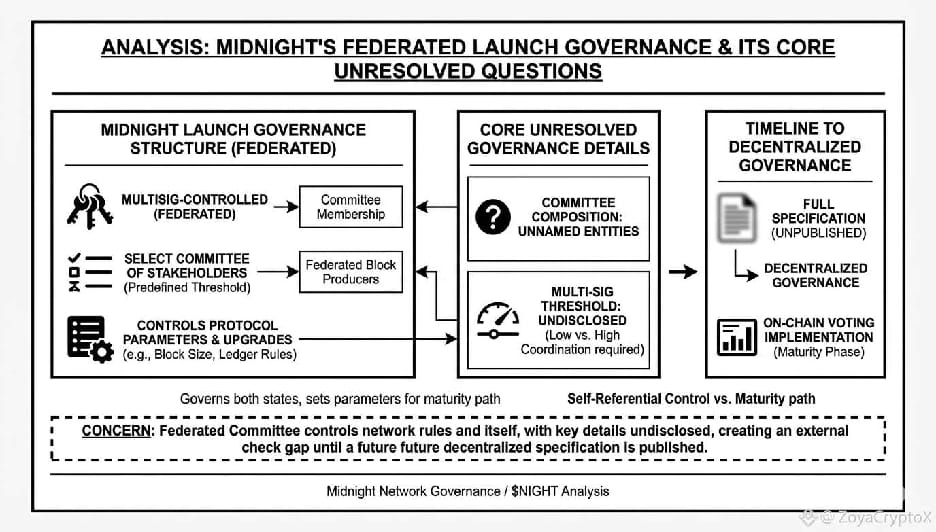
at mainnet launch Midnight does not operate under decentralized community governance. it operates under a federated governance structure. a select committee of stakeholders with equal governance powers controls protocol parameters and upgrades. a specific threshold of their combined approvals is required to pass any governance action.
that threshold is implemented as a multisig mechanism. meaning a predefined number of committee members must sign any transaction before it executes on-chain.
the whitepaper describes this committee as responsible for two specific categories of action.
first — updating Midnight-related parameters on the Cardano network, including governance committee membership itself and the list of federated block producers.
second — updating the Midnight protocol directly, including version upgrades, hard forks, and core parameters like block size and ledger rules.
what worries me:
the whitepaper explicitly states this committee is expected to be composed of various entities that have yet to be identified or formed.
read that again. the committee that controls block size, ledger parameters, hard fork decisions, and its own membership composition — has not been identified. the entities dont exist yet. and Midnight is approaching mainnet.
this isnt a minor detail. the multisig threshold determines how many committee members must coordinate to change any network parameter.
if the threshold is low — say 3 of 5 — a small coordinated group can alter fundamental network rules.
if the threshold is high — say 7 of 9 — changes require broad consensus but the network becomes resistant to necessary upgrades during emergencies.
the part that surprises me more:
the committee controls its own membership. the whitepaper lists updating governance committee members as one of the committee's own responsibilities. this is a self-referential governance structure.
the committee decides who joins or leaves the committee. there is no external check on this process until decentralized governance is implemented.
and decentralized governance is explicitly described as a future development. the full specification and mechanics are expected to be detailed in a future document that hasnt been published yet.
so the timeline looks like this:
unnamed committee forms, controls all parameters including its own membership, operates under undisclosed multisig threshold, until some future point when decentralized governance is implemented under rules that havent been written yet.
still figuring out if:
the whitepaper does acknowledge that as Midnight matures, all components including monetary policy may become subject to on-chain governance provided a predefined voting threshold is met.
that framing is careful — may become subject. not will.
and the predefined threshold itself is a governance parameter that the federated committee would presumably set.
honestly dont know if the undisclosed committee composition and undisclosed multisig threshold is a reasonable pre-mainnet design choice — or a governance gap that concentrates meaningful protocol control in a small unnamed group during the most critical phase of network establishment.
watching:
public announcement of committee member identities
disclosure of multisig threshold before mainnet launch
timeline for transition from federated to decentralized governance
---
what's your take — responsible phased governance approach or an unnamed committee holding more protocol control than most participants realize??
---
Compact language — the part developers might be missing.
been reading Midnight's litepaper architecture section and honestly? the Compact language design is the part most developers completely miss every smart contract platform forces a choice.
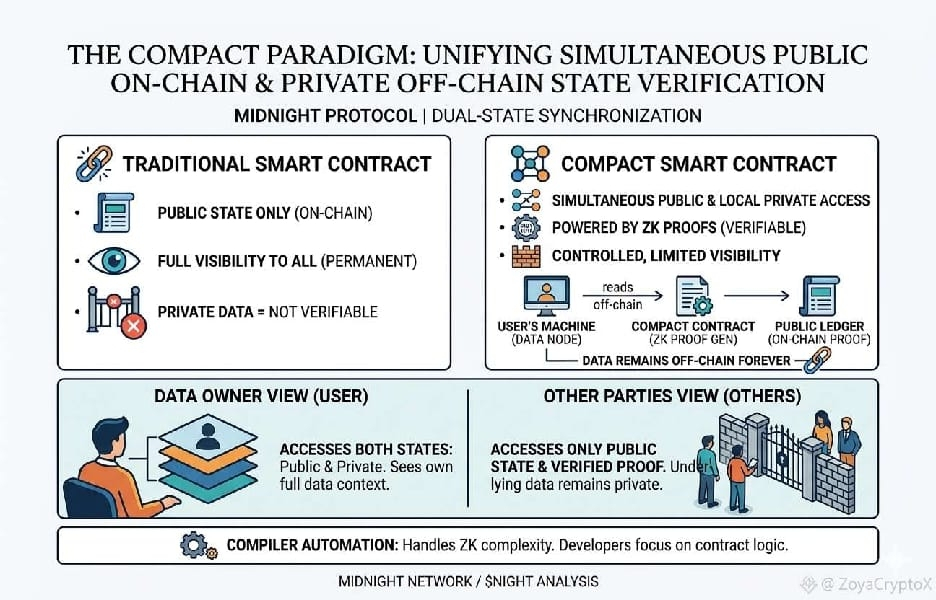
put data on-chain — public, permanent, visible to everyone.
or keep data off-chain — private, but then smart contracts cant verify it.
heres how it works:
a Compact smart contract can simultaneously interact with the on-chain public state — visible to everyone — and off-chain private state stored locally on the user's machine.
same contract. same execution.
two separate data environments.
---
a user holds private data locally — medical records, financial history, identity credentials.
the Compact smart contract reads that private data off-chain, generates a ZK proof that the data meets certain conditions, and submits only that proof on-chain.
the public ledger sees the proof. it never sees the underlying data.
---
other parties interacting with the same contract see only the public state.
they can verify the proof is valid.
they cannot access the private data that generated it.
---
the whitepaper describes this as bridging public and private data.
data owners interact with both states.
other parties interact only with public state in a permissible way.
Honestly dont know how many developers building on Midnight actually understand they have access to both states simultaneously — or whether most will default to treating it like a standard smart contract platform.
what's your take — the feature that finally makes enterprise blockchain viable, or a complexity layer most developers will avoid and build around??