
In the crypto world, new projects appear almost every day new names, new tokens, and new stories promising to reshape the industry. But over time, one pattern has become very clear: the structure behind most of these projects tends to be the same. The packaging changes, the narrative evolves, but the underlying mechanics often remain familiar. And more often than not, the ending follows a similar path.
That’s one of the reasons Midnight Network feels a little different to me.
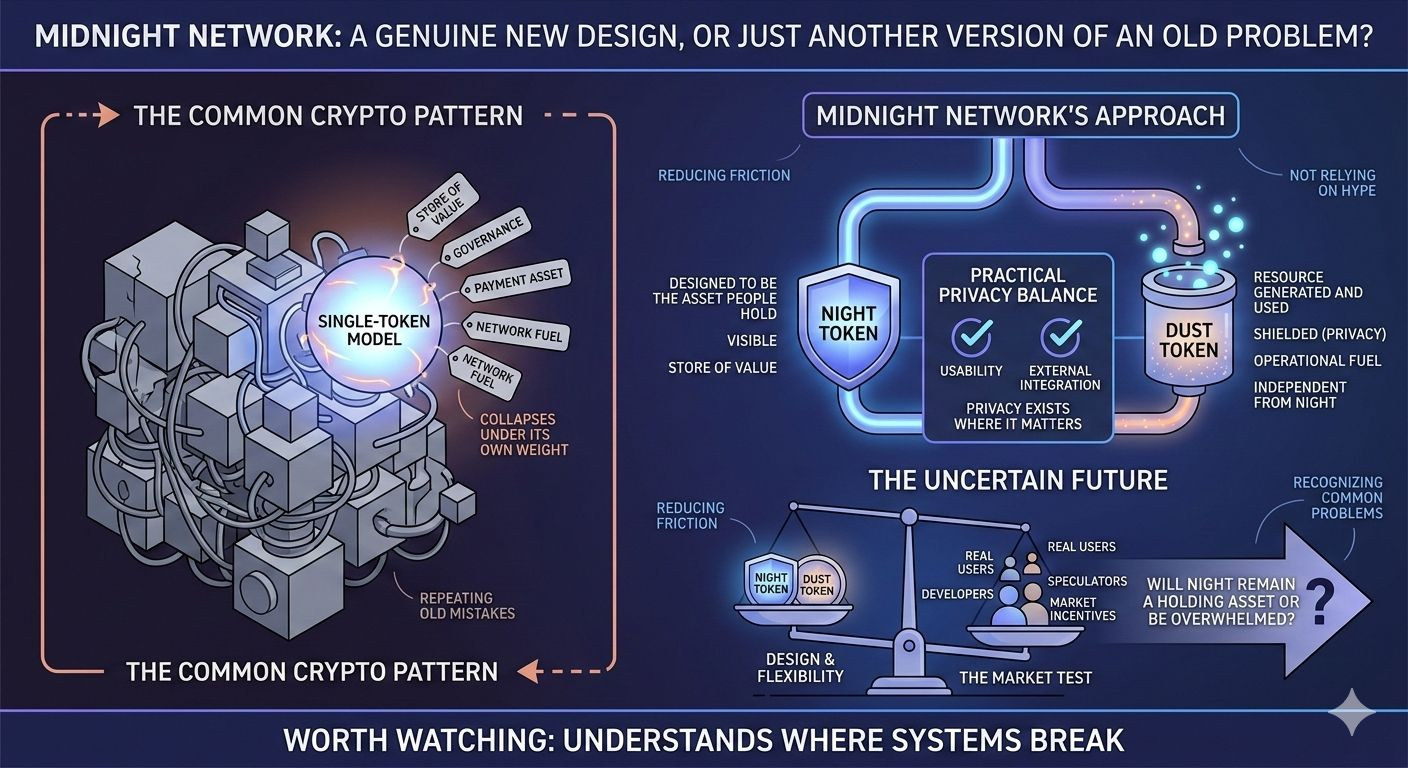
I’m not saying it’s perfect, or that it will solve every problem in crypto. But at the very least, it gives the impression that it was designed by people who understand where things usually start to break in this market.
One of the most noticeable aspects of Midnight is the separation between its two tokens: NIGHT and DUST.
In crypto, we’ve repeatedly seen projects try to make a single token do everything. It becomes the store of value, the governance token, the payment asset, and the fuel for the network all at once. On paper, that sounds convenient. In practice, however, this model often collapses under its own weight.
Midnight takes a different path.
NIGHT is designed to be the asset that people hold.
DUST, on the other hand, is the resource generated and used within the network itself.
This separation has a meaningful advantage. Using the network doesn’t necessarily mean constantly reducing your long-term holdings. Instead, the operational resource (DUST) functions independently from the primary asset (NIGHT), which creates a more flexible economic structure.
Another interesting design choice is how privacy is handled.
DUST is shielded, while NIGHT remains visible.
This suggests that Midnight isn’t trying to push toward extreme privacy where everything becomes completely hidden. In reality, that level of secrecy often reduces usability and makes integration with external systems much harder.
Instead, Midnight seems to be aiming for a more practical balance one where privacy exists where it matters, but the entire system doesn’t become opaque.
That restrained approach is part of what makes the project stand out to me.
Many crypto projects present themselves as if they’ve reinvented the entire industry. The dramatic narratives and oversized promises can feel exhausting after a while. Midnight doesn’t seem to rely on that kind of hype. Instead, it feels like a project that understands the real challenge isn’t inventing a new story it’s reducing the friction within the system itself.
Still, one important truth remains:
Good design does not guarantee success.
Ultimately, the market tests everything.
On paper, structures can look elegant and well thought out. But once real users, developers, holders, and speculators enter the system, each brings their own incentives. Under that pressure, even the most carefully designed frameworks can start to shift.
And that’s where the real question for Midnight lies.
Will NIGHT truly remain a long-term holding asset?
Or will the market eventually push every responsibility back onto it, the way it often does with other tokens?
Because the crypto market has a strong tendency to simplify complex systems into a single narrative. Multiple layers get reduced to one trade, one token, or one dominant story.
How well Midnight can resist that tendency is something that still needs to be seen.
That said, one thing deserves recognition: this project doesn’t appear to ignore the common problems in crypto. Instead, it feels like those issues were considered from the very beginning especially the points where systems usually start to crack.
Whether Midnight ultimately succeeds is still uncertain.
But it’s refreshing to see a project that seems to understand a simple reality:
The biggest problem in crypto isn’t the lack of new ideas it’s repeating the same old mistakes.
And that alone makes Midnight Network worth watching.
