
What keeps pulling me back to Fabric Foundation is that it is not trying to sell me another empty “AI + blockchain” story. A lot of projects throw big words around and expect people to clap. Fabric feels different to me because the idea is actually easy to understand once I strip away the noise: robots are going to do more work in the real world, but the systems around them still treat them like closed corporate tools instead of open economic participants. Fabric is trying to build the missing layer for that. In its own materials, the project frames Fabric as an open network to build, govern, own, and evolve general-purpose robots, with onchain identity, payments, verification, and coordination sitting at the center of that system. It also positions $ROBO as the utility and governance asset for fees, participation, and rewards across that network.
 The part I find most interesting is not the robot, it is the system around the robot
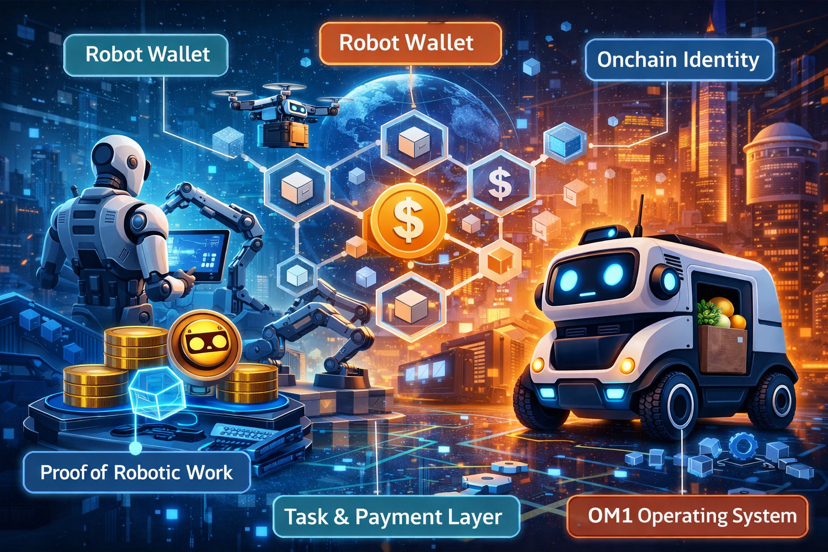
When I look at Fabric, I do not think the real story is “robots earning crypto.” That line is catchy, but to me the deeper point is accountability. Today, when a machine does something wrong or something valuable, the record usually lives inside a company’s private system. That means the company controls the logs, the story, and sometimes even the definition of what happened. Fabric’s answer is to put machine identity and machine activity into a public coordination layer, so actions, payments, and proofs are not just internal records that can quietly disappear later. The official project description leans heavily into this idea that future autonomous robots will need wallets, onchain identities, and verifiable records, because they cannot rely on traditional human documents or banking rails.
I think Fabric is really building for a machine-native economy
This is the point that made me take it more seriously. Fabric is not only imagining robots as hardware. It is imagining them as participants in a network where they can receive tasks, complete work, and settle payment through code. That is a very different mental model. Instead of one company owning everything and every machine being trapped inside one platform, Fabric is pushing toward a system where robots, developers, validators, and users all connect through shared infrastructure. The whitepaper describes a broader vision where data, computation, and oversight are coordinated through public ledgers, while the blog explains that users, developers, and businesses would need to interact with the network through $ROBO staking and usage. That makes the whole thing feel less like a gadget story and more like a new economic framework.
OM1 and the “skill layer” are what make the idea bigger than one robot
Another reason I find Fabric interesting is that it is not talking about one fixed robot doing one narrow job forever. In the whitepaper, Fabric presents ROBO1 as a general-purpose robot built around a modular cognition stack, where specific abilities can be added or removed like “skill chips.” That part stood out to me because it suggests the long-term play is not just hardware deployment, but a marketplace around skills, improvements, data, and machine behavior itself. If that vision works even partially, the value would not come only from one machine doing one task. It would come from a wider ecosystem where capabilities can be upgraded, shared, and monetized across the network. I think that is a much more ambitious idea than most people first realize.
What I like about the token model, and what I still question
I will be honest: I never blindly trust token models, especially when a project has a strong narrative. But with Fabric, I can at least see the logic they are aiming for. The official blog says $ROBO is meant to be used for network fees tied to payments, identity, and verification, while staking is required for certain kinds of participation and builders may need to buy and stake tokens to access the network. Rewards are also supposed to flow toward verified work, data, compute, skill development, and validation. On paper, that creates a loop where the token is tied to actual network functions instead of existing only for speculation. Still, I think the hard part is execution. A model can look clean in a diagram and still become messy in real life if activity stays shallow or if the token gets more attention than the robotics layer itself. The project’s own whitepaper even leaves some governance and design questions open, which honestly makes it feel more real to me than pretending everything is already solved.
Recent momentum is real, but I do not think hype is the real test
Fabric has clearly picked up more attention recently. The token rollout happened in late February 2026, and the market has already shown the usual pattern of listings, trading interest, and volatility that follows new narrative-driven launches. Public market trackers show meaningful swings in both price and trading volume over the past week alone. That tells me people are paying attention, but it does not tell me the thesis is proven. I think the real test is much simpler: can Fabric move from a powerful story into repeatable, verifiable machine activity that people actually want to use? If it can, then this becomes far more than another AI token cycle. If not, it risks becoming one more project that had the right words at the right time.
My honest view on Fabric right now
My opinion is that Fabric Foundation is interesting because it is trying to answer a problem that will only get bigger from here. More machines are entering the economy. More AI systems are making decisions. More real-world actions will need proof, payment, identity, and coordination. I think Fabric understands that the missing piece may not be “better robot marketing” or even just better hardware. It may be the economic and verification layer that lets machines participate in a way that humans can inspect, challenge, and build around.
That is why I keep coming back to it.
Not because I think every promise is already delivered.
Not because I think the market has priced anything correctly.
But because I think the question Fabric is asking is the right one: when machines stop being simple tools and start becoming active participants in work, who owns that system, who verifies it, and who benefits from it?
For me, that is the real @Fabric Foundation thesis.
And honestly, that is a much bigger conversation than just one token.