

If you’ve spent enough time in crypto, you start to notice a pattern. Every cycle promises innovation, but most projects quietly ignore one uncomfortable truth: real-world applications need privacy. Not total secrecy, not shady anonymity just the kind of everyday confidentiality people expect in normal life. That’s exactly where Midnight Network is trying to position itself, and honestly, it’s why traders and developers are paying attention right now.
Midnight isn’t just another Layer 1 chasing speed or TPS metrics. Its core idea is simple: let users prove something without revealing everything. That concept called “selective disclosure” sounds technical, but in plain terms, it’s like showing your ID to confirm your age without handing over your full personal details.
From a developer’s perspective, this removes a huge friction point. Traditional blockchains expose too much data. Imagine building a payroll app where every employee’s salary is visible on-chain. That’s not just inconvenient it’s unusable in the real world. Midnight fixes that by allowing private smart contracts where only necessary information is revealed, while the rest stays hidden but verifiable. 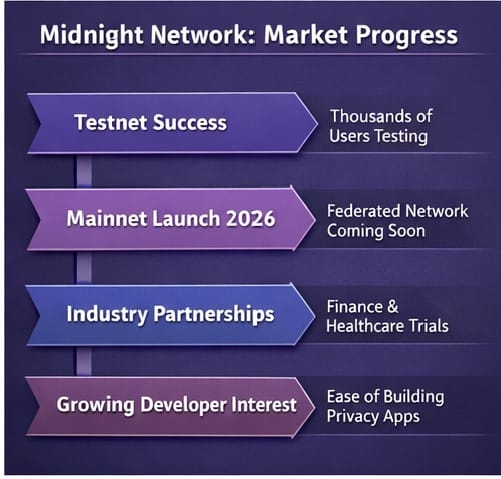
This is where the real-world use cases start to make sense. Think about digital identity. Right now, verifying identity online often means over-sharing documents, addresses, sensitive data. Midnight allows users to prove things like age or credentials without exposing the raw data. It sounds small, but in sectors like finance or healthcare, this is massive. These industries can’t adopt blockchain fully because of compliance and privacy concerns, and Midnight is clearly targeting that gap.
Another area that stands out is business data. If you’ve ever worked with trading firms or even small crypto startups, you know how sensitive internal transactions can be. No one wants competitors tracking their treasury moves in real time. Midnight allows companies to use blockchain rails without broadcasting their entire financial activity. That’s not just useful it’s necessary if blockchain is going to move beyond speculation.
What’s interesting, though, is how this ties into developer experience. Midnight uses a TypeScript-based smart contract language, meaning developers don’t need deep cryptography knowledge to build privacy-focused apps. This might sound like a small design choice, but it’s actually a big deal. Most privacy tech in crypto is powerful but painful to work with. If you reduce that friction, you unlock more builders and more builders usually means more real applications.
From a market perspective, timing also matters. Midnight is trending right now largely because it’s moving toward its federated mainnet launch in 2026, where actual production apps can go live. That transition from testnet experimentation to real usage is where many projects either prove themselves or fade out.
Personally, I see this as one of those “quiet infrastructure plays.” It’s not flashy like meme coins or hyped DeFi protocols, but it solves a real problem I’ve seen repeatedly. I remember trying to explain blockchain payments to a small business owner, and the first question was, “So everyone can see my transactions?” That was the end of that conversation. Midnight is clearly built for that exact moment.
There’s also an interesting angle with its dual-token model and predictable costs, which reduces the volatility developers face when building apps. If you’ve ever deployed contracts on networks where fees spike unpredictably, you understand how frustrating that can be. Simplicity and predictability are underrated features.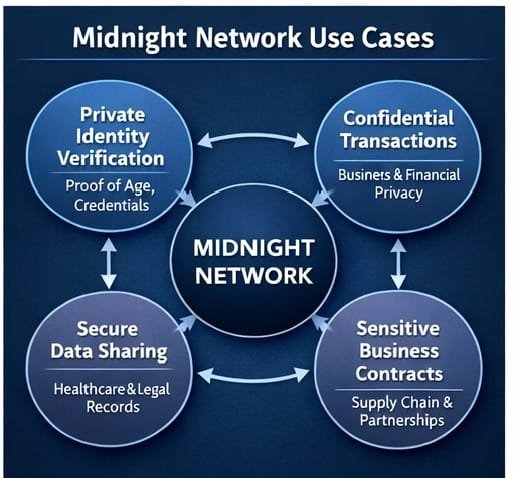
Still, it’s not without challenges. Privacy in crypto always walks a fine line between usability and regulation. Midnight’s “rational privacy” approach where data can be selectively revealed seems like a practical compromise, but adoption will depend on whether developers actually use it and whether institutions trust it.
In the end, Midnight Network isn’t trying to reinvent blockchain. It’s trying to make it usable in situations where privacy is normal, expected, and non-negotiable. And if it delivers on reducing development friction while maintaining speed and simplicity, that’s when it stops being just another project and starts becoming real infrastructure.
