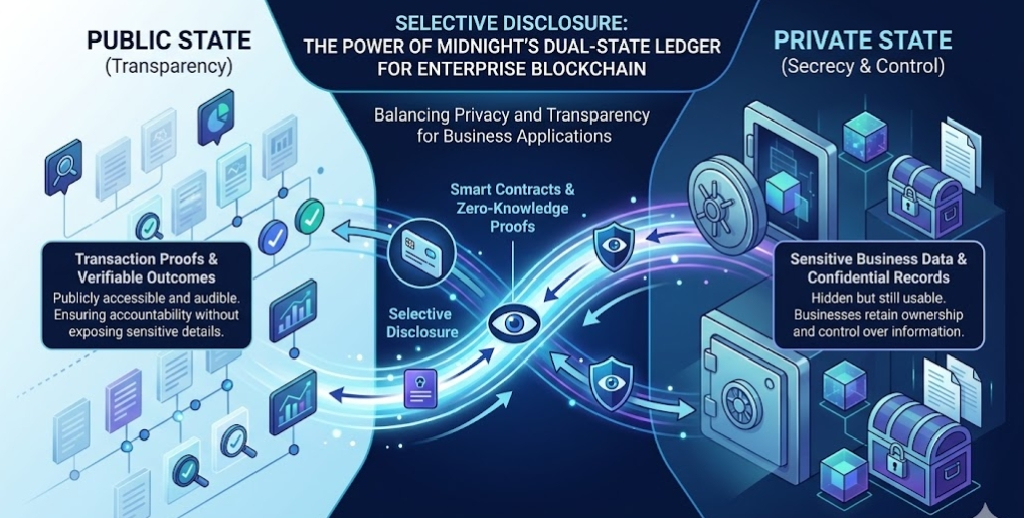
Let’s be honest—one of the biggest problems with blockchain in business isn’t the tech. It’s trust. Not in the system itself, but in how much information gets exposed. Companies don’t want their sensitive data floating around, even on a secure network. That’s where Midnight’s dual-state ledger starts to feel like a real solution instead of just another buzzword.
At its core, selective disclosure is exactly what it sounds like. You share only what’s necessary, nothing more. Think of it like showing your ID to prove your age, but covering everything except your birthdate. Midnight takes this idea and builds it directly into its blockchain design.
The dual-state ledger is the interesting part. It separates public and private data into two layers. One side handles transparency—things like transaction proofs and verifiable outcomes. The other side keeps sensitive details hidden but still usable. So businesses can operate securely without sacrificing compliance or accountability.
This balance matters more than people think. Enterprises don’t just need privacy; they need control. Regulations, audits, partnerships—everything depends on sharing the right data with the right people at the right time. Midnight makes that possible without forcing companies to choose between secrecy and transparency.
What makes this approach feel like the future is its practicality. It doesn’t try to reinvent everything. Instead, it fixes a real pain point in blockchain adoption. And honestly, that’s what enterprise tech needs more of—solutions that actually fit how businesses work.
In a space full of hype, Midnight’s dual-state model feels refreshingly grounded. It’s not just about decentralization anymore. It’s about smart, controlled visibility—and that’s a shift worth paying attention to.