I’m going to be honest: I’ve reached the point where I tune out the moment crypto people start selling me speed like it’s the answer to everything.
Every cycle starts to sound the same after a while. Faster transactions. Lower fees. Better throughput. New architecture, new acronym, new system that’s supposed to fix what the last one couldn’t. And sure, some of that matters. But eventually it all starts blending together.
Because underneath all that noise, one really simple question keeps getting ignored:
Why is so much of this public in the first place?
That, to me, is the part that never gets enough attention.
A while ago, I was explaining blockchain to someone I know who runs a small business. He’s not technical, not deep into crypto, not the kind of person who cares about consensus models or scalability debates. But he understands risk. He understands competition. He understands what sensitive information actually means.
And the moment he realized that transactions on many blockchains can be traced and viewed by basically anyone willing to look, he stopped me mid-conversation.
He just looked at me and said, “Wait… so other people can see who I’m paying?”
That moment stuck with me.
Because inside crypto, people get used to this stuff. They start treating it like normal. They talk about transparency like it’s automatically a good thing. But once you explain it to someone outside that bubble, you realize how strange it really sounds.
For most people, privacy is not some niche feature.
It’s expected.
If I make a payment, I don’t expect strangers to inspect it. If I run a business, I don’t expect competitors to map out who I deal with. If I verify my identity somewhere, I don’t expect to hand over my entire digital life just to prove one thing.
That’s why zero-knowledge tech matters.
Not because it sounds futuristic. Not because the cryptography is clever. But because it feels like one of the first serious attempts to fix something blockchain probably got wrong from the beginning.
The idea itself is actually simple once you strip away the intimidating language.
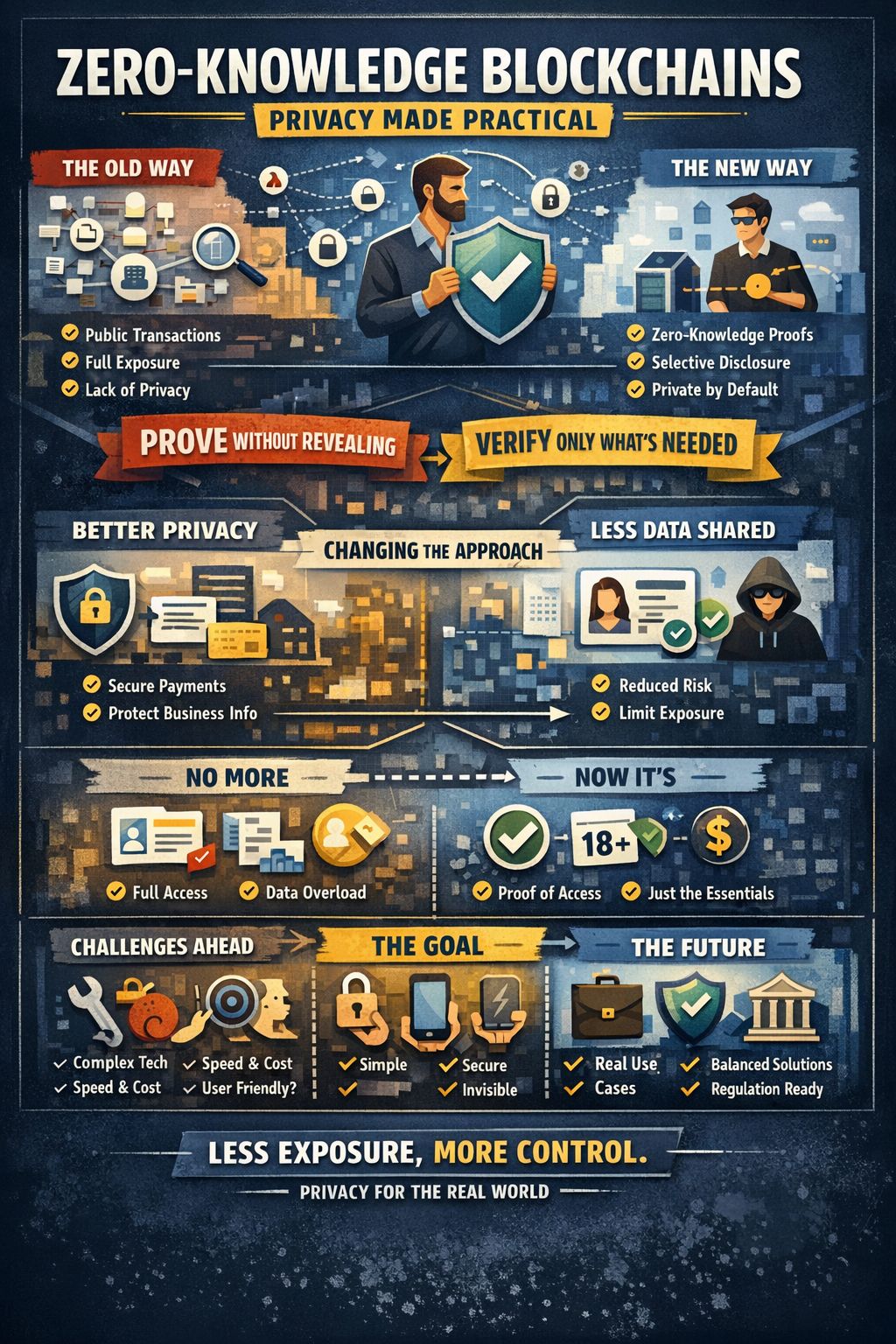
With zero-knowledge proofs, you can prove something is true without revealing the underlying information.
That’s really it.
You can prove you have enough money without revealing your full balance. You can prove you meet a requirement without exposing your entire identity. You can prove something checks out without opening up everything underneath it.
And when you say it like that, it doesn’t sound weird at all.
It sounds normal.
Because that’s already how life works offline.
Most of the time, people don’t need your whole story. They just need the part that matters. If you’re entering a building, they need to know you’re allowed in. If you’re making a payment, they need to know it clears. If you’re proving your age, they need to know you’re old enough.
That’s it.
What’s strange is not selective disclosure.
What’s strange is that blockchain spent so long acting like exposing everything was a reasonable default.
For a while, privacy coins were the main answer to that problem. And to be fair, they saw the issue early. They understood before a lot of the industry did that financial systems without privacy were always going to feel incomplete.
But they also ran into the obvious backlash.
The more privacy became associated with “hide everything,” the more regulators closed in. And once that happened, privacy in crypto got pushed into an awkward corner where it was treated as suspicious, impractical, or like something only a small ideological group really cared about.
That’s why zero-knowledge feels different now.
The framing is more realistic.
It’s not really about disappearing completely. It’s more about revealing only what’s necessary.
That shift matters more than people think.
Because there’s a huge difference between saying, “Nobody should ever know anything,” and saying, “People shouldn’t have to give away more than they need to.”
One sounds extreme.
The other sounds reasonable.
And honestly, I think that’s why this area is finally getting more serious attention. Privacy is starting to be discussed less like rebellion and more like infrastructure.
That’s a much healthier place for the conversation to be.
Because if you zoom out a little, this isn’t only a blockchain issue.
It’s an internet issue.
We’ve become way too comfortable handing over data.
Everywhere you go online, the process is basically the same. Sign up. Use your email. Add your phone number. Upload ID. Verify something. Accept permissions. Give away more information than the situation actually needs, then hope the company on the other side handles it responsibly.
Most people know this is ridiculous.
They’ve just gotten used to it.
That’s what makes zero-knowledge interesting beyond crypto. It suggests a different default.
Instead of handing over raw data, you prove a fact about it. Instead of exposing the whole file, you expose the answer.
That may sound like a small difference, but it changes a lot.
It changes how identity could work. It changes how payments could work. It changes how platforms think about storing sensitive information. It changes how much damage a breach can do, because ideally there’s less unnecessary data sitting around to steal in the first place.
And that part matters.
People often talk about privacy like it’s only about secrecy. Sometimes it is. But just as often, it’s about reducing exposure. Reducing what can be tracked, leaked, sold, scraped, or stolen later.
That’s why I think businesses may end up caring about this even more than individual users.
Public blockchains sound great in theory until you imagine running an actual company on one. No serious business wants its transaction patterns, counterparties, treasury movements, or payment flows visible in public if that visibility gives away strategic information.
That’s not openness in some noble sense.
That’s operational exposure.
And once you start thinking in those terms, you realize privacy isn’t some optional extra feature for blockchain.
It may be one of the main things stopping broader use from making sense.
Still, this is the part where I think people need to stay grounded.
Because a good idea does not automatically become a finished product.
And crypto has always had a bad habit of acting like a strong concept is basically the same thing as real adoption.
It isn’t.
Zero-knowledge is still hard. Not “hard” in the way people say when they want to sound deep. Actually hard. Hard to build. Hard to optimize. Hard to explain. Hard to turn into something normal people will use without friction.
The tooling has improved, sure. A lot more teams are building in this area now than a few years ago. But it’s still not the kind of environment where everything feels smooth and mature. Performance still matters. Proof generation still comes with cost. User experience still breaks more easily than the pitch decks suggest.
And that gap matters.
Because users do not care how elegant your cryptography is.
They care whether the product feels annoying.
That’s it.
If it’s confusing, they leave. If it’s slow, they leave. If it feels like homework, they definitely leave.
That’s why the real test for this category is not whether the technology works in theory. It clearly does. The real test is whether it becomes invisible enough to feel natural.
That, to me, is the real goal.
The best technology fades into the background.
You don’t think about the security layer every time you open your banking app. You don’t think about encryption every time you sign into something. You don’t think about internet protocols when you load a page. It all disappears into the experience.
That’s what privacy tech should do too.
If people are still being forced to learn zero-knowledge terminology years from now just to use products, then something probably went wrong. The ideal future is not one where everyone becomes a cryptography nerd. It’s one where people are simply less exposed by default.
No drama. No constant explanation. No unnecessary surrender of personal data just to exist online.
That’s the promise, at least.
And I do think the direction is real. The tone around zero-knowledge has changed. It feels more mature now than it did when privacy in crypto was mostly treated as either a fringe obsession or a regulatory headache. More builders are focusing on selective disclosure. More serious conversations are happening around privacy-preserving identity, private payments, and systems that can still function in regulated environments.
That matters, because regulation is not going away. And to be fair, some of the concerns are legitimate.
Whenever privacy tech shows up, the same question follows:
What stops abuse?
That question can be annoying, but it’s not unreasonable.
Any system that wants to protect privacy at scale has to answer it. Not dodge it. Not act morally superior about it. Actually answer it.
That’s why I think the more practical versions of zero-knowledge will be the ones that survive. The ones that accept the world as it is, not the world people wish existed. Systems that let users stay private by default, while still making targeted disclosure possible when there’s a real reason for it.
It’s not pure.
But most things that last aren’t.
They’re just workable.
And maybe that’s enough.
Because the deeper point here is simple: people should not have to expose more than necessary just to use digital systems.
That shouldn’t sound radical.
It should sound overdue.
For years, blockchain treated privacy like something optional, something that could be added later after the “important” things were solved. Speed came first. Cost came first. Scale came first. Privacy was pushed to the side like it was a niche preference instead of a basic requirement for real life.
Now that is starting to look like a mistake.
And that’s why zero-knowledge matters more than a lot of the usual hype cycles. Not because every project using the label deserves attention. Most don’t. And not because the space is magically finished. It isn’t.
It matters because it points toward a better default.
Not total opacity. Not reckless exposure. Just a smarter middle ground where systems can verify what they need without forcing people to reveal everything else.
That’s the version that makes sense to me.
Whether the industry can actually deliver it is another question.
And that’s where I still have some skepticism.
Crypto is full of ideas that were genuinely smart and still went nowhere. Not because they were useless, but because they never crossed the gap between technical promise and normal human usability. That gap is where a lot of ambitious projects die.
So yes, I think zero-knowledge blockchains are important.
I think they’re addressing something real.
I think privacy has been neglected for too long because it was easier to market speed than to solve subtle problems properly.
But I also think the hard part is still ahead.
Can this become simple enough that people use it without thinking about it?
Can it protect users without making everything feel complicated?
Can it fit into real products, real businesses, and real habits?
If it can, then this might end up being one of the most meaningful shifts blockchain ever makes.
Not because it reinvents everything.
Because it fixes something that should have been fixed a long time ago.
And if it can’t, then it risks becoming another one of those ideas the industry loves talking about more than actually delivering.
That’s where I land.
Promising, definitely. Necessary, probably. Finished? Not even close.
But for once, the conversation feels like it’s moving in the right direction.
And maybe that’s the real point.
For years, blockchain kept asking how to make everything faster.
Maybe it should have been asking how to make people less exposed.
That’s a much more human question.
And zero-knowledge, at its best, feels like the first serious attempt to answer it.
#night $NIGHT @MidnightNetwork