

I'll be honest. When I first read "ShieldUSD deployed on Preprod" in Charles Hoskinson's post yesterday, my reaction was: "Great, another stablecoin."
Then I looked closer. And I realized this is different.
What Actually Happened
Yesterday — March 17, 2026 — a quiet announcement crossed my timeline. ShieldUSD, a privacy-preserving stablecoin built on Midnight, is now live in the Preprod environment.
Not a whitepaper. Not a promise. Code, deployed, and running.
A minimal viable contract, yes. Limited in scope, yes. But running on the same infrastructure that mainnet will use next week.
Why This Isn't Just Another Stablecoin
Every other stablecoin faces the same impossible trade-off:
Transparent blockchains (USDC on Ethereum, USDT on every chain) expose everything. Your wallet address. The amount you sent. Who you sent it to. Your salary, your payments, your business relationships — all public, forever.
Privacy coins (Monero, Zcash) go the other way. They hide everything. Which sounds great until a regulator asks: "Prove you're not laundering money." You can't. So institutions stay away.
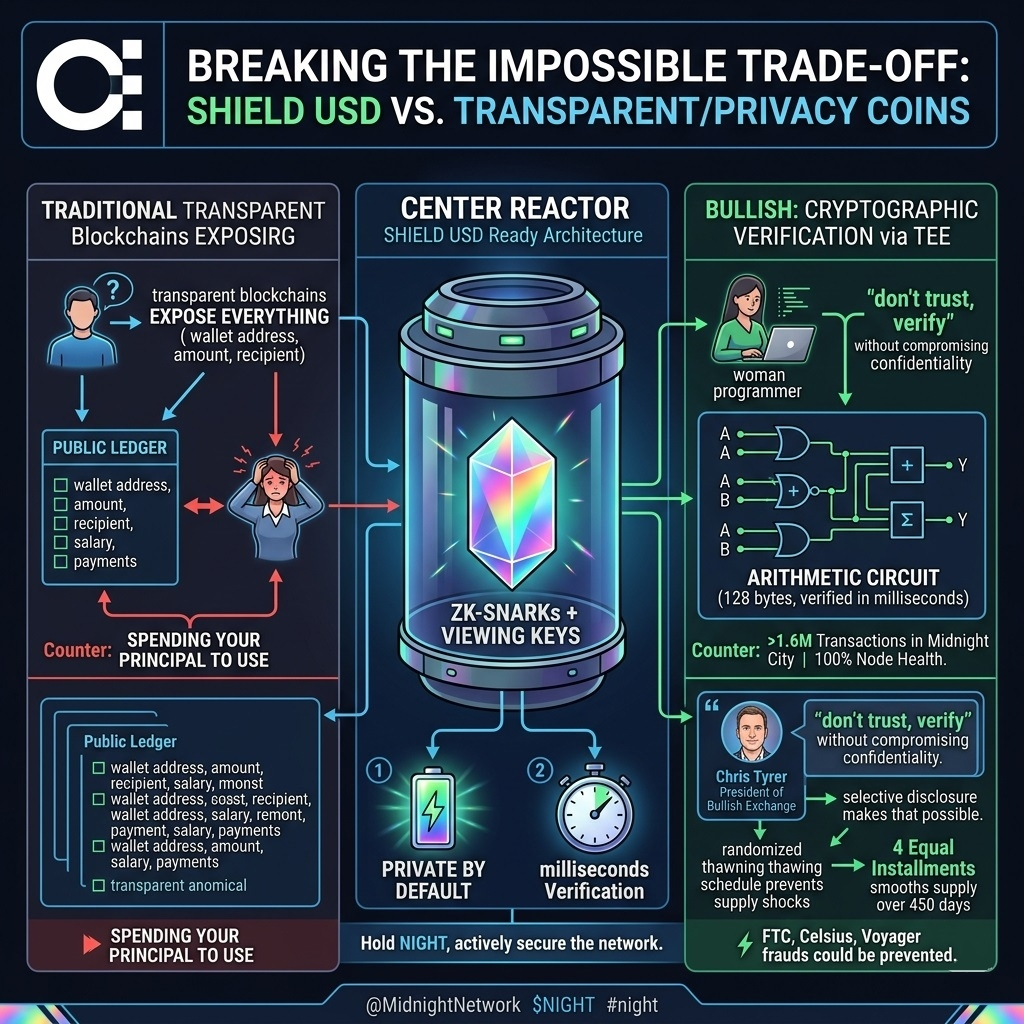
ShieldUSD is the first to break this trade-off.
It uses ZK-SNARKs to keep transactions private by default. The network sees a proof that the transaction is valid. It never sees the amounts, the addresses, or the metadata.
But here's the part that changes everything: selective disclosure.
Every user holds a cryptographic "viewing key." If a regulator, auditor, or compliance officer needs to verify something — proof of funds, AML check, tax reporting — the user can share that key. The regulator sees exactly what they're authorized to see. Nothing more. Nothing less.
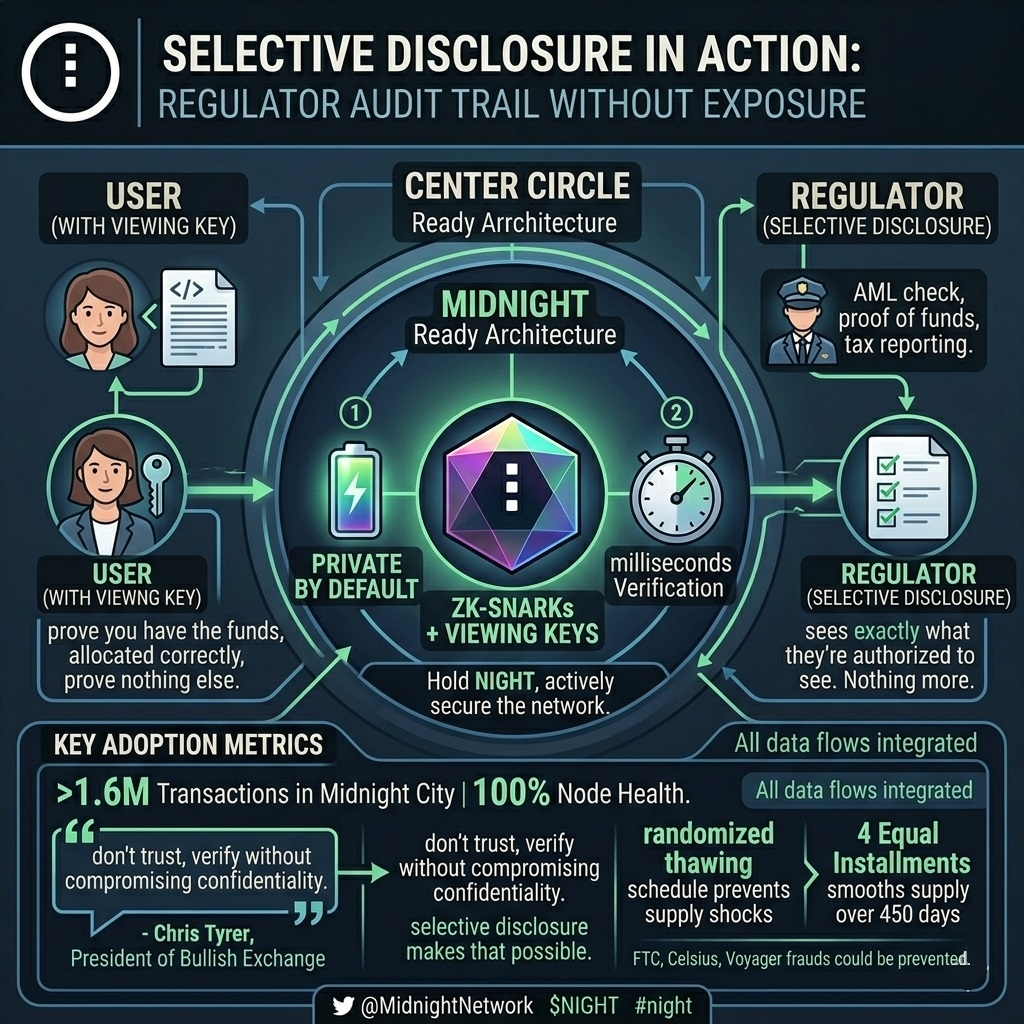
That's not a feature. That's the missing piece that's kept institutional money off-chain for a decade.
The Technical Layer Nobody's Talking About
ShieldUSD isn't just a token on Midnight. It's a demonstration of what the architecture enables:
ZK-SNARKs generate proofs that are tiny — around 128 bytes — and verify in milliseconds. The proof confirms: "This transaction follows the rules. Sufficient balance. No double-spend. Valid signatures." The underlying data never touches the public ledger.
Viewing keys are the breakthrough. They're not backdoors — they're cryptographic capabilities. With the right key, an authorized party can decrypt specific transaction details. Without it, they see nothing.
The Preprod deployment means developers can now:
Examine the contract code
Test private transfers
Experiment with selective disclosure workflows
Build applications before mainnet even launches
What This Means for Developers
For the first time, building compliant private applications doesn't require a cryptography PhD.
The ShieldUSD contract is open source. Any developer can:
Fork it
Modify it for their use case
Deploy their own version on Preprod today
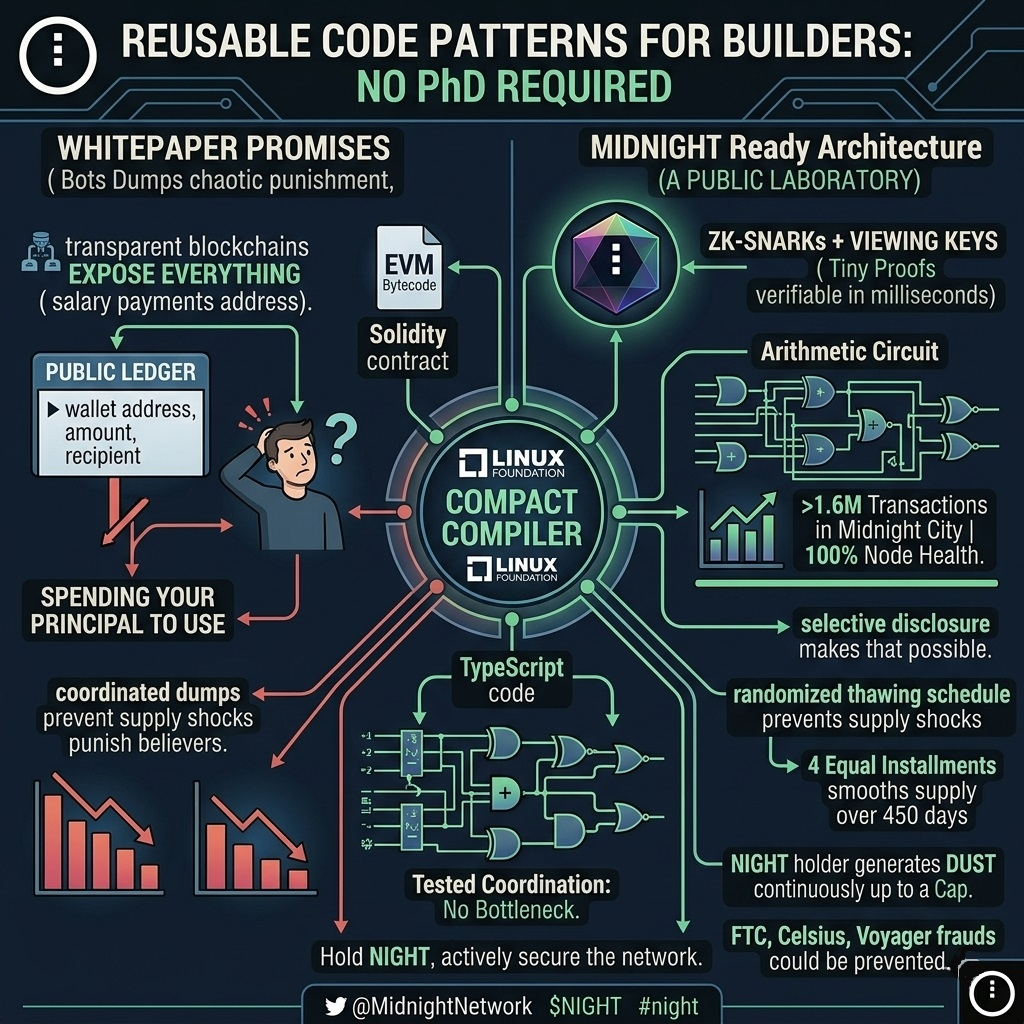
A developer in Southeast Asia building a remittance app can use the same pattern. A team in Europe building a payroll system can adapt the code. A bank exploring private settlements can start from working software, not a blank page.
This is how ecosystems grow: not through press releases, but through reusable code that solves real problems.
The Risk Nobody's Mentioning
Let's be honest about what Preprod means. It's a test environment. The contract is minimal. The liquidity isn't there yet. Mainnet could reveal edge cases no one caught in testing.
But that's exactly why Preprod exists. To find the edge cases before they matter.
ShieldUSD on Preprod isn't the finished product. It's the proof that the pattern works. The finish line is next week.
Why It Matters for Mainnet
Mainnet launches next week. ShieldUSD on Preprod is the first real proof that:
The technology works. It's deployed, it's running, it's generating proofs.
Developers are building. Someone wrote this contract. More will follow.
Use cases are real. Stablecoins are the obvious first step — but the same pattern applies to payroll, supply chain finance, cross-border payments, and every other context where sensitive data meets regulatory requirements.
When Worldpay starts moving billions through Midnight — and they will, they've already announced — this is what it'll look like. Private settlements. Auditable trails. Nothing exposed that shouldn't be.
The Part That Should Make You Think
Here's what keeps coming back to me: ShieldUSD isn't a separate project. It's built by the same team that built Midnight. They're not waiting for someone else to build on top — they're showing what's possible themselves.
That's rare. Most infrastructure projects launch and hope developers show up. Midnight is launching with working examples.
The Questions Nobody's Asking
If ShieldUSD works on Preprod, what comes next?
Private payroll systems where employees see their own salaries but not each other's. Supply chain finance where banks verify invoices without seeing supplier relationships. Cross-border payments where regulators see compliance proofs but not transaction details.
All of these become possible with the same pattern: ZK proofs + selective disclosure.
What This Means for You
When mainnet goes live next week, the question won't be "will someone build on this?" The question will be "what do you build first when privacy is programmable?"
ShieldUSD is one answer. There will be more.
And for the first time, you won't have to choose between privacy and compliance. You'll have both.