
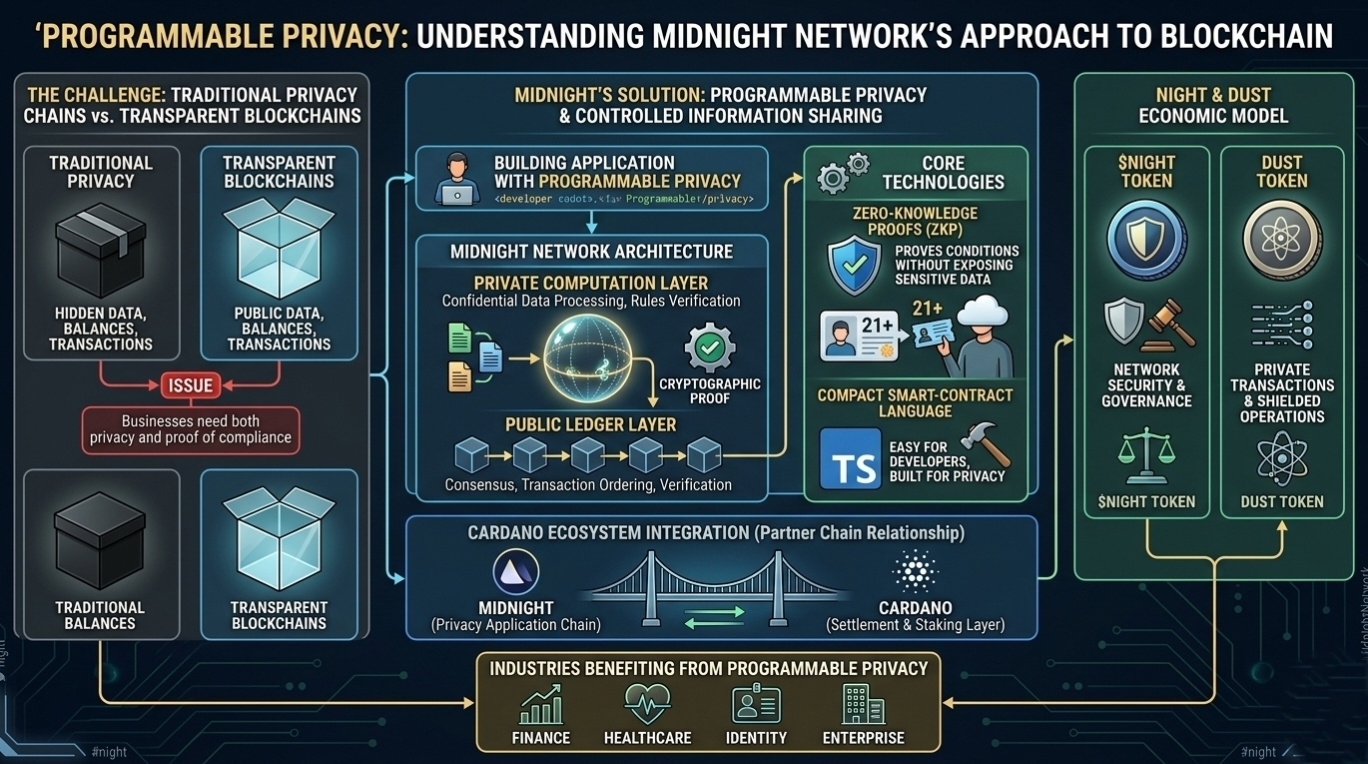
Whan i approach a blockchain that relies on zero-knowledge (ZK) proofs with a different set of expectations than i would bring to a conventional distributed system. i am less interested in novelty and more interested in how the system behaves under pressure—when it is audited, when it is integrated into existing compliance frameworks, and when operators are required to explain its behavior to non-technical stakeholders. the promise here is straightforward: offer utility while preserving data protection and ownership. what matters is how that promise is implemented in practice.
at a design level, the use of ZK proofs shifts where trust is placed. instead of exposing raw data for validation, the system allows verification of statements about that data. i find this appealing, but it introduces a subtle trade-off. the system reduces data exposure, but it increases reliance on the correctness of the proving and verification mechanisms. in other words, i am not trusting the data itself—I am trusting the process that attests to it. this changes the audit surface. auditors are no longer reviewing datasets directly; they are evaluating whether proofs are generated and verified correctly, consistently, and reproducibly.
this has immediate implications for compliance. in regulated environments, it is rarely sufficient to say that something is private; it must also be demonstrably correct. a ZK-based system must therefore provide clear pathways for validation without revealing sensitive information. i would expect deterministic verification, stable proof formats, and well-defined interfaces for third-party inspection. if these elements are inconsistent or opaque, the system becomes difficult to certify, regardless of its theoretical guarantees.
operational stability is another area where design choices become visible. ZK systems often introduce additional computational steps—proof generation, verification, and sometimes aggregation. these steps must be predictable in both performance and failure modes. i look for systems where proof generation does not introduce unpredictable latency spikes or resource contention. if proof generation is slow or variable, it complicates capacity planning. infrastructure teams need to know how the system behaves under load, not just in ideal conditions.
reliability also depends on how failures are handled. if a proof fails to generate or verify, the system should fail in a way that is observable and diagnosable. silent failures or ambiguous states are unacceptable in environments where financial or regulatory consequences are involved. i would expect clear logging, structured error reporting, and consistent retry semantics. these are not glamorous features, but they are the difference between a system that can be operated and one that cannot.
developer ergonomics is another area that tends to be underestimated. ZK systems can be conceptually complex, and that complexity often leaks into tooling and APIs. i pay close attention to defaults. if the default configuration is unsafe or ambiguous, developers will unintentionally build fragile systems. conversely, if the defaults are conservative and well-documented, they act as guardrails. clear APIs, predictable inputs and outputs, and minimal hidden state all contribute to a system that developers can reason about.
tooling is part of this picture as well. i am interested in whether developers can easily test proofs, simulate edge cases, and validate integrations before deploying to production. if the tooling is incomplete or inconsistent, it increases the likelihood of errors that only surface later, under real-world conditions. in regulated contexts, this is particularly problematic because post-deployment fixes are often constrained by audit requirements.
monitoring and observability deserve equal attention. a ZK-based system may hide data, but it cannot hide its own behavior. operators need visibility into throughput, latency, failure rates, and resource usage. i would expect metrics that reflect both the underlying blockchain activity and the additional ZK-related processes. without this visibility, it becomes difficult to diagnose issues or demonstrate compliance with service-level expectations.
the balance between privacy and transparency is delicate. the system aims to protect data while still allowing verification. from my perspective, the key question is not whether data is hidden, but whether the system remains understandable. transparency does not necessarily mean exposing raw data; it means providing enough information for stakeholders to trust the system’s outputs. this includes clear documentation of what is being proven, how proofs are constructed, and what assumptions underlie them.
infrastructure reliability ties all of these elements together. a system that depends on ZK proofs must ensure that the infrastructure supporting proof generation and verification is robust. this includes handling hardware variability, network conditions, and scaling requirements. if the infrastructure is fragile, the benefits of ZK proofs are undermined by operational risk.
operator trust is built over time, through consistent behavior and clear communication. i look for systems that prioritize predictability over optimization. small, well-understood steps are often more valuable than complex optimizations that are difficult to explain. in environments where accountability matters, being able to explain how and why the system behaves as it does is essential.
ultimately, i do not see ZK proofs as a solution in isolation. they are a component within a broader system that must meet real-world constraints. the value of such a system emerges not from its theoretical properties, but from how those properties are integrated into a stable, auditable, and operable environment. if the design choices support these goals—through clear interfaces, reliable operations, and thoughtful defaults—then the system can deliver on its promise without requiring users to take on unnecessary risk.
i find that the most credible systems are those that acknowledge their trade-offs openly. privacy is achieved at the cost of additional complexity. verification replaces direct inspection. performance must be managed carefully. these are not weaknesses, but they are realities that must be addressed. when they are handled with care, the result is a system that can function not just in theory, but in the environments where scrutiny is constant and failure is not an option.
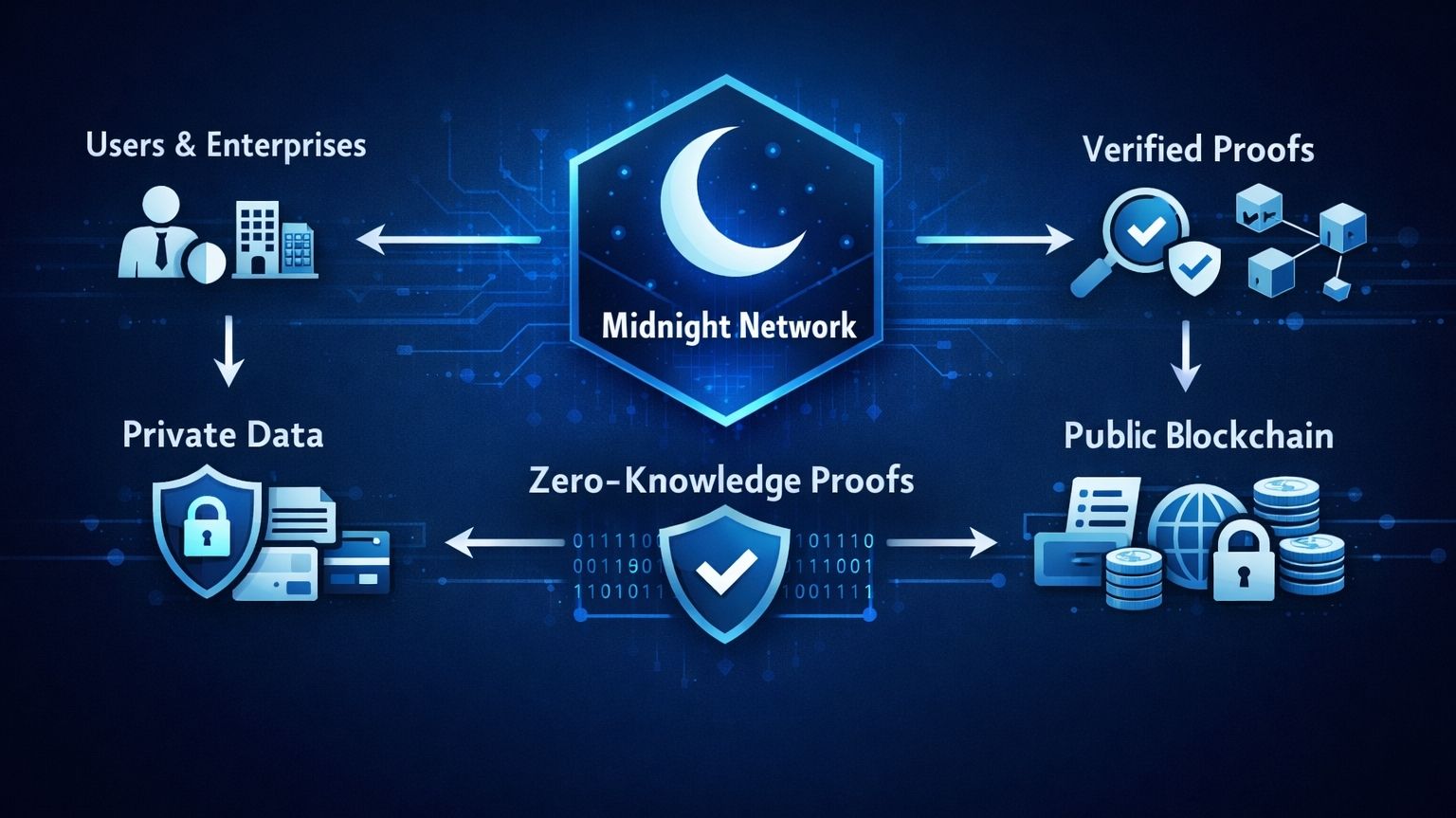
@MidnightNetwork #night $NIGHT
