

I’ve been in the SIGN campaign on Binance Square for a couple of weeks now, posting threads, replying to comments, and actually trading the token with my own money instead of just farming points. It’s given me a front-row view that feels different from the usual Twitter noise or quick chart glances. Most people see the price bouncing around $0.042 and the volume spiking and assume it’s pure campaign hype that’ll fade. What I’ve come to believe and what keeps me holding through the noise is something quieter: the campaign isn’t just inflating short-term liquidity; it’s forcing a rare alignment between reward chasers and real credential users, turning temporary volume into the early scaffolding of organic demand that the market hasn’t priced in yet.
Let me walk you through what I’ve been tracking, because the numbers tell a story that’s more interesting than the usual “low float, big upside” pitch.
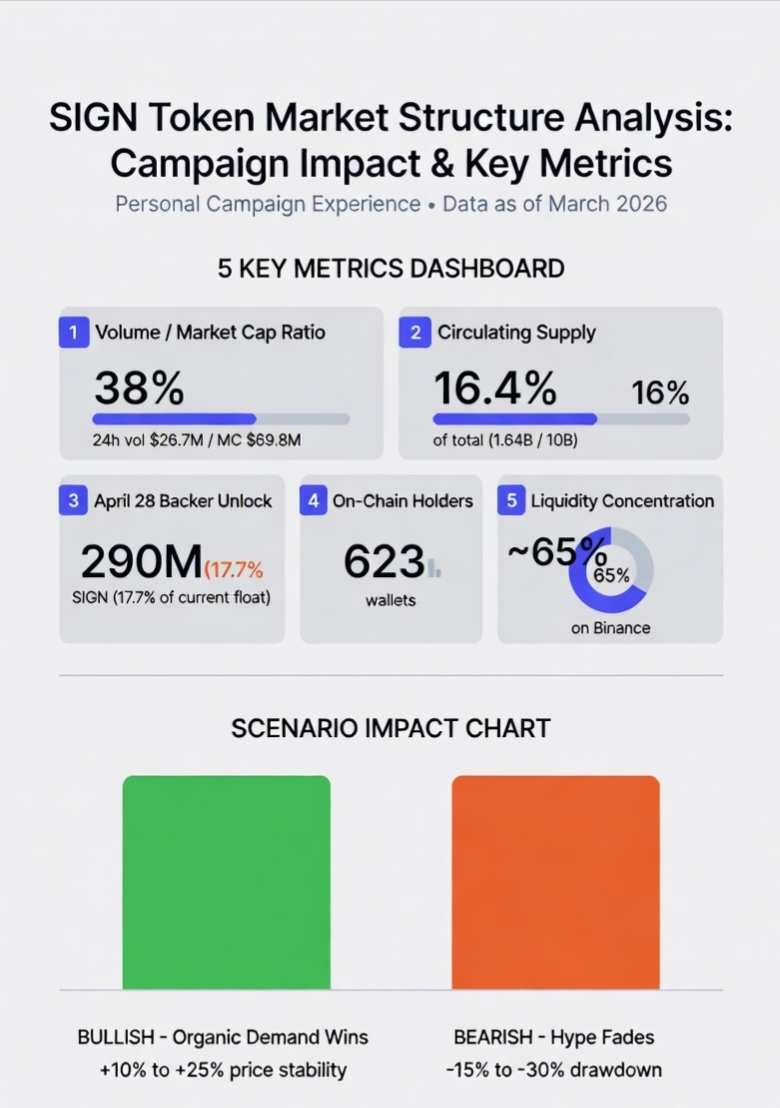
Right now the 24-hour volume sits at roughly $26.7 million on a $69.8 million market cap that’s almost 38% turnover in a single day. I’ve seen days where my own posts and the replies they generate move the pair noticeably. To me this isn’t wash trading or bots; it’s creators who started for the points ending up reading the whitepaper and keeping some tokens because they see the credential verification use case in their own work. The forward read is simple: when the campaign ends, a chunk of that volume should stick as actual users, not just farmers.
The circulating supply picture is another piece that feels misunderstood. Only 16.4% of the 10 billion total supply is out there right now market cap versus FDV gap is huge. A lot of folks treat that as automatic dilution risk later, but watching it day to day I see the low float acting like a governor on volatility while the protocol quietly signs real pilots. It gives price room to reflect growing utility before the rest of the tokens ever hit the market.
Then there’s the April 28 backer unlock – 290 million tokens, about 17.7% of today’s float. I get why charts people flag it as a sell event. But the engagement I’m seeing in the Square comments and the wallet activity tied to campaign participants makes me think the demand side is being built in parallel. If the volume stays anywhere near current levels, that supply lands into hands that actually want the token for its utility, not just quick flips.
On-chain the story is still early. The main Ethereum contract shows only 623 holders, even though total holders across exchanges are over 16,000. At first I thought that was a red flag until I realized most campaign winners are still holding on Binance or Bybit while they learn the protocol. Every time someone asks me in the comments how to actually use Sign for a certification, I see another potential on-chain wallet in the making. That gap is the growth lever: the campaign is the bridge, and the real holder base is still forming....
Finally, the liquidity itself is super concentrated on Binance which makes total sense because that’s where the CreatorPad activity lives. Depth on SIGN/USDT is decent, spreads are tight for a mid-cap token, and the secondary venues are thinner. No staking or buyback mechanism yet, sure, but the way the campaign funnels everything through one liquid venue right now actually reduces slippage for participants and keeps the incentive flywheel spinning cleanly. As the ecosystem spreads, that concentration should naturally decentralize into stronger multi exchange support....
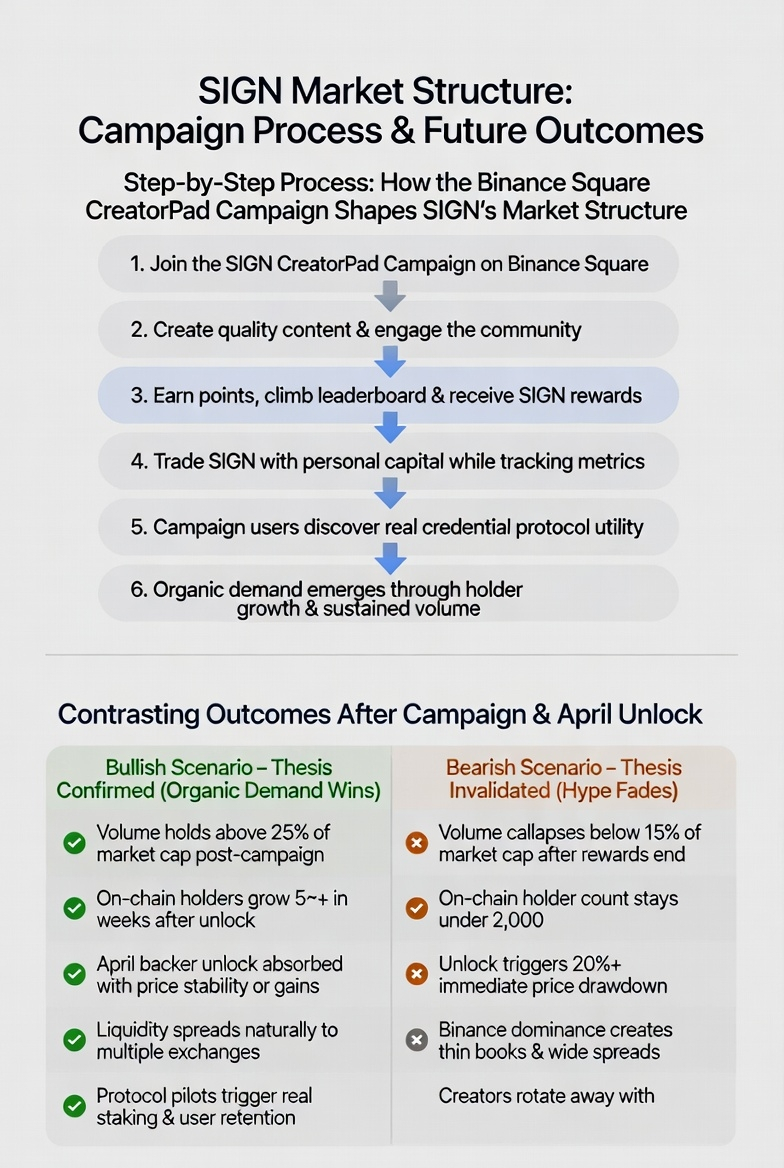
Sure, the counterargument, I keep hearing (and honestly still think about) is that once the reward pool closes and creators rotate to the next hot campaign, volume collapses and the unlock becomes a straight supply shock. Fair point ,I’ve seen it happen with other CreatorPad tokens.
What would make me even more convinced I’m right? Holder count climbing past a few thousand new wallets in the weeks after the unlock, volume holding above 25-30% of market cap, and price either flat or higher through May. That would show the campaign actually converted participants into users. What would prove me wrong? Volume cratering below 15% of market cap post-campaign and the unlock triggering a clean 20%+ drawdown with no recovery that would mean it was all incentive noise after all.
For me, the whole experience of grinding posts, watching the order book react, and checking the contract every few days has shifted how I look at SIGN. It’s not a clean “buy the dip” story or a narrative play. It’s a token whose current market structure is being shaped in real time by people who are both earning points and starting to see the actual credential infrastructure. That overlap feels like the non-obvious edge, and it’s why I’m comfortable staying in the position while everyone else debates the hype cycle..
@SignOfficial #SignDigitalSovereignInfra $SIGN
